

In this article
Top 10 Endpoint Security Tools In 2026
Do you want to know “What Is Endpoint Security?” If not, then you are at the right place. Here, we will talk about Endpoint Security, its uses, and benefits for the users who want to protect their data against unauthorized access.
In the end, we will introduce you to a reputed training institute offering a dedicated training program related to Endpoint Security skills. What are we waiting for? Let’s get started!
What is Endpoint Security?
Endpoint security is a cybersecurity strategy that guards against threats to end-user devices, such as servers, laptops, desktops, and mobile phones. In order to prevent these devices from serving as entry points for network assaults, software must be installed directly on them in order to monitor, identify, and stop harmful behavior.

Let’s take a look at “What Is Endpoint Security?” and how it can help users to secure their communications against malicious attempts!
Key Features to Look for in Endpoint Protection Software
|
S.No. |
Factors |
What? |
|
1. |
Next-Generation Antivirus (NGAV) |
Detects and blocks fileless and zero-day attacks in real-time using behavioral analysis and machine learning, not just signatures. |
|
2. |
Endpoint Detection and Response (EDR) |
Keeps an eye on endpoint behavior, logs information, and gives security teams the resources they need to look into, contain, and evaluate complicated threats. |
|
3. |
Firewall and Host Intrusion Prevention System (HIPS) |
Controls network traffic that enters and exits the endpoint and actively prevents unauthorized application behavior or suspicious system activity. |
|
4. |
Device and Application Control |
Enables administrators to avoid virus entrance or data leakage by limiting or blocking the use of unauthorized USB drives, external devices, or apps. |
|
5. |
Data Loss Prevention (DLP) |
Keeps an eye on and regulates the access, sharing, transfer, and printing of sensitive data (such as financial or personally identifiable information) from the endpoint. |
|
6. |
Centralized Management Console |
Enables security teams to implement policies, keep an eye on every endpoint, handle warnings, and carry out investigations throughout the whole environment using a single, unified interface. |
|
7. |
Automated Remediation and Rollback |
Enables the system to automatically eliminate malicious programs, isolate compromised devices, and return the endpoint to its pre-infection state. |
|
8. |
Vulnerability Assessment and Management |
Prioritizes and facilitates the required updates to minimize the attack surface by scanning endpoints for known software flaws and missing patches. |
List of Top 10 Endpoint Security Tools
The following are the top 10 Endpoint Security Tools for 2026:
1. CrowdStrike Falcon:
Superior breach prevention, EDR, and round-the-clock Managed Detection and Response (MDR) services are provided by this lightweight, AI-native single agent platform.
2. Microsoft Defender for Endpoint:
Offering complete XDR capabilities with robust AI-powered threat and vulnerability management, it is deeply integrated into the Windows OS and Microsoft 365 ecosystem.
3. SentinelOne Singularity Platform:
Autonomous security driven by AI that offers prevention, detection, reaction, and remediation without the need for constant human engagement or cloud connectivity.
4. Bitdefender GravityZone
Unified platform with excellent anti-ransomware protection and no impact on system performance that offers multi-layered security (EPP/EDR/XDR).
5. Sophos Intercept X:
Focuses on deep learning and anti-exploit technologies, offering an efficient Extended Detection and Response (XDR) solution that is simple to administer using Sophos Central.
6. Trellix Endpoint Security (Formerly McAfee):
An all-inclusive, flexible XDR platform with an open ecosystem for integrating third-party applications and customisable response orchestration.
7. Palo Alto Cortex XDR:
Extends EDR by consuming and evaluating data from all security sources (cloud, network, and endpoint) to provide automatic reaction and unified investigation.
8. ESET Endpoint Security:
Employs a low-impact, modular design and a multi-layered defense strategy, making it a dependable option for efficient, successful company protection.
9. Kaspersky Endpoint Security Cloud:
Ideal for companies looking for streamlined security, it provides strong protection, anti-ransomware, and management through a single, simple-to-deploy cloud console.
10. Trend Micro Apex One:
A feature-rich solution that provides complete security and visibility from a single agent by using machine learning and behavior monitoring.
Why Endpoint Security Matters in 2026?
|
S.No. |
Factors |
Why? |
|
1. |
Rise of AI-Powered Attacks |
Endpoint AI/ML defenses are necessary for real-time, behavioral detection because attackers employ AI to automate, scale, and quickly modify malware and phishing campaigns. |
|
2. |
The Zero Trust Mandate |
In a Zero Trust architecture, endpoints serve as the main validation point. Before allowing access to resources, they must undergo ongoing verification and health checks. |
|
3. |
Persistent Remote/ Hybrid Work |
The endpoint is the most vulnerable point of entry to the corporate cloud and data since employees' devices connect from unsecure home networks. |
|
4. |
Focus on Identity Theft |
Endpoint protection is the first line of defense against identity-based and lateral movement threats since attackers frequently target endpoints to obtain tokens and credentials. |
|
5. |
Evolution of Ransomware |
The endpoint is crucial for early detection and isolation because ransomware has developed into "data theft extortion," in which data is stolen before encryption. |
|
6. |
Supply Chain Vulnerability |
Every endpoint is a potential vector since compromising the software of a single vendor (often through an endpoint) might disseminate malicious malware to thousands of downstream clients. |
|
7. |
Proliferation of IoT/ SaaS |
The attack surface is greatly increased by the sheer volume of unmanaged and unconventional devices (IoT, cloud services) connecting to the network, necessitating endpoint visibility for each connection. |
|
8. |
Need for EDR/ XDR |
Because advanced threats require EDR (Endpoint Detection and Response) to monitor, probe, and automate replies and XDR for comprehensive correlation across all systems, traditional antivirus software is inadequate. |
Cloud vs. On-Premise Endpoint Security: Which Is Better in 2026?
Due to its improved scalability, automated updates for protection against AI-driven attacks, and centralized management for hybrid workforces, cloud-based endpoint security is typically better in 2026.
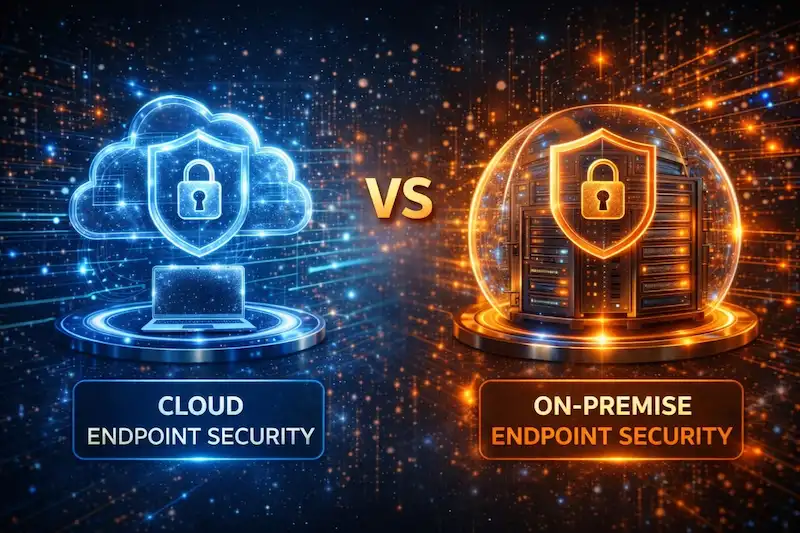
For highly regulated sectors that need the most control over data sovereignty and compliance, on-premise solutions are still relevant. A hybrid architecture, which takes advantage of cloud speed while keeping tight control over the most sensitive on-premise assets, is the ideal strategy for the majority of businesses.
Best Practices for Securing Devices Across Remote and Hybrid Workforces
|
S.No. |
Factors |
What? |
|
1. |
Implement a Strict Zero Trust Model |
Regardless of location, treat all users, devices, and connection attempts as untrusted and demand constant verification and least-privilege access. |
|
2. |
Mandate Strong Endpoint Protection (EPP/ EDR) |
To identify and quickly address threats outside the corporate network perimeter, deploy and centrally administer advanced EPP and EDR capabilities on all authorized personal and business devices. |
|
3. |
Enforce Multi-Factor Authentication (MFA) Universally |
To reduce the possibility of passwords being stolen from home or public networks, make MFA required for all cloud services, VPNs, and workplace apps. |
|
4. |
Automate Patch Management and Configuration |
Make sure devices follow a baseline security configuration before gaining network access by using centralized tools to automatically and often patch operating systems and applications. |
|
5. |
Establish a Secure Access Method |
Encrypt all traffic and enforce policies from the user to the cloud resource by requiring the usage of a corporate VPN or, ideally, a cutting-edge Secure Access Service Edge (SASE) solution. |
|
6. |
Implement Strong Data Loss Prevention (DLP) |
Use DLP policies to keep an eye on and prevent critical company data from being transferred from endpoints to unauthorized cloud storage, email, or personal devices. |
|
7. |
Provide Continuous Security Awareness Training |
Employees should receive regular training on social engineering, phishing, safe Wi-Fi use, and how to handle company data when they're not in the office. |
|
8. |
Define Clear Incident Response Procedures |
Create automated, tested, and well-documented processes for quickly identifying, analyzing, and fixing a hacked remote endpoint. |
How AI and Zero Trust Architecture Shape Future Endpoint Security?
In the following ways, AI and Zero Trust Architecture shape future Endpoint Security:
● Predictive Threat Detection: Before an exploit is performed, artificial intelligence (AI) examines enormous volumes of historical and current data to find anomalies and anticipate possible attack routes.
● Intelligent EDR/ XDR: AI speeds up investigations and coordinates a coordinated, quick reaction (XDR) by automating the correlation of security data across the endpoint, network, and cloud.
● Reducing Alert Fatigue: By removing noise and false positives, AI prioritizes high-fidelity, actionable alerts, freeing up security staff to concentrate on real, serious threats.
● Advanced Malware Combat: In order to identify new, fileless, and polymorphic malware that eludes conventional signature-based detection techniques, AI uses advanced behavioral analysis.
● Continuous Device Posture Validation: ZTA requires that the endpoint's security status, configuration, and patches be verified frequently during a session, not only at login.
● Dynamic, Context-Aware Access: Instead of relying solely on network location, access decisions take into account the user's complete context, the location of the device, the time of day, and the sensitivity of the data.
● Micro-Segmentation Enforcement: By imposing fine-grained regulations that limit endpoint access to the precise resources strictly necessary for its operation, ZTA restricts lateral movement.
● Identity-Device Linkage: Zero Trust ensures policy enforcement and responsibility for every endpoint behavior by firmly linking the user's identity to the particular device they are using.
Final Thoughts: Choosing the Right Endpoint Security Tool for Your Organization
|
S.No. |
Factors |
How? |
|
1. |
Assess Your Current Environment and Risk Profile |
Describe your present security vulnerabilities, the number and kind of endpoints (OS), the compliance requirements (e.g., GDPR, HIPAA), and the main threats (e.g., ransomware) that are pertinent to your industry and organization size. |
|
2. |
Evaluate Core Protection and Detection Capabilities (EPP/ EDR/ XDR) |
Give top priority to Next-Gen Antivirus (NGAV) systems that score highly in independent efficacy tests (such as MITRE ATT&CK, AV-Test), robust Endpoint Detection and Response (EDR) for visibility, and integrated Extended Detection and Response (XDR) for cross-domain context. |
|
3. |
Check Management, Usability, and Deployment |
Make sure that the solution supports flexible deployment (cloud-native is desirable) and easy scalability for future growth, that the centralized console is user-friendly, and that the agent is lightweight with little effect on user productivity. |
|
4. |
Confirm Integration and Compatibility |
Make sure that the solution works flawlessly with your current security ecosystem, which includes your cloud infrastructure, identity management, SIEM, SOAR, and open APIs. |
|
5. |
Review Vendor Reputation and Support Model |
Select a financially sound supplier with solid security research, a well-defined product roadmap, dependable round-the-clock technical assistance, and explicit Service Level Agreements (SLAs). |
Frequently Asked Questions
About Why It Matters in 2026?
- What is endpoint security, and why is it important in 2026?
Endpoint security is the practice of defending end-user devices (such as laptops, phones, and servers) against cyber threats. It is important in 2026 because the traditional network perimeter has been dismantled by the Zero Trust model and remote/hybrid work, making the easily compromised endpoint the main point of entry for AI-driven ransomware and data theft.
- How does endpoint security protect against ransomware and phishing attacks?
In the following ways, endpoint security protects against ransomware and phishing attacks:
a) Next-Generation Antivirus (NGAV)/ Behavioral Analysis,
b) Web & URL Filtering,
c) Endpoint Detection and Response (EDR)/ Rollback,
d) Application & Device Control, and
e) Host Firewall and Intrusion Prevention System (HIPS).
- What are the key features of a good endpoint security tool?
The following are the key features of a good endpoint security tool:
a) Next-Generation Antivirus (NGAV) with Behavioral Analysis,
b) Endpoint Detection and Response (EDR) Capabilities,
c) Automated Remediation & Rollback,
d) Centralized, Cloud-Native Management Console, and
e) Vulnerability Management and Control.
- Which is better: cloud-based or on-premise endpoint protection?
Because of its higher scalability, ongoing updates against contemporary threats, and centralized management needed by distant and hybrid workforces, cloud-based endpoint protection is generally better in 2026.
- Can endpoint security solutions protect mobile and IoT devices?
Yes, contemporary Endpoint Protection Platforms (EPP) and Mobile Threat Defense (MTD) solutions are made to protect mobile devices (tablets and smartphones) and increasingly provide management and visibility for managed IoT devices.
- How does AI improve endpoint security in modern tools?
In the following ways, AI improves endpoint security in modern tools:
a) Predictive & Behavioral Detection,
b) Autonomous Threat Response,
c) Advanced Malware & Fileless Attack Combat,
d) Security Analyst Augmentation (Reducing Alert Fatigue), and
e) Risk Scoring & Vulnerability Prioritization.
- What is the difference between EPP and EDR in endpoint protection?
While EDR (Endpoint Detection and Response) concentrates on visibility, investigation, and incident response (watching activity, identifying hidden dangers, and controlling breaches), EPP (Endpoint Protection Platform) is primarily concerned with prevention (stopping known threats and malware execution).
- How do Zero Trust principles apply to endpoint security?
The concept of "never trust, always verify," which states that each device and user must be continually vetted, allowed with least privilege access, and checked for security posture before accessing any resource, is how Zero Trust applies to endpoint security.
- Are free endpoint security tools reliable for businesses?
No, because they usually lack the complex capabilities (including EDR, centralized management, and expert assistance) required to fight against sophisticated modern corporate threats. Free endpoint security technologies are generally unreliable for enterprises.
- How to choose the best endpoint security solution for my organization?
By considering the following factors, you can choose the best endpoint security solution for your organization:
a) Assess Organizational Risk & Environment,
b) Prioritize EDR & XDR Capabilities,
c) Evaluate Performance & User Experience,
d) Verify Third-Party Validation & Compatibility, and
e) Examine Vendor Support & Future Roadmap.
Conclusion
Now that we have talked about “What Is Endpoint Security?”, you might want to learn such skills professionally. For that, you can get in contact with Craw Security, offering the End Point Security Course in Delhi to IT Aspirants.
During the training sessions, students will be able to try their skills on various tasks under the supervision of cybersecurity experts. Moreover, online sessions will facilitate students in remote learning.
After the completion of the End Point Security Course with AI in Delhi offered by Craw Security, students will receive a certificate validating their honed knowledge & skills during the sessions. What are you waiting for? Contact, Now!
Read More Articles
Top 10 Endpoint Security Tools: How to Secure Devices in 2026?
Top 10 Hacking Attacks and How to Prevent Them [2026]
Top 10 Hacking Groups In the World - Craw Security
Top 10 Malware Attacks in World History - Craw Security
Top 10 Cyber Lawyers in India [2026] | Craw Security
Top 10 Signs Your Computer Has Been Hacked [2026]
Top 10 Endpoint Security Tools: How to Secure Devices in 2026?
Want to build a career in cyber security?
Talk to our counsellors about courses, batches and fees. Free demo class available.


