

In this article
Let’s take a look at the Top 10 Web Application Security Tools and see how such tools can protect web apps against online threats! Several companies preach to professionals with web app security skills.
In the end, we will introduce you to a reputed training institute offering a dedicated training program related to web app security skills. What are you waiting for? Contact, Now!
What is Web Application Security?
Web application security is the process of finding, stopping, and fixing flaws in the code, configuration, and design of websites, web apps, and APIs to avoid attacks. Its main objective is to guarantee that sensitive data is safeguarded throughout the software development lifecycle (SDLC) and that the application operates securely.

Let’s take a look at the Top 10 Web Application Security Tools and see how they are beneficial for organizations!
What are Web Application Security Testing Tools?
Web Application Security Testing (WAST) tools are divided into three main categories: Interactive Application Security Testing (IAST), a hybrid approach; Dynamic Application Security Testing (DAST), which tests the running application from the outside (black-box testing); and Static Application Security Testing (SAST), which examines source code without executing the application (white-box testing).
OWASP ZAP, an open-source proxy and scanner, Burp Suite, a complete pen-testing platform, and commercial scanners like Invicti and Acunetix, which assist in automating the detection of vulnerabilities like SQL injection and XSS, are well-known examples.
Key Features for Web Application Security Testing Tools
The following are the key features for web application security testing tools:
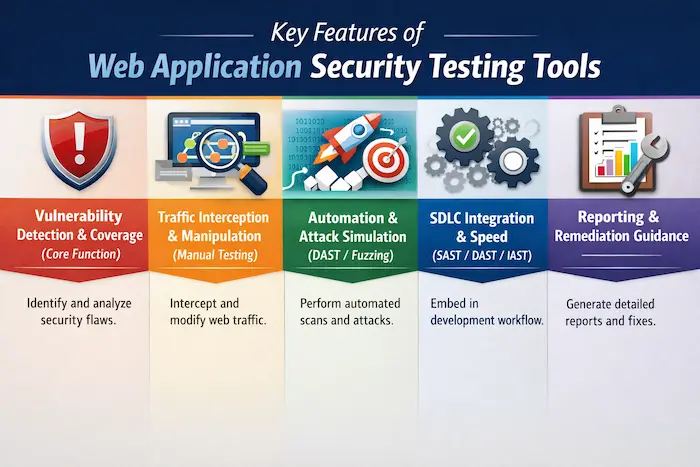
- Vulnerability Detection & Coverage (Core Function): Across contemporary frameworks and technologies, the tool must precisely identify a broad variety of known vulnerabilities (e.g., OWASP Top 10 like SQLi, XSS, and failed access control).
- Traffic Interception and Manipulation (Manual Testing): To enable an analyst's hands-on testing, the tool must act as a proxy to record, examine, and alter all HTTP/S traffic between the browser and the application.
- Automation and Attack Simulation (DAST/ Fuzzing): By crawling the application and simulating thousands of malicious inputs against all parameters using advanced, fast fuzzing techniques, the tool should automate the testing process.
- SDLC Integration and Speed (SAST/ DAST/ IAST): To enable "shift left" security, the tool must be able to smoothly integrate into the Continuous Integration/Continuous Deployment (CI/CD) pipeline and give developers quick, useful feedback.
- Reporting and Remediation Guidance: To assist developers in promptly and accurately resolving vulnerabilities, the tool must produce clear, prioritized notifications of vulnerabilities found and offer comprehensive, contextual remediation recommendations.
Benefits of Web Application Security Testing
|
S.No. |
Benefits |
How? |
|
1. |
Reduce Business Risk and Financial Loss |
The possibility of costly exploits, legal actions, and incident response expenses is reduced when vulnerabilities are proactively found and fixed. |
|
2. |
Ensure Regulatory Compliance |
In order to avoid severe non-compliance penalties, testing assists in meeting the stringent security criteria required by regulations such as GDPR, HIPAA, or PCI DSS. |
|
3. |
Prevent Data Breaches |
It protects assets and privacy by plugging security holes that hackers use to steal confidential client and company information. |
|
4. |
Protect Brand Reputation and Customer Trust |
Preventing public safety problems keeps customers confident and protects the company's reputation. |
|
5. |
Enable "Shift Left" Security |
Fixing defects before release is far less expensive and time-consuming when automated testing is incorporated early in the development process. |
|
6. |
Increase Code Quality and Resilience |
Security testing frequently identifies underlying logical or architectural weaknesses, resulting in code that is more resilient, dependable, and of higher quality overall. |
|
7. |
Optimize Developer Productivity |
Long debugging cycles and reactive firefighting time are decreased when developers receive early, targeted feedback and remedial instructions. |
|
8. |
Support Business Expansion and Innovation |
The firm may quickly implement new features and apps without compromising security or accruing technological debt thanks to security confidence. |
Top 10 Web Application Security Tools
The following are the top 10 web application security tools:
- Burp Suite: The best automated scanner (Burp Scanner) is part of the industry standard for manual penetration testing and traffic interception.
- OWASP ZAP (Zed Attack Proxy): The OWASP community actively maintains this robust, free, open-source, and extremely expandable web application security scanner through add-ons.
- Checkmarx: A top corporate tool that supports a wide range of programming languages early in the SDLC and is renowned for its quick and accurate source code analysis (SAST).
- Veracode: A comprehensive combination of SAST, DAST, SCA (Software Composition Analysis), and manual penetration testing services is provided by this enterprise cloud platform.
- Invicti (formerly Netsparker): Renowned for its Proof-Based ScanningTM, which reduces triage time by automatically verifying vulnerabilities found to remove false positives.
- Acunetix: Finding a variety of online and API vulnerabilities, including complex problems like out-of-band flaws, was the main goal of a specialized DAST scanner.
- SonarQube/ SonarCloud: Primarily a code quality platform with robust SAST features to identify security "code smells" during development and enforce secure coding standards.
- Snyk: Vulnerabilities in open-source dependencies and containers may be swiftly found, prioritized, and fixed using this developer-focused tool.
- Qualys WAS (Web Application Scanning): A cloud-based solution with strong interaction with the larger Qualys vulnerability management platform and continuous scanning that works well for big businesses.
- Rapid7 InsightAppSec: Integrates Rapid7's whole security intelligence platform with a dynamic scanner that focuses on API testing and risk prioritization.
Challenges of Web Application Security Testing
|
S.No. |
Challenges |
What? |
|
1. |
False Positives and Negatives (Tool Accuracy) |
Automated scanners frequently miss real defects (false negatives) or identify benign findings as vulnerabilities (false positives), necessitating a substantial amount of manual labor for validation. |
|
2. |
Business Logic Flaws and Chained Attacks (Human Expertise) |
Tools are unable to uncover multi-step, chained attacks or vulnerabilities unique to the application's business operations, necessitating the need for expert human testers (pen-testers). |
|
3. |
Complex Modern Architectures (Coverage) |
Modern applications that rely on complex APIs, microservices, Single-Page Applications (SPAs), and third-party dependencies make testing challenging and result in insufficient test coverage. |
|
4. |
Authentication and Session Management |
The capacity of automated scanners to thoroughly scan authenticated areas is typically limited by their inability to retain complicated session states, multi-factor authentication (MFA), and granular authorization levels. |
|
5. |
Integration and Speed in CI/ CD (DevOps Friction) |
Long security scans cause friction and slowdowns when integrated into quick CI/CD pipelines, which frequently leads to security being pushed to the end or ignored completely. |
Next Steps for Strengthening Web Application Security Testing
The following are the next steps for strengthening web application security testing:
a) Implement IAST (Interactive AST) and RASP (Runtime Application Self-Protection): Use RASP to actively stop attacks in real-time in the production environment, and IAST tools to increase accuracy by testing while the application is running.
b) Deepen DAST/ SAST Integration into the SDLC (Shift Left Fully): To guarantee that security feedback is prompt and useful before deployment, incorporate both static and dynamic scans directly into developer processes and CI/CD pipelines.
c) Prioritize Software Composition Analysis (SCA) for Open Source: To regularly monitor, inventory, and find vulnerabilities and licensing issues in all third-party and open-source dependencies, use specialized SCA tools.
d) Implement Formal API Security Testing: Create specialized testing protocols and instruments that are intended to verify data exposure, authorization, and authentication for all internal and external APIs.
e) Conduct Regular, Targeted Manual Penetration Testing: Periodic, high-value human-led testing that focuses on intricate business logic problems, chained attacks, and recently implemented crucial features should be added to automated scans.
Frequently Asked Questions
About the Top 10 Web Application Security Tools
- What are the best web application security tools in 2026?
The following are the best web application security tools in 2026:
a) Unified AST Platforms,
b) Developer-Centric SAST/ SCA,
c) Manual/ Hybrid Testing Gold Standard,
d) Runtime Protection & High-Accuracy, and
e) Next-Gen AI & Posture Management (ASPM).
- Which web application security tool is most effective?
Using a layered collection of tools, usually integrating SAST (for early code fault detection), DAST (for runtime exposure), and SCA (for open-source risk) within a Unified Application Security Testing (AST) Platform like Checkmarx or Veracode, is the most effective way to secure online applications.
- What is the best tool for web application security testing?
Although there isn't a single optimal tool, the most successful strategy makes use of a unified Application Security Testing (AST) platform (such as Checkmarx, Veracode, or Snyk) that integrates SAST, DAST, and SCA to deliver thorough, integrated security checks across the whole development process.
- Are web application security tools free or paid?
Web application security tools are available in both free (often open-source) and paid (commercial) versions. While paid enterprise tools (like Checkmarx and Veracode) offer deeper SDLC integration, advanced automation, and superior accuracy, free tools like OWASP ZAP and Burp Suite Community offer basic manual testing features.
- Which web application security tool is best for beginners?
Because it is free, open-source, and features an intuitive desktop graphical user interface (GUI) with a "Quick Start" automatic scan feature that requires little technical setup, the OWASP Zed Attack Proxy (ZAP) is often regarded as the greatest online application security solution for novices.
- What tools are used to secure web applications?
The following tools are used to secure web applications:
a) Static Application Security Testing (SAST) Tools,
b) Dynamic Application Security Testing (DAST) Tools,
c) Software Composition Analysis (SCA) Tools,
d) Web Application Firewalls (WAFs), and
e) Runtime Application Self-Protection (RASP)/ IAST Tools.
- What is the difference between SAST and DAST tools?
While DAST (Dynamic Application Security Testing) evaluates the running program by simulating external assaults to uncover runtime problems, SAST (Static Application Security Testing) examines source code without execution (like a code review) to find vulnerabilities early in the SDLC.
- Which web security tools are used by professionals?
The following web security tools are used by professionals:
a) Burp Suite Professional (Manual DAST/Pen-Testing),
b) SAST Platforms (e.g., Checkmarx, SonarQube, Veracode),
c) DAST Scanners (e.g., Invicti, Acunetix),
d) OWASP ZAP (Zed Attack Proxy), and
e) SCA Tools (e.g., Snyk, Mend).
- Can web application security tools prevent hacking?
A multi-layered combination of testing tools (SAST, DAST) and defensive tools (WAF, RASP) can greatly minimize the attack surface and avoid the great majority of known exploits; however, no single web application security solution can ensure 100% prevention of all hacking.
- What is the best web application vulnerability scanner?
Burp Suite Professional is widely recognized as the best web application vulnerability scanner for expert-driven, manual testing, whereas Invicti (Acunetix) is highly rated for automated DAST scanning because of its high accuracy and conclusions supported by evidence.
- Are web application security tools required for DevSecOps?
Since web application security tools are the fundamental technology that enables automated, continuous security testing and feedback required to integrate security practices early and quickly across the development lifecycle, they are unquestionably critical for DevSecOps.
- Which tools protect web applications from SQL injection and XSS?
The following tools protect web applications from SQL injection and XSS:
a) Web Application Firewalls (WAFs),
b) SAST (Static Application Security Testing) Tools,
c) DAST (Dynamic Application Security Testing) Tools,
d) Runtime Application Self-Protection (RASP), and
e) Input Validation/ Output Encoding Libraries.
Conclusion
Now that we have talked about the Top 10 Web Application Security Tools, you might want to learn web application security skills professionally. For that, you can get in contact with Craw Security, offering the Web Application Security Course with AI in Delhi to IT Aspirants.
During the training sessions, students will be able to try their skills on various tasks involving web app security skills under professional guidance. Moreover, online sessions will facilitate students in remote learning.
After the completion of the Web Application Security Course with AI in Delhi offered by Craw Security, students will receive a certificate validating their honed knowledge & skills during the sessions. What are you waiting for? Contact, Now!
Related Blogs
Top 10 Cybersecurity Training Tools [Update 2026]
Top 10 Worst Cyber Crimes Analysed | Craw Security
Latest OWASP Top 10 Vulnerabilities
Top 10 Critical Network Pentest Findings IT Teams Overlook
Top 10 Zero-Day Attacks | Cyber Attacks - Craw Security
10 Smallest Hacker Gadgets & Ethical Uses in Pen-Testing [2026]
Want to build a career in cyber security?
Talk to our counsellors about courses, batches and fees. Free demo class available.


