

In this article
Let’s talk about what the ‘OSI Model in Networking’ is and how it can be beneficial for the users! Several organizations offer huge working opportunities for networking professionals who can use such technologies in the IT Industry professionally.
In the end, we will introduce you to a reputed training institute offering a dedicated training program related to networking skills. What are we waiting for? Let’s get started!
What is the OSI Model in Networking?
A conceptual framework called the Open Systems Interconnection (OSI) model separates network communication into seven different layers, from high-level software applications to physical hardware.

Regardless of the underlying technology or manufacturer, it acts as a common language for networking, facilitating smooth communication across various computer systems and devices. Standardizing the communication process gives engineers a clear, methodical framework for diagnosing network problems at certain levels and aids in the creation of interoperable systems.
Let’s take a look at the OSI Model in Networking and see how it works for the benefit of organizations!
What Are the 7 Layers of the OSI Model?
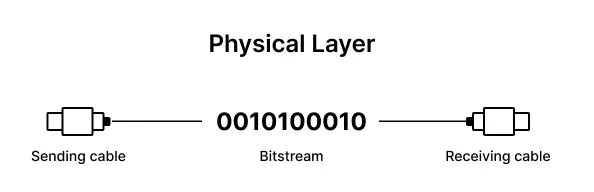
Layer 1 - Physical Layer
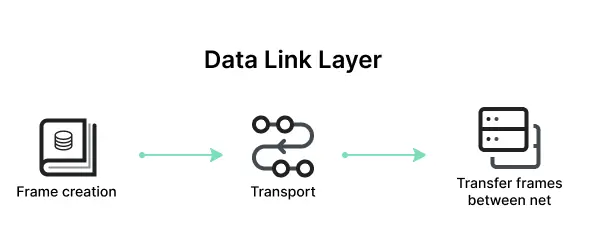
Layer 2 - Data Link Layer
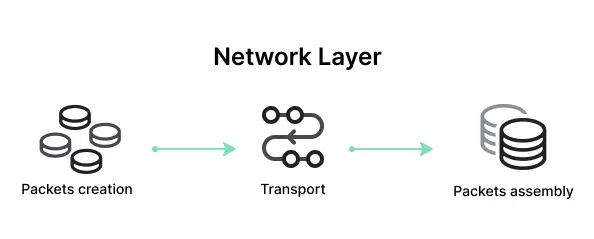
Layer 3 - Network Layer
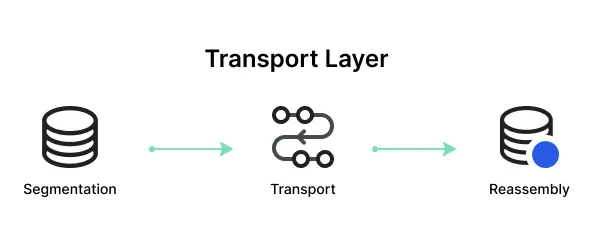
Layer 4 - Transport Layer
Layer 5 - Session Layer

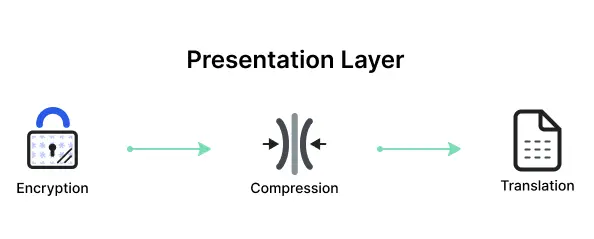
Layer 6 - Presentation Layer
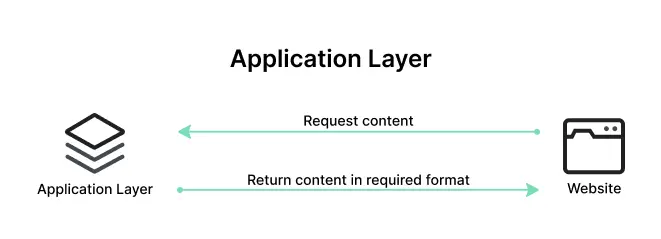
Layer 7 - Application Layer
How Does the OSI Model Work in Network Communication?
In the following ways, the OSI Model works in network communication:
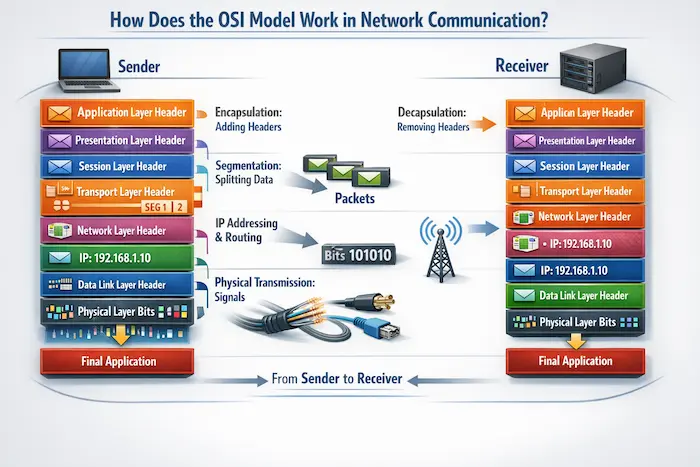
- Top-Down Encapsulation (Sender): Each layer wraps the data from the layer above with a distinct "header" that contains instructions for the destination as the data travels from the Application to the Physical layer.
- Data Segmentation: Large data streams are divided into smaller, more manageable pieces by the Transport Layer (Layer 4), which also adds sequence numbers to guarantee that the segments may be reassembled in the proper order.
- Addressing and Routing: Segments are given logical IP addresses by the Network Layer (Layer 3), which transforms them into packets that routers employ to find the fastest route between various networks.
- Physical Transmission: The fully encapsulated data, now known as bits, is transformed into electrical, optical, or radio signals at the Physical Layer (Layer 1) so they may be sent over cables or radio waves.
- Bottom-Up Decapsulation (Receiver): The procedure is reversed upon arrival, with the receiving device removing each layer's header one at a time and confirming the information before sending the original data to the final application.
Benefits of the OSI Model in Networking
|
S.No. |
Benefits |
How? |
|
1. |
Simplified Troubleshooting |
In order to avoid wasting time on unrelated systems, it enables you to isolate network failures to a particular layer (e.g., inspecting a physical cable vs. a routing problem). |
|
2. |
Universal Interoperability |
By adhering to the same defined criteria, it guarantees that hardware and software from various suppliers (such as an Apple iPhone and a Cisco router) may communicate with each other without any problems. |
|
3. |
Modular Engineering |
Without having to completely redesign the network stack, developers can upgrade a single layer, such as the Presentation Layer's encryption. |
|
4. |
Reduced Complexity |
Complex systems are easier to design and manage when the enormous burden of worldwide data transmission is divided into seven smaller, more manageable stages. |
|
5. |
Standardized Interfaces |
It offers a blueprint that enables designers to produce goods that "plug into" particular layers, guaranteeing interoperability with emerging technology. |
|
6. |
Enhanced Security (Defense-in-Depth) |
In order to create a multi-layered defense, it assists security teams in mapping certain threats to layers (e.g., IP spoofing at the network layer versus DDoS at the application layer). |
|
7. |
Accelerated Innovation |
Faster technological advancements in fields like 6G and AI-driven networking are made possible by the ability to separately build new protocols for a single layer. |
|
8. |
Effective Training and Education |
It acts as the fundamental mental model for pupils, offering a rational, sequential framework for understanding how the internet as a whole actually works. |
Industries that need Networking Skills
The following industries need networking skills:
● Technology & SaaS: The main hub for network engineers and architects creating the cloud infrastructure that enables software, artificial intelligence, and international web services.
● Fintech & Banking: High-demand industry where blockchain, real-time transactions, and combating financial fraud all depend on secure, low-latency networking.
● Healthcare & Health-Tech: Strong networks are needed for telemedicine, remote patient monitoring, and protecting sensitive electronic health information (EHR) in this quickly expanding profession.
● Telecommunications (5G/6G): Concentrated on the widespread deployment of fiber optics, satellite internet, and high-speed wireless infrastructure.
● Manufacturing (Industry 4.0): Vital for integrating industrial robots, smart factories, and the Industrial Internet of Things (IIoT).
● Government & Defense: Vital for managing public infrastructure, safeguarding state-level digital assets against cyberattacks, and maintaining national security.
● E-commerce & Logistics: Depends on smooth networking to run automated warehouses, high-traffic online stores, and international supply chains.
● Energy & Utilities: Essential for overseeing "Smart Grids," keeping an eye on solar and wind energy sites, and protecting vital utility infrastructure.
● Education (EdTech): Supports the digital campus infrastructure for colleges and universities as well as international remote learning platforms.
● Entertainment & Media: Provides the high bandwidth needed for virtual reality (VR) scenarios, cloud gaming, and 4K/8K streaming.
Job Profiles Related to Networking Skills
|
S.No. |
Job Profiles |
What? |
|
1. |
Network Engineer |
Designing, setting up, and maintaining the virtual and physical gear (firewalls, switches, and routers) that keep a company linked was the core responsibility of the traditional position. |
|
2. |
Network Architect |
A senior strategic position that creates high-level network designs with an emphasis on long-term scalability, dependability, and how the network advances corporate objectives. |
|
3. |
Cloud Network Engineer |
Focuses on "Software-Defined Networking" (SDN) to guarantee smooth connectivity between on-premise and cloud systems using cloud platforms like AWS, Azure, or GCP. |
|
4. |
Network Security Engineer |
A customized hybrid position that uses sophisticated firewalls, VPNs, and intrusion detection systems (IDS) to specifically defend the network from outside attacks. |
|
5. |
Network Administrator |
The daily maintenance of an existing network, including user permissions, troubleshooting, and performance monitoring, falls under this hands-on operational job. |
|
6. |
Wireless Network Specialist |
Fully committed to designing and optimizing 5G, 6G, and Wi-Fi infrastructures, especially in large-scale settings like stadiums, hospitals, or smart cities. |
|
7. |
VoIP/ Unified Communications Engineer |
Ensures a high "Quality of Service" (QoS) for digital communication by specializing in networking requirements for voice, video, and collaboration technologies. |
|
8. |
Systems Administrator |
In order to guarantee that servers and end-user devices can reliably interact throughout the corporate infrastructure, this function necessitates strong network knowledge, even though it goes beyond networking. |
|
9. |
IoT Infrastructure Architect |
An innovative position that oversees the security and networking needs of thousands of linked "Internet of Things" gadgets in smart homes or industries. |
|
10. |
Data Center Engineer |
Oversees the high-performance networking fabrics in large server farms with an emphasis on physical hardware reliability, cooling-related network efficiency, and fast data transfer. |
Conclusion
Now that we have talked about the OSI Model in Networking, you might want to learn about how to use such technologies professionally. For that, you can get in contact with Craw Security, offering the Basic Networking Course with AI in Delhi to IT Aspirants.

During the training sessions, students will be able to try their skills on various tasks & while learn about the OSI Model under the guidance of experts. Moreover, online sessions will facilitate students in remote learning.
After the completion of the Basic Networking Course with AI in Delhi offered by Craw Security, students will receive a certificate validating their honed knowledge & skills during the sessions. What are you waiting for? Contact, Now!
Frequently Asked Questions
About the OSI Model in Networking
- What is the OSI model in networking?
The Open Systems Interconnection (OSI) model is a seven-layer conceptual framework that breaks down communication between various computer systems and network devices into discrete, controllable phases.
- How many layers are there in the OSI model?
The following layers are in the OSI model:
a) Layer 7 - Application Layer,
b) Layer 6 - Presentation Layer,
c) Layer 5 - Session Layer,
d) Layer 4 - Transport Layer,
e) Layer 3 - Network Layer,
f) Layer 2 - Data Link Layer, and
g) Layer 1 - Physical Layer.
- What are the main functions of the OSI model?
The following are the main functions of the OSI model:
a) Standardized Interoperability,
b) Modular Troubleshooting,
c) Data Encapsulation & Decapsulation,
d) Flow & Error Control, and
e) Layer-Based Security (Defense-in-Depth).
- What is the role of the physical layer in the OSI model?
Digital data is transformed into electrical, optical, or radio signals by the Physical Layer (Layer 1), which is in charge of actually sending and receiving raw bitstreams across a physical medium.
- How does the data link layer function in the OSI model?
By arranging bits into frames, controlling physical addressing via MAC addresses, and offering error detection, the Data Link Layer (Layer 2) is in charge of dependable node-to-node data transport within a single network segment.
- What does the network layer handle in the OSI model?
The Network Layer (Layer 3) is principally in charge of routing data between various networks by figuring out the optimal route for packets to take in order to get to their destination, utilizing logical IP addresses.
- How does the transport layer ensure reliable data transfer?
By combining sequencing to maintain data order, acknowledgments (ACKs) to verify receipt, and retransmissions to automatically resend any lost or corrupted data during transit, the Transport Layer (Layer 4) assures dependable data transfer.
- What is the importance of the session layer in the OSI model?
As the "dialogue controller," the Session Layer (Layer 5) is essential because it establishes, maintains, synchronizes, and gracefully ends communication sessions between programs on various devices.
- What are the responsibilities of the presentation layer in networking?
As the network's translator, the Presentation Layer (Layer 6) is in charge of translating, encrypting, and compressing data from application-specific forms into a common network format.
- How does the application layer interact with end-user applications?
By offering established protocols and network services that programs like web browsers or email clients rely on to start network connections, the Application Layer (Layer 7) communicates with end-user applications.
Want to build a career in cyber security?
Talk to our counsellors about courses, batches and fees. Free demo class available.


