

Python Programming Language can be the best opportunity for coding practitioners who want to start their coding career with ease. That’s because Python programming is one of the easiest coding languages that can be learned faster than other languages.
Several organizations hire Python programmers to operate on various projects that need coding. Thus, we will help you to learn Python programming as a beginner. Let’s find out!
What is Python Programming?
Python is a high-level, interpreted programming language that is praised for its incredible adaptability in powering everything from sophisticated artificial intelligence to web applications, as well as its straightforward, English-like syntax.
It is the main option for contemporary software engineering in 2026 because of its extensive library ecosystem and emphasis on code readability, which enable developers to effectively handle complicated problems.
Let’s take a look at the Python Programming Language and see how beneficial it can be for coding practitioners in the IT Industry!
Popular Python Use Cases
The following are the popular Python use cases:
- Artificial Intelligence & Generative AI: The foundational language for developing Autonomous Agents and optimizing Large Language Models (LLMs) with frameworks like PyTorch and LangChain is Python.
- Data Science & Advanced Analytics: By using high-speed libraries like Polars and Dask to process enormous datasets that conventional tools can no longer handle, it dominates the data lifecycle.
- High-Performance Web Development: Python powers powerful backends that support millions of concurrent users and lightning-fast, asynchronous APIs through the usage of FastAPI and Django.
- Automation, DevOps & Scripting: It serves as the foundation for MLOps and AIOps, precisely automating intricate CI/CD pipelines and infrastructure-as-code activities.
- Fintech & Algorithmic Trading: The industry standard for creating quantitative models and high-frequency trading bots that instantly assess market volatility is Python.
Benefits of Python for Developers
|
S.No. |
Benefits |
How? |
|
1. |
Exceptional Readability & Productivity |
Developers can express sophisticated reasoning in fewer lines of code thanks to its English-like syntax, which drastically cuts down on development time and maintenance expenses. |
|
2. |
True Multi-core Parallelism (GIL Removal) |
The Global Interpreter Lock has been removed, allowing developers to perform complex computational processes natively across all CPU cores. |
|
3. |
Dominant AI & Generative AI Ecosystem |
The most cutting-edge libraries in the world, such as PyTorch, LangChain, and Hugging Face, which are crucial for contemporary AI, are instantly accessible. |
|
4. |
Built-in JIT Compiler Speed |
The most recent versions guarantee that standard code runs quicker than ever without the need for manual optimization, thanks to the integration of a Just-In-Time (JIT) compiler. |
|
5. |
Superior Error Handling & Debugging |
Debugging is made simple by the extremely accurate, "fine-grained" error messages provided by modern Python versions, which show the particular column of a failure. |
|
6. |
Seamless "Glue Language" Integration |
It provides the best of both worlds by seamlessly fusing high-level logic with low-level, high-performance code (like Rust or C++). |
|
7. |
Mobile and Edge Computing Support |
Python can now operate effectively on iOS, Android, and Internet of Things devices thanks to improved frameworks, greatly extending its use beyond the desktop. |
|
8. |
The Massive "Help Economy" |
Every possible problem or architectural challenge has an open-source library or proven solution thanks to a global community of millions. |
Python Syntax: How to Write Python Code
You can write Python code in the following ways:
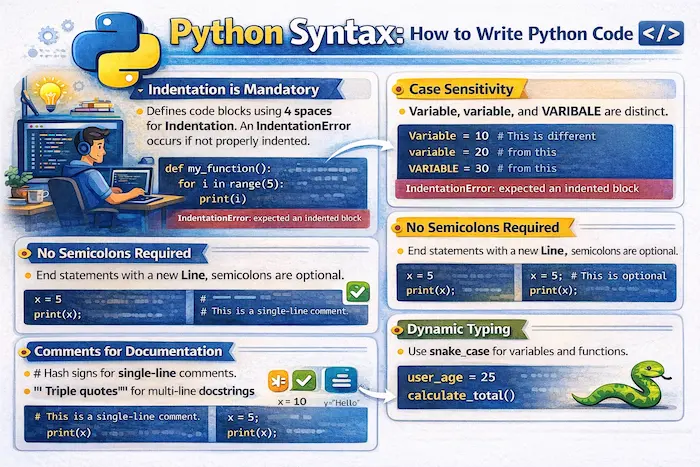
● Indentation is Mandatory: Python, in contrast to other languages, defines code blocks (such as loops or functions) using whitespace. An IndentationError will be raised if the indentation is not 4 spaces, which is the standard.
● Case Sensitivity: Python is case-sensitive. In other words, Variable, variable, and VARIABLE are all regarded as distinct entities.
● No Semicolons Required: A semicolon is not required at the end of a line of code. The conclusion of a statement is indicated by a straightforward new line.
● Comments for Documentation: For single-line comments, use the hash sign (#). Triple quotes (" "") are used to build docstrings for multi-line comments or documentation.
● Dynamic Typing: A variable's data type (such as int or string) does not need to be declared. Python uses the provided value to automatically determine the type; for example, x = 10 is automatically an integer.
● Colons for Header Statements: A colon (:) must always come at the end of statements that start a new block of code, such as if, for, while, def (functions), or class.
● Variable Naming (Snake Case): Python variables and function names, such as user_age or calculate_total(), are typically written in snake_case (all lowercase with underscores).
Python Examples in Real-World Applications
|
S.No. |
Examples |
What? |
|
1. |
Streaming & Entertainment (Personalization) |
Python powers Netflix's enormous recommendation engine, which analyzes watching patterns to tailor thumbnails and make content recommendations for more than 220 million viewers. |
|
2. |
Autonomous Transportation (Real-time Vision) |
For real-time lane detection, object tracking, and instant obstacle avoidance, self-driving systems use Python and modules such as OpenCV. |
|
3. |
Generative AI & Scientific Breakthroughs |
AlphaFold uses Python as its main interface to predict protein structures, while LLMs like GPT-4 use Python to produce code and reasoning that is similar to that of humans. |
How to Learn Python: A Step-by-Step Guide?
You can learn Python in the following steps:
a) Master the "AI-Native" Basics (2–4 Weeks): Practice right away in Jupyter Notebooks, the industry-standard setting for AI experimentation, and concentrate on fundamental grammar, conditional logic, and functions.
b) Deep Dive into Data Structures & Libraries (4 Weeks): Go from simple lists to high-performance data management with Pandas (or Polars) for handling the enormous datasets needed for machine learning and NumPy for numerical arrays.
c) Object-Oriented & Modular Design (3 Weeks): To create reusable machine learning pipelines and comprehend the internal workings of frameworks like PyTorch, learn how to organize your code using Classes and Objects.
d) Specialized Frameworks & AI Integration (4–6 Weeks): Learn how to use Scikit-learn for classical machine learning and advance into generative AI by becoming proficient with FastAPI for providing your models and LangChain for chaining LLM operations.
e) Build a Verifiable GitHub Portfolio (Ongoing): Upload at least three distinct "end-to-end" projects, such as a custom RAG-based chatbot with a professional README and Docker settings, to document your path.
Python vs Other Programming Languages
Python is the most adaptable "all-rounder" due to its accessible, English-like syntax, which enables developers to create code three to five times faster than in Java or C++, greatly accelerating AI research and prototyping.

In 2026, Python fills this gap by serving as a "glue" to high-performance libraries and leveraging its increased multi-core parallel processing capabilities, whilst compiled languages like C++ offer higher raw execution speed for gaming or autonomous vehicles.
Future of Python in Technology
The future of Python in 2026 will be determined by its development into a high-performance language that removes earlier bottlenecks, particularly by integrating Just-In-Time (JIT) compilation and removing the Global Interpreter Lock (GIL) for genuine multi-core parallel processing.
This change confirms its status as the main operating system for the "AI Age," supporting everything from quantum computing and sustainable "Green AI" infrastructures to autonomous agentic processes.
Career Opportunities with Python
|
S.No. |
Job Profiles |
What? |
|
1. |
AI Engineer |
Creating and implementing intelligent agents and autonomous systems. |
|
2. |
Machine Learning Engineer |
Constructing and expanding recommendation engines and prediction models. |
|
3. |
Data Scientist |
Utilizing statistics to turn large datasets into strategic business insights. |
|
4. |
Generative AI Specialist |
Creating prompt frameworks, RAG pipelines, and LLM-based applications. |
|
5. |
Backend Developer |
Utilizing Django or FastAPI to create server-side logic and fast APIs. |
|
6. |
Full-Stack Developer |
Overseeing backend Python systems as well as front-end user interfaces. |
|
7. |
DevOps Engineer |
Automating software deployments, CI/CD pipelines, and cloud infrastructure. |
|
8. |
Data Engineer |
Designing the pipelines used to gather and purify data for AI training. |
|
9. |
Cybersecurity Analyst |
Creating scripts for automated testing, network defense, and threat detection. |
|
10. |
Fintech Quant |
Constructing high-frequency risk assessment models and algorithmic trading bots. |
Conclusion
Now that we have talked about the Python Programming Language, you might want to learn such coding skills professionally. For that, you can get in contact with Craw Security, offering Python Programming Course in Delhi to IT Aspirants.
During the training sessions, students will be able to get real-life experience via various tasks under the supervision of Python programming professionals. Moreover, online sessions will facilitate students in remote learning.
After the completion of the Python Training in Delhi offered by Craw Security, students will receive a certificate validating their honed knowledge & skills during the sessions. What are you waiting for? Contact, Now!
Frequently Asked Questions
About the Python Programming Language
- What is the Python programming language, and how does it work?
Python is a high-level, readability-focused interpreted programming language that operates by translating source code into intermediate bytecode, which the Python Virtual Machine (PVM) subsequently executes.
- What are the key benefits of learning Python?
The following are the key benefits of learning Python:
a) Exceptional Readability & Productivity,
b) True Multi-core Parallelism (GIL Removal),
c) Dominant AI & Generative AI Ecosystem,
d) Built-in JIT Compiler Speed, and
e) Superior Error Handling & Debugging.
- How does Python compare to other programming languages?
Compared to compiled languages like C++ or Java, Python is easier to learn and faster to create with because of its straightforward, English-like syntax and wide library support. However, because it is interpreted, it usually operates more slowly.
- What are the most popular use cases for Python?
The following are the most popular use cases for the Python programming language:
a) Artificial Intelligence & Generative AI,
b) Data Science & Advanced Analytics,
c) High-Performance Web Development,
d) Automation, DevOps & Scripting, and
e) Fintech & Algorithmic Trading.
- How do I start learning Python as a beginner?
You can start learning Python as a beginner by joining the Python Training in Delhi offered by Craw Security.
- What are the career opportunities available for Python developers?
The following career opportunities are available for Python developers:
a) AI Engineer,
b) Machine Learning Engineer,
c) Data Scientist,
d) Generative AI Specialist, and
e) Backend Developer.
- Can Python be used for web development?
Yes, Python is frequently used for web development because of robust frameworks like Django and Flask, which manage database administration, server-side logic, and URL routing to effectively create scalable and secure websites.
- What is the future of Python in technology?
With 2025–2030 trends centered on notable performance gains through JIT compilation, the elimination of the Global Interpreter Lock (GIL) for genuine multi-core processing, and its extension into edge computing and quantum programming, Python will continue to dominate the future as the "language of AI."
- What are some real-world examples of Python applications?
The following are some real-world examples of Python applications:
a) Streaming & Entertainment (Personalization),
b) Autonomous Transportation (Real-time Vision), and
c) Generative AI & Scientific Breakthroughs.
- How long does it take to become proficient in Python?
Depending on your existing experience and daily time commitment, mastering the basics of Python usually takes two to six months, while reaching a job-ready or specialized level might take up to a year.
Want to build a career in cyber security?
Talk to our counsellors about courses, batches and fees. Free demo class available.


