

In this article
- What Is IoT Forensic Investigation?
- Step-by-Step IoT Forensic Investigation Workflow (End-to-End)
- Why IoT Forensic Investigation Matters?
- How IoT Forensics Differs From Traditional Digital Forensics?
- Key Challenges in IoT Forensic Investigation (Volatile Data, Scale, Proprietary Systems)
- Common IoT Incident Scenarios (Smart Home, Healthcare, Industry, Vehicles)
- IoT Evidence Sources You Must Check (Device, Gateway, Cloud, Mobile App, Network)
- Conclusion
- Frequently Asked Questions
Do you know “What Is IoT Forensic Investigation?” and how it can be useful in fighting against future cyberattack attempts? Several organizations are recently moving towards IoT forensic investigation, so that they can catch the culprit of a data breach.
Thus, acquiring such skills can be beneficial for future gains. In the end, we will introduce you to a reputed training institute offering a dedicated training program related to cyber forensics skills. What are we waiting for? Let’s find out!
What Is IoT Forensic Investigation?
The identification, preservation, analysis, and presentation of evidence taken from Internet of Things (IoT) ecosystems, including smart devices, sensors, and associated network settings, is the focus of IoT forensic investigation, a specific area of digital forensics.
In order to recreate events and establish facts for legal or security investigations, it relies on finding digital fingerprints throughout these interconnected systems. Let’s take a look at “What Is IoT Forensic Investigation?”
Step-by-Step IoT Forensic Investigation Workflow (End-to-End)
|
S.No. |
Steps |
What? |
|
1. |
Preparation & Identification |
Determine any linked IoT devices, related software, and possible cloud-based data sources that are pertinent to the incident. |
|
2. |
Securing the Scene |
To stop remote data cleaning or synchronization, isolate the physical region and cut off the local network from the internet. |
|
3. |
Data Acquisition |
Use specialist tools to retrieve digital evidence from cloud service provider archives, network traffic logs, and internal device memory. |
|
4. |
Preservation |
To guarantee the integrity and admissibility of the gathered data in a legal context, create bit-for-bit pictures and cryptographic hashes. |
|
5. |
Analysis |
To recreate user activity, device faults, or patterns of illicit access, look at the associated data timeframes. |
|
6. |
Reporting & Documentation |
Create a thorough final report that includes the approach, results, and conclusions for use by corporate or legal stakeholders. |
Why IoT Forensic Investigation Matters?
IoT Forensic Investigation matters for the following reasons:
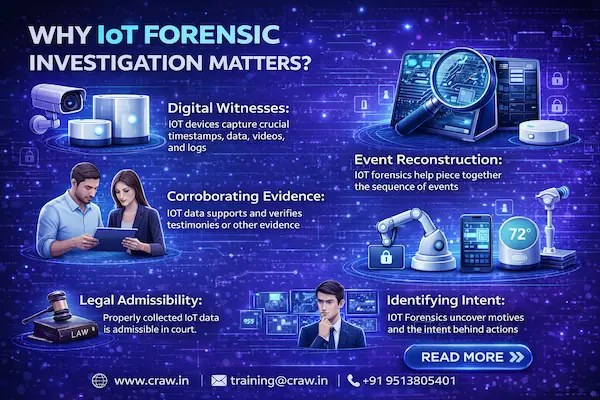
- Digital Witnesses: IoT devices serve as round-the-clock observers, recording environmental data that conventional computers could overlook, such as location, movement, sound, or temperature.
- Event Reconstruction: It enables investigators to create specific timelines, such as determining the precise moment a wearable device's pulse rate spiked or a smart lock was unlocked.
- Corroborating Evidence: By locating a suspect at a site or verifying their actions over a particular period of time, data from smart devices can support or refute alibis.
- Cyber-Physical Link: It connects the dots between cyberattacks and real-world repercussions, which is essential when looking into carjackings or industrial sabotage.
- Legal Admissibility: Data from dispersed sources (cloud, app, and device) is collected in a "forensically sound" manner for use in court, thanks to structured forensic techniques.
- Identifying Intent: Investigators can ascertain if an incident was an accident or a planned crime by examining user orders transmitted through voice assistants or mobile apps.
How IoT Forensics Differs From Traditional Digital Forensics?
|
S.No. |
Topics |
Factors |
What? |
|
1. |
IoT Forensics |
Heterogeneity |
Targets a wide range of special devices with proprietary firmware and unidentified operating systems, such as heart monitors, smart toasters, and factory sensors. |
|
Traditional Digital Forensics |
Device Focus |
Focuses on standardized devices with popular operating systems (Windows, macOS, Android), such as laptops, desktop computers, servers, and smartphones. |
|
|
2. |
IoT Forensics |
Distributed Evidence |
Evidence is typically dispersed among the actual device, a mobile app, and a cloud server rather than being in one location. |
|
Traditional Digital Forensics |
Data Location |
The majority of important evidence is kept locally on internal flash memory, SSDs, or hard drives that the investigator can physically take. |
|
|
3. |
IoT Forensics |
Data Volatility |
Evidence can disappear in a matter of minutes since IoT devices have extremely little internal memory and sometimes wipe old records to conserve space. |
|
Traditional Digital Forensics |
Data Formats |
Standard file formats (PDF, DOCX, JPEG) and common file systems (NTFS, APFS, EXT4) are typically used to store information. |
|
|
4. |
IoT Forensics |
Network Diversity |
Instead of focusing only on Wi-Fi or Ethernet, investigations must take into consideration non-standard communication protocols, including Bluetooth Low Energy (BLE), Z-Wave, and Zigbee. |
|
Traditional Digital Forensics |
Methodology |
Adheres to well-established, sophisticated workflows that use forensic techniques and bit-for-bit images that have been verified in court for decades. |
|
|
5. |
IoT Forensics |
Dependency on Third Parties |
For access to data logs kept on their servers, investigators frequently have to rely on cloud service providers (such as Amazon, Google, or specialist vendors). |
|
Traditional Digital Forensics |
Investigator Control |
Once the device is seized, the investigator usually has complete physical and logical control over the evidence. |
Key Challenges in IoT Forensic Investigation (Volatile Data, Scale, Proprietary Systems)
The following are key challenges in IoT Forensic Investigation:
● Extreme Data Volatility: Evidence may be permanently destroyed if IoT devices aren't secured right away, since they constantly overwrite old logs with new sensor data and have little internal RAM and flash memory.
● Massive Scale and Volume: Numerous devices may be present in a single "smart" scenario (such as a factory or smart home), producing a "data deluge" that makes it challenging for investigators to pinpoint the precise item that has the "smoking gun."
● Proprietary Systems: Manufacturers frequently require investigators to create "bespoke" tools or carry out dangerous hardware "chip-off" extractions in order to access data because they employ custom-built firmware, non-standard file systems, and distinctive hardware interfaces.
● Encryption Hurdles: Strong, "always-on" hardware encryption (such as AES) and safe boot procedures are used by many contemporary IoT devices to stop unwanted access to the data contained on the chip.
● Distributed Evidence (Data Fragmenting): A multi-layered search is necessary because evidence is rarely found in a single location; instead, it is usually distributed among the physical device (sensors), a mobile app (user commands), and the cloud (long-term logs).
● Lack of Standardization: There isn't a single "forensic standard" for the Internet of Things. Cross-device correlation is a manual nightmare because each brand employs distinct data formats and communication methods (Zigbee, Z-Wave, MQTT, CoAP).
● Cloud Dependency & Legal Jurisdiction: A large portion of the data is stored on servers that are owned by outside businesses like Google or Amazon. These servers might be spread across several nations, which could result in complicated legal disputes regarding cross-border warrants and data protection.
● Chain of Custody Complexity: When the "evidence" is continuously interacting with the internet, it becomes more difficult to maintain its integrity. A manufacturer's "ping" or remote update could change the device's state and jeopardize its use in court.
Common IoT Incident Scenarios (Smart Home, Healthcare, Industry, Vehicles)
|
S.No. |
Scenarios |
What? |
|
1. |
Smart Home |
Hackers can snoop on residents by using weak passwords on smart cameras or doorbells, or they can launch enormous botnet attacks using smart appliances. |
|
2. |
Healthcare (IoMT) |
Cybercriminals "medjack" vital devices, such as pacemakers or insulin pumps, to alter dosages or steal confidential patient health information. |
|
3. |
Industry (IIoT) |
Attackers breach industrial control systems in order to destroy physical equipment, ruin production lines, or use ransomware to hold operations hostage. |
|
4. |
Vehicles (IoV) |
In order to remotely open doors, track GPS locations, or even take control of the steering and braking systems while the vehicle is moving, malicious actors intercept wireless communications. |
IoT Evidence Sources You Must Check (Device, Gateway, Cloud, Mobile App, Network)
You must check the following IoT evidence sources:
a) Physical IoT Device: This is the "source" from which raw data is produced; look for sensor logs, boot logs, device status history, and distinct hardware IDs (MAC/IMEI) in internal flash memory.
b) IoT Gateway/ Controller: As a traffic director, the "hub" (such as a Zigbee controller or Google Nest Hub) frequently keeps lists of all connected "child" devices, device registration logs, and cached data.
c) Mobile Companion App: The user's smartphone is a "forensic goldmine"; search for remote command logs, user preference settings, synced activity databases (SQLite files), and authentication tokens.
d) Cloud Service Provider: The majority of IoT data is saved remotely; to access long-term telemetry, voice recordings, and cross-device interaction history, ask suppliers (Amazon, Google, Samsung) for account archives.
e) Network Infrastructure: Examine router logs and ISP records to find evidence "in transit" that includes connection timestamps, data volume surges, and an attacker's target IP addresses.
f) Wearable/ Biometric Data: Look for heart rate variations, sleep patterns, and GPS coordinates that can pinpoint a person's whereabouts using gadgets like smartwatches, which offer distinctive "human" evidence.
g) External Sensors: Smart light switches, motion sensors, and smart plugs are examples of peripheral devices that can verify a physical presence by displaying the time a light was turned on or a room was entered.
h) Web Interfaces: Examine the web portal history provided by the manufacturer; they frequently include administrative logs and login attempts that may not be accessible on the device or mobile app.
Conclusion
Now that we have talked about “What Is IoT Forensic Investigation?”, you might want to learn such skills professionally from reliable sources. For that, you can get in contact with Craw Security, offering the Digital Cyber Forensics Investigation Course in Delhi to IT Aspirants.
During the training sessions, students will be able to try their skills on various tasks using forensic techniques under the supervision of forensic experts. Moreover, online sessions will facilitate students in remote learning.
After the completion of the Digital Cyber Forensics Investigation Course in Delhi offered by Craw Security, students will receive a certificate validating their honed knowledge & skills during the sessions. What are you waiting for? Contact, Now!
Frequently Asked Questions
About What Is IoT Forensic Investigation?
- What is IoT forensic investigation?
IoT forensic investigation is a subfield of digital forensics that focuses on identifying, gathering, and analyzing evidence from networks, cloud services, and linked smart devices in order to reconstruct events for security or legal reasons.
- Why is IoT forensics important in cybersecurity incidents?
IT forensics is important in cybersecurity incidents for the following reasons:
a) Attack Attribution,
b) Reconstructing Digital Timelines,
c) Identifying Lateral Movement,
d) Corroborating Physical Actions, and
e) Vulnerability Mitigation.
- How is IoT forensics different from traditional digital forensics?
Instead of concentrating on localized data within conventional computers or smartphones, IoT forensics requires the collection and collation of evidence from a distributed ecosystem of heterogeneous devices, networks, and cloud services.
- What types of incidents typically require an IoT forensic investigation?
The following types of incidents typically require an IoT forensics investigation:
a) Cyber-Physical Crimes (Burglary & Stalking),
b) Medical Device Malpractice or Sabotage,
c) Industrial Espionage & Sabotage (IIoT),
d) Vehicle Accident Reconstruction (IoV), and
e) Botnet & DDoS Attack Attribution.
- What are the biggest challenges in collecting evidence from IoT devices?
The following are the biggest challenges in collecting evidence from IoT devices:
a) Extreme Data Volatility,
b) Massive Device Heterogeneity,
c) Data Fragmentation (The "3-Zone" Problem),
d) Legal & Jurisdictional Hurdles, and
e) Encryption & Proprietary Protocols.
- What are the main sources of IoT evidence (device, network, cloud, mobile apps)?
The following are the main sources of IoT evidence:
a) The Physical IoT Device (Zone 1),
b) Mobile Companion Apps,
c) Network Infrastructure (Zone 2),
d) Cloud Service Providers (Zone 3), and
e) IoT Gateways & Hubs.
- How do investigators preserve IoT evidence without altering it?
By employing write blockers to prevent data change during extraction and generating cryptographic hashes (such as SHA-256) to confirm that the forensic image remains a bit-for-bit identical match to the original source, investigators are able to preserve IoT evidence.
- What is the chain of custody, and why is it critical in IoT forensics?
In order to guarantee the integrity and legal acceptability of evidence by demonstrating that it has not been tampered with or altered, the chain of custody is a chronological, written record that keeps track of every individual who handled it from the time it was gathered until it is presented in court.
- How do you extract logs and artifacts from a smart device safely?
Investigators employ write blockers and Faraday bags to prevent data alteration or remote wiping while using non-invasive logical extraction through standard interfaces or hardware-level acquisition (such as JTAG, ISP, or Chip-off) in a controlled lab setting to safely extract logs and artifacts.
- Can IoT evidence be recovered after a device reset or reboot?
Because many devices employ flash memory, which marks data for deletion without instantly wiping it, and because important logs are often mirrored in associated mobile applications or cloud accounts, which are unaffected by a local device reset, it is possible to recover IoT evidence.
- How do you investigate IoT devices that store data in the cloud?
A "follow-the-data" strategy is needed to investigate cloud-connected IoT devices. This involves using legal warrants or authorized credentials to perform Cloud API extraction and Account Takeout (such as Google Takeout or Amazon GDPR requests) to download synchronized telemetry, voice recordings, and historical activity logs that the physical device may no longer hold.
- What role do routers, gateways, and hubs play in IoT investigations?
Routers, gateways, and hubs operate as crucial "digital witnesses" in an IoT forensic inquiry by logging device connection logs, traffic patterns, and IP/MAC address assignments that tie the external cloud to physical device activity.
Want to build a career in cyber security?
Talk to our counsellors about courses, batches and fees. Free demo class available.


