

In this article
Do you want to know “What Is Firewall-as-a-Service (FWaaS)?” and how you can use it as a helping hand for you? If yes, then you are at the right place. Here, we will talk about FWaaS in detail for a better understanding.
In the end, we will introduce you to a reputed training institute offering a dedicated training program related to web app security skills. What are we waiting for? Let’s get straight to the topic!
What Is Firewall-as-a-Service (FWaaS)?
Firewall-as-a-Service (FWaaS) is a cloud-based network security solution that does away with the requirement for on-premises hardware by providing next-generation firewall features as a subscription service.
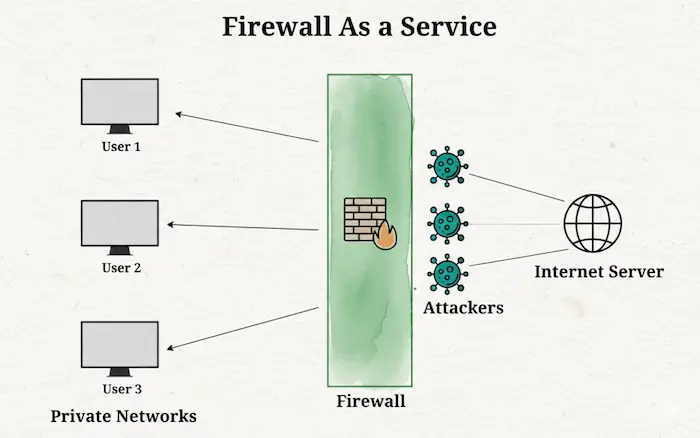
It offers sophisticated capabilities like intrusion prevention and cloud-based URL filtering while inspecting and filtering data at the network edge. For an organization's scattered workforce and cloud settings, this architecture provides increased scalability, easier management, and uniform policy enforcement.
Let’s take a look at “What Is Firewall-as-a-Service (FWaaS)?” and how it benefits organizations!
How Firewall-as-a-Service Works?
|
S.No. |
Factors |
How? |
|
1. |
Traffic Redirection |
The cloud architecture of the FWaaS provider receives all incoming and outgoing network traffic from the corporate data center, branch offices, and remote users. |
|
2. |
Centralized Inspection & Policy Enforcement |
Deep packet inspection, URL filtering, intrusion prevention (IPS), and other sophisticated security checks are carried out via the cloud-hosted firewall, which is a worldwide, dispersed security mesh. It employs a single, centrally controlled security policy that is uniformly applied to all users and locations. |
|
3. |
Delivery and Management |
The firm no longer needs to deploy and maintain physical security appliances because the FWaaS provider is in charge of administering, patching, scaling, and maintaining the complete firewall architecture. |
Key Advantages of Using FWaaS
The following are the key advantages of using FWaaS:
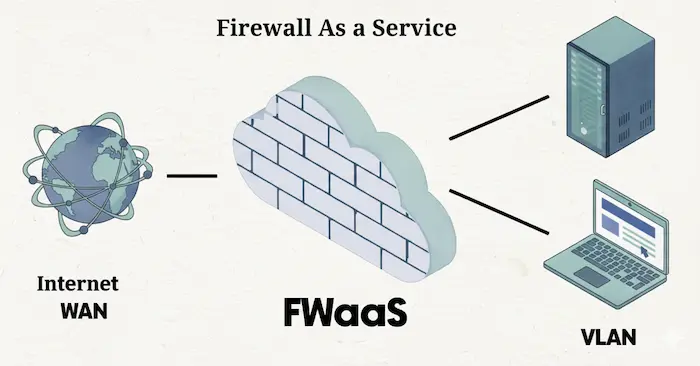
- Simplified Management and Operations: Physical security appliances no longer need to be deployed, maintained, and patched in various places.
- Enhanced Scalability and Flexibility: To adapt to the changing demands of a dispersed workforce and expanding organization, FWaaS can quickly scale protection up or down.
- Increased Security Posture: It offers all users and devices, wherever they may be, consistent, always-up-to-date next-generation firewall capabilities.
- Cost Efficiency (OPEX vs. CAPEX): Through a subscription model, it transfers security spending from significant upfront capital expenditures (CAPEX) to predictable operating expenses (OPEX).
- High Availability and Reliability: In order to reduce downtime and maintain service continuity, the cloud provider guarantees built-in redundancy and failover capabilities.
How FWaaS Enhances Cloud Security?
|
S.No. |
Factors |
How? |
|
1. |
Consistent, Unified Policy Enforcement |
From a single administration panel, FWaaS guarantees that the same security policies are enforced for all users, branches, and cloud workloads. |
|
2. |
Elastic Scalability and Capacity |
Without the need for manual hardware provisioning, it easily manages high traffic volumes and unexpected demand surges. |
|
3. |
Advanced Next-Generation Capabilities |
It incorporates essential security features that are usually lacking in entry-level cloud provider firewalls, such as advanced malware protection and intrusion prevention systems (IPS). |
|
4. |
Protection for Encrypted Traffic (SSL/ TLS Inspection) |
To find hidden risks before they enter the network, FWaaS can decrypt, examine, and re-encrypt SSL/TLS communication in the cloud. |
|
5. |
Support for Zero Trust Architecture |
In order to implement the "never trust, always verify" philosophy, which is crucial for contemporary security models, it offers granular, identity-aware access control. |
|
6. |
Optimized Performance (Local Breakout) |
By lowering latency and eliminating the need to backhaul traffic to a central data center, FWaaS enables secure direct-to-internet access for reliable cloud applications. |
Cost Benefits of Implementing FWaaS
The following are the cost benefits of implementing FWaaS:
● Reduces Capital Expenditure (CAPEX): By transferring the cost to an operational approach, it removes the requirement for significant upfront investments in the purchase and installation of physical firewall appliances.
● Shifts to Operational Expenditure (OPEX): Security is no longer a costly capital project but rather a utility expense thanks to the subscription-based approach, which enables predictable monthly or annual planning.
● Lowers Maintenance and Management Costs: By taking care of all hardware upkeep, patching, updates, and upgrades, the FWaaS supplier drastically lowers the labor expenses for internal IT and security teams.
● Eliminates Hardware Refresh Cycles: The costly and disruptive process of replacing outdated or old gear every few years is no longer something that businesses must budget for.
● Cost-Effective Scalability: In order to avoid the expense of over-provisioning hardware to suit future, uncertain needs, security can be instantly scaled up or down, dependent on consumption (such as users or bandwidth).
● Reduces Multi-Site Security Costs: One single cloud service takes the role of having to buy and maintain a different firewall device for each branch office or remote site.
FWaaS vs Traditional Firewalls: A Comparison
|
S.No. |
Factors |
Topics |
What? |
|
1. |
Deployment |
FWaaS |
Cloud-Based: Provided as a service from the provider's worldwide network; no hardware installation is necessary on-site. |
|
Traditional Firewalls |
On-Premises Appliance: Need a specialized hardware box to be purchased and physically installed in a data center or office. |
||
|
2. |
Scalability |
FWaaS |
Elastic and Instant: Without requiring any hardware modifications, it can quickly scale up or down to meet unexpected traffic demands or user growth. |
|
Traditional Firewalls |
Limited: The hardware's capacity limits scalability, which frequently necessitates costly and time-consuming appliance updates or replacements. |
||
|
3. |
Management & Updates |
FWaaS |
Vendor Managed: All software upgrades, patching, maintenance, and infrastructure management are automatically handled by the provider around the clock. |
|
Traditional Firewalls |
Manual and In-House: Increases operational costs by requiring an internal IT team to manually patch, update, and maintain the appliance at each location. |
||
|
4. |
Policy Consistency |
FWaaS |
Unified and Centralized: Regardless of location, it uses a single cloud console to enforce the same security policy for all users, devices, and cloud workloads. |
|
Traditional Firewalls |
Localized and Fragmented: Consistent enforcement across several sites is difficult and prone to error because policies must be administered independently for each individual appliance. |
||
|
5. |
Cost Model |
FWaaS |
Operational Expenditure (OPEX): Businesses can only pay for the security they use thanks to a fixed membership price. |
|
Traditional Firewalls |
Capital Expenditure (CAPEX): High initial expenditures for hardware, installation, and licensing are followed by continuing maintenance and replacement costs. |
Common Use Cases for Firewall-as-a-Service
The following are the common use cases of firewall-as-a-service:
a) Securing the Remote and Hybrid Workforce: Enables employees to connect from any location or device outside of the conventional boundary with corporate-grade, unified security policy enforcement.
b) Centralizing Branch Office Security: Replaces the requirement for each remote office to manage separate hardware firewalls with a single security service provided by the cloud.
c) Enforcing Consistent Multi-Cloud Security: Extends uniform network security regulations, guidelines, and adherence to several public cloud environments (AWS, Azure, GCP).
d) Integrating with SASE Architecture: Combines networking and cloud-delivered security features to form a fundamental part of the Secure Access Service Edge (SASE) concept.
e) Accelerating Mergers and Acquisitions (M&A): Applies the security policies of the acquiring firm to the network and users of the acquired entity in a timely manner without requiring the installation of new hardware.
f) Supporting Direct-to-Internet Access (Local Breakout): By avoiding the central data center and lowering latency, it safely enables branch office users to access reliable cloud apps directly over the internet.
Choosing the Right FWaaS Provider for Your Business
|
S.No. |
Factors |
How? |
|
1. |
Security Efficacy and Next-Gen Capabilities |
Make sure that the supplier has strong, regularly updated Next-Generation Firewall (NGFW) features, such as SSL/TLS decryption, IPS/IDS, and deep packet inspection. |
|
2. |
Global Performance and Latency (PoPs) |
To guarantee low latency and quick security assessment, look for a supplier with a large network of Points of Presence (PoPs) near your users and offices. |
|
3. |
Integration with SASE and Zero Trust |
To provide a complete SASE and Zero Trust architecture, the provider should natively integrate FWaaS with additional security components like ZTNA, SWG, and CASB. |
|
4. |
Management Ease and Policy Orchestration |
For unified policy formulation, maintenance, and deployment across all users and cloud environments, the solution must provide a single, user-friendly cloud console. |
|
5. |
Service Reliability and Support (SLA) |
For assured uptime, minimal latency, and round-the-clock technical support for timely issue response, review the vendor's Service Level Agreement (SLA). |
Emerging Trends in Firewall-as-a-Service
The following are the emerging trends in firewall-as-a-service:
- Deep SASE Convergence (Platformization): With its smooth integration with ZTNA and SWG, FWaaS is quickly evolving into a cohesive part of a broader Secure Access Service Edge (SASE) architecture.
- AI/ML-Powered Policy Automation: In order to substantially reduce setup errors and administrative effort, providers are leveraging AI and machine learning to autonomously develop, audit, and improve complicated firewall rules.
- Microsegmentation and Distributed Firewalls: By imposing fine-grained microsegmentation regulations, FWaaS capabilities are expanding inward to protect internal traffic (East-West) between application workloads and devices.
- Increased Hybrid Cloud Momentum: Specifically, solutions that provide centralized visibility and uniform policy enforcement between multi-cloud infrastructure and on-premises data centers are being optimized for complicated hybrid settings.
- IoT and OT Security Integration: To secure the increasing number of unmanaged IoT (Internet of Things) and OT (Operational Technology) devices, next-generation FWaaS is integrating specialized profiling and threat detection.
- Autonomous Security Operations: The objective is to transition to a self-healing security architecture in which FWaaS can automatically identify, isolate, and address risks in real-time with little assistance from humans.
The Future of Firewall-as-a-Service: What’s Next?
The deep convergence of Firewall-as-a-Service (FWaaS) into the Secure Access Service Edge (SASE) architecture, which transforms it from a stand-alone cloud service into the unified security backbone, is what will determine its future.

In this stage, FWaaS will use AI and machine learning for autonomous policy orchestration, allowing for real-time threat neutralization and instantaneous, error-free rule development without the need for human interaction.
In order to implement genuine Zero Trust principles worldwide, FWaaS will ultimately provide advanced, identity-aware security and microsegmentation across all network edges, endpoints, and cloud workloads.
Conclusion
Now that we have talked about ‘What Is Firewall-as-a-Service (FWaaS)?’, you might want to learn about FWaaS professionally. For that, you can get in contact with Craw Security, offering the Web Application Security Course with AI in Delhi to IT Aspirants.
During the training sessions, students will be able to try their skills on various tasks using the FWaaS under the supervision of professionals. Moreover, online sessions will facilitate students in remote learning.
After the completion of the Web Application Security Course with AI in Delhi offered by Craw Security, students will receive a certificate validating their honed knowledge & skills during the sessions. What are you waiting for? Contact, Now!
Frequently Asked Questions
About What Is Firewall-as-a-Service (FWaaS)?
- What is Firewall-as-a-Service (FWaaS)?
Firewall-as-a-Service (FWaaS) is a cloud-based network security solution that does away with the requirement for on-premises hardware by providing next-generation firewall features as a subscription service.
- How does Firewall-as-a-Service work?
In the following ways, Firewall-as-a-Service works:
a) Traffic Redirection,
b) Centralized Inspection & Policy Enforcement, and
c) Delivery & Management.
- What are the key benefits of using FWaaS?
The following are the key benefits of using FWaaS:
a) Simplified Management,
b) Elastic Scalability,
c) Consistent Policy Enforcement,
d) Cost Efficiency, and
e) Enhanced Security Posture.
- How does FWaaS differ from traditional firewalls?
Traditional firewalls are physical hardware appliances that are installed and maintained on-site, whereas FWaaS is a cloud-delivered, scalable, and centrally managed subscription service.
- What are the most common use cases for FWaaS?
The following are the most common use cases for FWaaS:
a) Securing the Remote & Hybrid Workforce,
b) Centralizing Branch Office Security,
c) Enforcing Consistent Multi-Cloud Security,
d) Integrating with SASE Architecture, and
e) Supporting Direct-to-Internet Access (Local Breakout).
- What trends are shaping the future of Firewall-as-a-Service?
The following trends are shaping the future of Firewall-as-a-Service:
a) SASE & Platform Convergence,
b) AI/ ML-Powered Automation,
c) Zero Trust Architecture Enforcement,
d) Distributed & Microsegmentation Capabilities, and
e) Hybrid Cloud & Edge Expansion.
- How does FWaaS improve cloud security?
In the following ways, FWaaS improves cloud security:
a) Consistent, Unified Policy Enforcement,
b) Elastic Scalability & Capacity,
c) Advanced Next-Generation Capabilities,
d) Protection for Encrypted Traffic (SSL/ TLS Inspection), and
e) Support for Zero Trust Architecture.
- Is FWaaS cost-effective for businesses of all sizes?
Because it avoids expensive upfront capital expenditures and provides scalable, predictable operating costs, FWaaS is especially cost-effective for enterprises of all sizes, making enterprise-grade security readily manageable by bigger organizations and accessible to smaller ones.
- How do I choose the best FWaaS provider for my organization?
By considering the following factors, you can choose the best FWaaS provider for your organization:
a) Security Efficacy & Integrated Next-Gen Features,
b) Global Network Footprint & Low Latency (PoPs),
c) SASE & Zero Trust Integration,
d) Management Simplicity & Policy Orchestration, and
e) Service Reliability, Performance Guarantees, & Support.
- What is the future outlook for Firewall-as-a-Service technology?
Firewall-as-a-Service (FWaaS) has a bright future thanks to its deep integration with the SASE framework and its use of AI/ML for enhanced threat identification and autonomous policy enforcement.
Want to build a career in cyber security?
Talk to our counsellors about courses, batches and fees. Free demo class available.