

In this article
What is Cyberbullying? | How its done | Online Harassment
In India, we are now continuously facing the largest number of Cyberbullying Cases in India, where these Cyberbullying Cases with Women and Children have surged at a huge pace in number. Although almost 90% of Cyberbullying Cases are not reported in India, the number is still so high.
What is Cyberbullying in simple words?
Cyberbullying is commonly defined as when someone uses the internet's characteristics for negative objectives, such as harassing, threatening, embarrassing, or targeting someone else.

Although teenagers are typically the target of cyberbullying, it has been observed that adults can also become victims of some forms of cyberbullying and public humiliation in front of others or a small group of friends, which causes a great deal of social and psychological strain.
What is cyberbullying and why is it a problem?
Widespread viral communications have also been observed in which users remove offensive posts or stories from the internet, but screenshots or other shared contexts remain in the inboxes of different users. In the worst situation, some targeted cyberbullying users are even unaware of the identity of the individual using the negative effects of the internet to harass them, making it even more difficult to stop the cyberbullying.
Types of Cyberbullying
Since they have more time than anyone else, children and teenagers in general are now the ones who socialize the most. They use their social media accounts to interact with friends, family, and relatives on a daily basis. This specific situation provides them with an ideal opportunity to ensnare others in cyberbullying or become victims of cyberbullying by others.
Although there are many ways for someone to harass other online users, we have listed the following five categories of cyberbullying:
● Harassment,
● Impersonation,
● Inappropriate Photograph,
● Website Creation, and
● Video Shaming.
Furthermore, you can watch the following video showcasing the views of Mohit Yadav, a renowned cybersecurity expert and a former member of the hacking group Anonymous, and currently a highly famous media panelist for more than 12 reputed media houses, on the various factors associated with Cyberbullying and its impact on our society, especially on women and children.
Additionally, we have outlined all five forms of cyberbullying tactics in the following paragraphs for those who are committed to looking up “What is cyberbullying means?”
Harassment
One common way of cyberbullying is to use certain tactics to harass someone, oppressing them in order to achieve one's own goals. One of the most well-known ways to make fun of someone online is to report their profile or videos as if they contain inappropriate content, even when there is nothing wrong with them.
Unusual "texting" is another way that the same harassment is carried out. Children frequently engage in one-on-one or group written altercations with a target child in order to torment them. This can cause extreme social and psychological strain because of the sudden isolation in front of other children. Since not everyone has an infinite number of internet or SMS packages in their membership, it can occasionally also cost the parents.
Impersonation
This well-known technique of cyberbullying involves one person pretending to be the other and engaging in conversation as the real one, which can ultimately result in financial and time losses. Not only do children engage in these kinds of embarrassing behaviors with one another, but adults do the same in order to ridicule and degrade the other person in front of others or a special someone.
Despite eliminating billions of fake profiles made annually on a very large index, a Facebook survey indicates that approximately 5% of social media profiles are fraudulent.
There are numerous ways to carry out this impersonation. For example, children can hack an account or steal a password by sneaking into the target's credentials from any blind spot and altering the target's profile in a way that will ultimately humiliate and amuse the target in front of everyone on the internet. Additionally, if the credentials of social media accounts are not discovered, children will create phony profiles with identical names and photos and post offensive and hurtful messages under the profile bearer's name. In certain cases, this will undoubtedly result in the actual children taking their own lives.
Furthermore, catfishing is a well-known technique that involves tricking someone into falling for a fictitious profile of the other gender in order to make another person fall in love. The victim is then made fun of and teased because of the communication that took place between the two people in a supposed relationship.
Inappropriate Photographs
People who look up "What is cyberbullying on social media?" should be aware that this is the worst way that many people kill themselves every year. Photographs taken without the subject's consent in any private setting, like a dressing room, locker room, or restroom, can be used to harass or humiliate someone in front of others.
Due to the mischievous behavior of certain bad guys or even girls, the majority of instances involve women whose indecent or nude photos have been circulating on social media platforms and in everyone's WhatsApp inboxes. Everyone has access to these dehumanizing images on the internet, making it difficult to prevent these kinds of situations and remove the original images from people's phones.
Nevertheless, some lads even use these kinds of images as weapons, sending them to all of the target's acquaintances via bulk emails or texts. Another instance involves two people in a purported relationship exposing their private parts to one another via online live streaming, which is captured by someone on one side and then shared on porn websites or social media platforms that are practically hard to change. This specific action, which falls under the category of "Sexting," is also punishable by fines and jail time in numerous countries.
Because of the short skirts they wear, the way they dance, or the way they speak on social media, you've all seen a lot of offensive remarks about girls' bodies in photos that have gone viral. These comments are known as slut shaming. This falls under the area of cyberbullying as well.
Website Creation
It is a less popular strategy because it is expensive to torment the target by building a website, blog, or poll. For instance, they might build a website on a paid or free portal to produce an online survey regarding a target or a group of targets. Many cruel or insensitive questions about the target's appearance, color, race, ethnicity, weight, or other characteristics that could cause abrupt turmoil in their life are asked in these polls.
Video Shaming
These days, a lot of people watch videos on social media. Additionally, there are a few specialist apps on the market that are only focused on extensively distributing video content. In a similar vein, cyberbullying occurs in this culture to humiliate and victimize the victims for their own amusement or advantage. For instance, it has been reported that someone is cyberbullying others by using a video that is fully live on YouTube or has gone popular on WhatsApp or any other communication app, in which the target is humiliated in any way.
Additionally, the perpetrator of cyberbullying may distribute these humiliating recordings via mass SMS or email. Additionally, the mischievous elements capture an occurrence in which someone is humiliated in any way in front of a crowd and then use social media to broadcast it online for the same reason—cyberbullying.
We have attempted to address the frequently asked topic, “What is cyberbullying examples?” with the aforementioned instances. Let's now investigate its effects in more detail.
Impact of Cyberbullying
The victim of cyberbullying experiences a range of physical, psychological, and emotional repercussions. Additionally, individuals may complain about anything from anxiety and dread to sadness and low self-esteem brought on by instances of cyberbullying. Some of them experience trauma, stress, and hypertension as a result of the oppression they endure while being protected by cyberbullying.

Additionally, some victims of cyberbullying feel unsafe going outside by themselves since they feel cut off from society as a result of being humiliated by some antisocial forces. They reportedly experience a great deal of melancholy, despair, and helplessness.
How to Respond to Cyberbullying?
The victim of cyberbullying experiences a range of physical, psychological, and emotional repercussions. Additionally, individuals may complain about anything from anxiety and dread to sadness and low self-esteem brought on by instances of cyberbullying. Some of them experience trauma, stress, and hypertension as a result of the oppression they endure while being protected by cyberbullying.
Additionally, some victims of cyberbullying feel unsafe going outside by themselves since they feel cut off from society as a result of being humiliated by some antisocial forces. They reportedly experience a great deal of melancholy, despair, and helplessness.
Reporting the Incident Accurately
The main error made by a target is failing to report the cyberbullying incident to someone they can trust and responding as strongly as possible to the cyberbullying post in order to defend themselves or provide an explanation in order to prevent being humiliated. In most situations, the individual or group is anticipating the victim's precise reaction in order to tease them as much as possible.
Instead of responding, a person who has experienced this kind of cyberbullying incident can report it to the school, college, university, employers, police, cyber cell, or any other higher authority that they can contact in order to take proper action against such occurrences.
Perhaps you were wondering, “What is cyberbullying law?” Nearly every country in the world has strong laws prohibiting cyberbullying. Any instance of cyberbullying may be reported to the police or cyber cell.
Document the Incidents
Most of the time, once the perpetrator suspects that the target is initiating severe legal action against him, he deletes the profile. Therefore, in those situations, the perpetrators would remove the post or any other media from the location where they were posted in order to harass the victim online. To take significant action against the offenders, one must capture screenshots of the material after downloading it and present them as evidence to the relevant authorities. Nonetheless, it is highly recommended that you keep a copy of the evidence on hand so you may present it to the investigating officials if needed.
Involve the Police and the School
Before reporting a cyberbullying incident to the police, one should always notify the victim's higher management, whether they work at a school, college, university, or an office. But you also have a main duty to keep the police and higher authorities informed about the case's progress at all times.
Additionally, you should notify the authorities right away if there are any horrible crimes, such as threats of murder or physical violence, serious indications of stalking, or even suggestions that your child should end their own life. If online harassment is not stopped in a timely manner, it may eventually result in physical molestation. But there are other forms of harassment as well, such as harassment because of one's color, religion, or disability.
Be Aware of the Effects
Additionally, one should be aware of the potential repercussions of cyberbullying, which include a variety of sensations like feeling extremely vulnerable and alone, hypertension, stress, sadness, and even suicidal thoughts. Therefore, in addition to calling the police and higher authorities, don't be afraid to knock on the doors of some counselors, doctors, or psychiatrists for some counseling sessions to help your ward in need. Furthermore, the victim should be provided enough time to recover from those degrading experiences.
Don’t Halt Their Social Connection
It is essentially incorrect to permanently delete someone's social media accounts on the grounds that they have committed a crime or violated social norms. Rather, offer them a vacation and make an effort to allow them to return and reclaim their lost respect on social media by sharing positive content and spending time with them. That will undoubtedly aid them in healing from the internal injuries brought on by some instances of cyberbullying.
What is Cyberbullying Law in India?
In order to humiliate someone in front of a specialist or a group of people, we have heard of several instances when someone has created a false profile of another individual and sent offensive or demeaning texts to other people. The incident of cyberbullying in India was first brought to the attention of the Hon'ble Supreme Court of India in the historic case of Vishaka v. State of Rajasthan. In this case, the Supreme Court established guidelines for online bullying to protect Indian women from sexual harassment and other forms of cyberbullying.
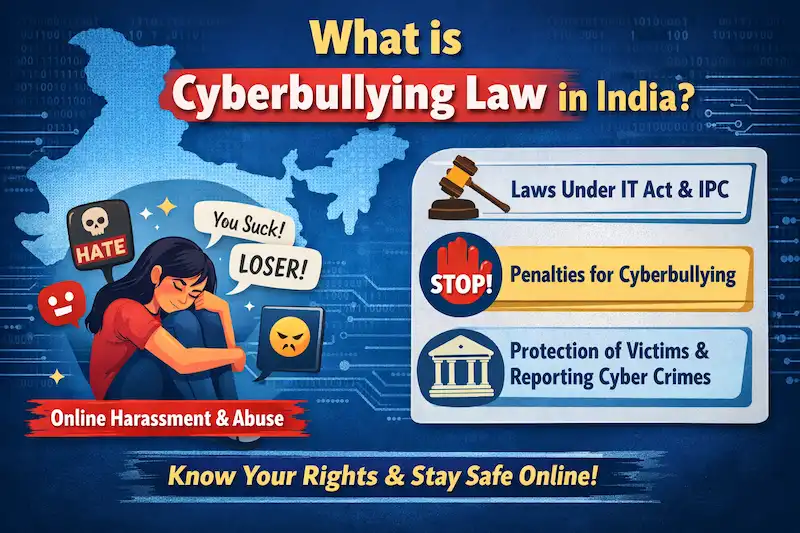
To get a decent understanding of cyber law in India, it is highly required for us to put some valuable laws with strict actions and punishments to put cyberbullying criminals behind bars within the shortest possible time.
Furthermore, there is no specified legislation that offers some specific cyberbullying laws in India; however, some provisions like Section 67 of the Information Technology Act are coherent with cyberbullying in a particular way. In addition, Section 67 of the act describes the punishment for posting or sharing obscene media in e-form for a period that may be extended to 5 years of rigorous imprisonment with a fine that may extend to ₹10,00,000/-.
Apart from Section 67 of the Indian Penal Code, which resembles the IT Act, the following are some of the provisions of the cyberbullying laws in India that are being implemented by the Government of India:
● Section 507 IPC: In this law, if any person receives a criminal threat by any known or anonymous message, then the person who is responsible for giving such intimidation shall be punished with imprisonment for up to 2 years if proven guilty.
● Section 66 E of the IT Act: This section of law from the Constitution of IPC describes the punishment for infringement of privacy. Moreover, it prescribes that any person who willingly breaches the privacy of a person(s) by sharing, capturing, or posting private photos shall be punished with up to 3 years of imprisonment with a fine of up to ₹3,00,000/-.
Conclusion
In the end, we would like to touch on the horrible instances of cyberbullying, which are like a scourge to our society in this technologically advanced world, where some antisocial elements are using technology to tease others as they see fit. Additionally, we have made an effort to shed some light on all the steps that may be taken to prevent cyberbullying, as well as strategies that you can employ in order to comply with legal requirements. As part of a public awareness campaign against cyberbullying, Craw Security, the top-notch cybersecurity organization in all of India, is publishing this blog to educate the public.
Want to build a career in cyber security?
Talk to our counsellors about courses, batches and fees. Free demo class available.

