

Do you know about “What Is Buffer Overflow?” If not, then you are at the right place. Here, we will talk about Buffer Overflow uses and impacts, and how you can defend yourself against such attacks professionally.
Moreover, we will introduce you to a reputed training institute offering a dedicated training program related to cybersecurity skills. What are we waiting for? Let’s get straight to the topic!
What Is Buffer Overflow?
When a software writes more data to a fixed-length block of memory than it can accommodate, the surplus data spills over into nearby storage space, a phenomenon known as a buffer overflow.
Data corruption or application crashes may result from an inadvertent "overflow" overwriting important system instructions. In terms of security, attackers take advantage of this vulnerability to introduce malicious code, effectively taking over the program's execution flow and gaining unapproved authority. Let’s take a look at “What Is Buffer Overflow?”
What Is A Buffer Overflow Attack?
By carefully crafting this extra data, hackers can replace legitimate system commands with malicious instructions, like opening a "backdoor" for remote access. A buffer overflow attack is a purposeful exploit in which an attacker intentionally inserts more data than a memory buffer can handle in order to overwrite nearby memory locations.
This vulnerability turns a simple memory error into a high-level security breach that permits unauthorized code execution or a complete system takeover.
Which Programming Languages Are More Vulnerable?
|
S.No. |
Languages |
Why? |
|
1. |
C and C++ |
All of these are the main offenders because they lack "bounds checking." A C program will attempt to fit 100 characters into a 10-character box without alerting you. |
|
2. |
Assembly Language |
There are no safety nets because this is the lowest programming level. Each byte of memory must be individually managed by the programmer. |
|
3. |
Objective-C |
Similar to C, it permits manual memory management and direct pointer manipulation, which makes it vulnerable if the developer isn't very cautious with buffer sizes. |
|
4. |
Fortran |
Legacy scientific or engineering programs could be targets since older versions of Fortran lack the contemporary safety checks present in more recent languages. |
Types Of Buffer Overflow Attacks
The following are the types of buffer overflow attacks:

- Stack-based Buffer Overflow: By focusing on the "stack," which houses local variables and function return addresses, this vulnerability enables an attacker to change the program's execution path.
- Heap-based Buffer Overflow: This attack is more difficult to carry out since it corrupts program data structures rather than straight return addresses, and it targets the "heap," a memory region utilized for dynamic allocation.
- Format String Attack: An attacker can read or write to unauthorized memory regions when a program incorrectly handles input that contains format specifiers (such as %s or %x).
- Integer Overflow Leading to Buffer Overflow: When an arithmetic operation yields a value that is too big for the integer type, it will "wrap around" to a small number to get around memory size checks.
Buffer Overflow Exploits
The following are some buffer overflow exploits:
● Denial of Service (DoS): The most basic exploit, in which the overflow renders the application unusable for authorized users by causing it to crash or become unstable.
● Arbitrary Code Execution (ACE): To make the CPU execute the "shellcode" (malicious instructions), the attacker overflows the buffer and replaces the instruction pointer.
● Privilege Escalation: An attacker can gain administrative or "root" access to the entire computer by overflowing a buffer in a high-privilege program (such as a system driver).
● Return-to-libc Attack: To execute commands, the attacker points to an existing, valid system function (such as system() in the C library) by overwriting the return address rather than injecting their own code.
● Remote Code Execution (RCE): This happens when a network triggers the overflow, which enables an attacker to take control of a computer or server remotely without having to physically be there.
Buffer overflow consequences
|
S.No. |
Consequences |
What? |
|
1. |
System or Application Crashes |
The most frequent outcome of memory corruption is that the software "segfaults" (segmentation faults), which causes a Denial of Service (DoS) since it no longer knows how to operate. |
|
2. |
Data Corruption |
Nearby variables or data structures may be overwritten by the overflow, resulting in inaccurate computations, corrupted files, or inconsistent program behavior. |
|
3. |
Unauthorized Access |
An attacker can get around authentication to access restricted regions if the overflow occurs in a program that manages login credentials or permissions. |
|
4. |
Arbitrary Code Execution (ACE) |
In the most dangerous scenario, an attacker inserts their own "shellcode" into the computer's memory and compels it to execute, thereby gaining control of the machine. |
|
5. |
Privilege Escalation |
A minor flaw in a background service might be used by an attacker to obtain "root" or "administrator" level rights, which would enable them to install malware or steal confidential information. |
|
6. |
Data Exfiltration |
In certain instances (such as the well-known Heartbleed flaw), an overflow enables an attacker to "read" additional data from the buffer, exposing secret messages, encryption keys, or passwords. |
Buffer Overflow Attack Examples
The following are the buffer overflow attack examples:
a) The Morris Worm (1988): Using a buffer overflow in the Unix fingerd network service, it was one of the first known worms to propagate via the internet and eventually crashed about 10% of all machines with internet access at the time.
b) SQL Slammer (2003): By taking advantage of a buffer overflow in Microsoft SQL Server, this worm, which was incredibly tiny at just 376 bytes, spread so quickly that it doubled in size every 8.5 seconds, essentially shutting down the internet in regions of Asia, Europe, and North America.
c) The Heartbleed Bug (2014): This OpenSSL library vulnerability, which is technically a "buffer over-read" (the reverse of an overflow), gave attackers the ability to fool a server into exposing its private memory. Millions of websites' sensitive information, passwords, and encryption keys were made public.
How To Prevent Buffer Overflows?
In the following ways, you can prevent buffer overflows:
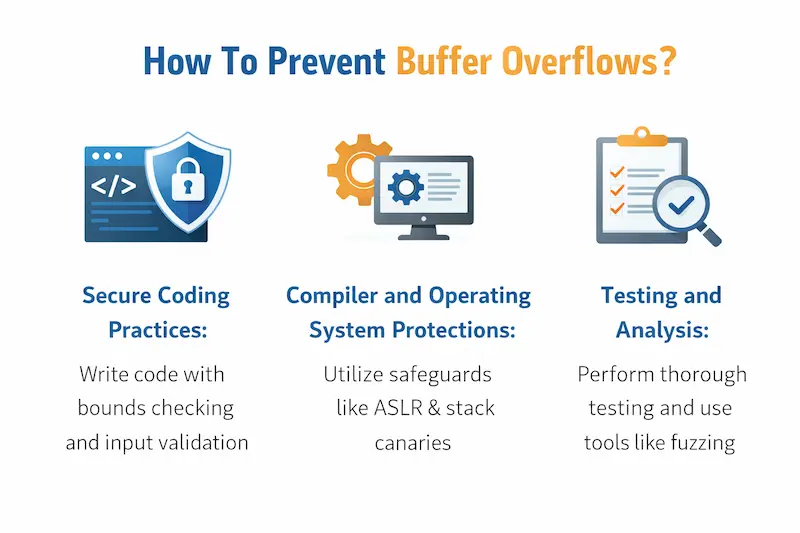
- Secure Coding Practices: Make use of memory-safe routines (such as strncpy() rather than strcpy()) and contemporary programming languages that automatically verify all data inputs for boundaries.
- Compiler and Operating System Protections: To prevent attackers from executing injected malware, enable security techniques like DEP/NX bits (designating memory as non-executable) and ASLR (randomizing memory addresses).
- Testing and Analysis: Before deploying, regularly utilize Static Analysis tools to check source code for any memory vulnerabilities and Fuzzing to hammer inputs with random data.
Conclusion
Now that we have talked about “What Is Buffer Overflow?”, you might want to learn how to prevent such attacks professionally. For that, you can get in contact with Craw Security, offering the 1 Year Cyber Security Diploma Course powered by AI to IT Aspirants.
During the training sessions, students will be able to test their knowledge on various tasks using buffer overflow attack techniques under the supervision of experts. Moreover, online sessions will facilitate students in remote learning.
After the completion of the Cyber Security Training Course for 1 Year offered by Craw Security, students will receive a certificate validating their honed knowledge & skills during the sessions. What are you waiting for? Contact, Now!
Frequently Asked Questions
About What Is Buffer Overflow?
- How does a buffer overflow attack work?
By delivering more data than a memory buffer can contain, a buffer overflow attack overwrites the instruction pointer with malicious code, rerouting the CPU to carry out the attacker's directives.
- Why is buffer overflow a vulnerability?
It is a vulnerability because it enables an attacker to overwrite neighboring memory and get beyond data boundaries, transforming a straightforward storage error into a means of causing system crashes or launching malicious code without authorization.
- What is a buffer stack overflow?
An attacker can take control of the return address and reroute the program to run malicious instructions when too much data overwrites the "stack" memory, a phenomenon known as a stack buffer overflow.
- Is buffer overflow a DDoS attack?
No, a buffer overflow is not a Distributed Denial of Service (DDoS) attack, which involves flooding a target with excessive traffic from numerous sources. Instead, it is a memory corruption vulnerability that can result in a Denial of Service (DoS) by crashing a system.
- How is buffer overflow prevented?
In the following ways, buffer overflows are prevented:
a) Input Validation and Bounds Checking,
b) Use of Memory-Safe Languages,
c) Address Space Layout Randomization (ASLR),
d) Stack Canaries, and
e) Data Execution Prevention (DEP / NX Bit).
- What is the purpose of overflow?
A buffer overflow is an exploitation technique used by attackers to overwrite a computer's memory in order to crash a system or run malicious code without authorization. It is not a feature of a program.
Want to build a career in cyber security?
Talk to our counsellors about courses, batches and fees. Free demo class available.


