

In this article
IT Security Analyst Interview Questions and Answers
Are you preparing for an interview for the role of security analyst? If yes, then you are at the right place. Here, we will talk about the Top 30 IT Security Analyst Interview Questions and Answers to give an idea of future interviews to the job seekers.
In the end, we will introduce IT Aspirants to a reliable institute offering a dedicated training program related to cybersecurity skills. What are we waiting for? Let’s get started!
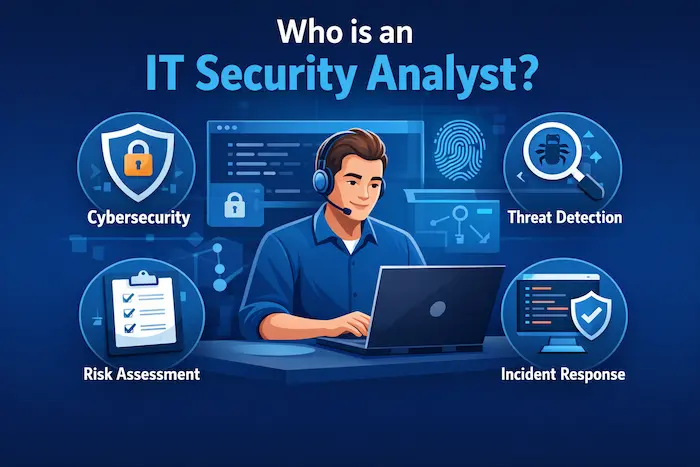
Who is an IT Security Analyst?
Protecting an organization's computer systems, networks, and data from cyber attacks is the responsibility of an IT security analyst, sometimes referred to as an information security analyst. To protect sensitive data, they plan and implement security measures, keep an eye out for breaches, perform vulnerability assessments, and react to security incidents.
Let’s take a look at the Top 30 IT Security Analyst Interview Questions and Answers and give you motivation to crack the interview!
Top 30 IT Security Analyst Interview Questions
Fundamental Security Concepts:
- What is the role of an IT Security Analyst?
Implementing and overseeing security measures to shield an organization's computer systems, networks, and data from cyberattacks and unwanted access is the responsibility of an IT security analyst.
- What is the CIA Triad (Confidentiality, Integrity, Availability)?
The CIA Triad is a fundamental information security architecture that helps companies preserve data by guaranteeing availability (assuring authorized access when needed), confidentiality (preventing unwanted access), and integrity (protecting correctness and completeness).
- Difference between Vulnerability, Threat, and Risk?
Risk is the possibility of loss or harm in the event that a threat successfully exploits a vulnerability (often calculated as Risk = Threat x Vulnerability x Impact). Vulnerability is a weakness in a system.
- What is Defense in Depth?
A cybersecurity tactic known as "Defense in Depth" (DiD) employs several redundant, layered security controls (such as firewalls, antivirus software, and access control) to safeguard data and systems, guaranteeing that in the event that one protection fails, another will be available to thwart the attack.
- What is the principle of least privilege?
In order to minimize the possible harm from a compromise, the Principle of Least Privilege (PoLP) is a security concept that mandates that each user, process, or device be granted only the minimal permissions or access rights required to carry out its duties.
Network & Infrastructure Security:
- What is a firewall? Explain types of firewalls.
A firewall serves as a barrier between a trusted internal network and untrusted external networks (such as the Internet) by monitoring and regulating incoming and outgoing network traffic in accordance with preset security rules.

The following are some types of firewalls:
a) Packet-Filtering Firewalls,
b) Stateful Inspection Firewalls,
c) Proxy Firewalls (Application-Level Gateway),
d) Next-Generation Firewalls (NGFW),
e) Hardware Firewalls (Network-Based),
f) Software Firewalls (Host-Based), and
g) Cloud Firewalls (Firewall-as-a-Service - FWaaS).
- Difference between IDS and IPS?
While an intrusion prevention system (IPS) keeps an eye on traffic and has the ability to actively block or halt harmful behavior, an intrusion detection system (IDS) only notifies users of suspicious activity.
- What is a DMZ (Demilitarized Zone)?
An organization's trusted internal network and an untrusted external network (such as the Internet) are separated by a DMZ (Demilitarized Zone), a physical or logical subnetwork that usually houses publicly accessible services.
- What are common network attacks?
The following are common network attacks:
a) Distributed Denial of Service (DDoS) Attacks,
b) Malware Attacks (Ransomware, Viruses, Worms),
c) Man-in-the-Middle (MITM) Attacks,
d) Phishing & Social Engineering, and
e) Injection Attacks (e.g., SQL Injection, XSS).
- What is port scanning, and why is it dangerous?
Because it is a reconnaissance step that attackers use to find potential vulnerabilities and services to exploit, port scanning, a technique used to find out which ports on a network host are open and listening for connection requests, is risky.
Malware & Threat Detection:
- What is malware? Explain types of malware.
Any intrusive software intended to harm, interfere with, steal data, or generally carry out illegal, hostile operations on a computer system, network, or server is referred to as malware, short for malicious software. The following types of malware:
a) Ransomware,
b) Trojan Horse (Trojan),
c) Virus,
d) Worm, and
e) Spyware.
- Difference between a virus, a worm, and a Trojan?
A Trojan poses as trustworthy software in order to obtain access, a worm is a self-contained program that duplicates itself and spreads throughout networks, and a virus requires a host file and user input in order to spread and execute.
- What is ransomware, and how do you prevent it?
Maintaining up-to-date backups, utilizing endpoint protection (antivirus/EDR), and exercising security awareness are the major ways to stop ransomware, which is malicious software that encrypts a victim's files and prevents access until a ransom is paid.
- What are Indicators of Compromise (IOCs)?
Indicators of Compromise (IOCs) are forensic artifacts (such as hash values, IP addresses, file names, and registry keys) that provide strong evidence of a security breach or compromise on a host system or network.
- What is a zero-day vulnerability?
A zero-day vulnerability is a software security defect that the vendor is unaware of, which means that when the exploit is initially found and used by attackers, there is no official patch or remedy available.
SOC & Incident Response:
- What is a Security Operations Center (SOC)?
An organization's centralized unit or facility, known as a Security Operations Center (SOC), is where a group of security experts continuously monitors, identifies, evaluates, and reacts to cybersecurity threats and occurrences.

- Explain the incident response lifecycle.
A company can prepare for, detect, contain, eradicate, recover from, and learn from a security breach or cyberattack using the incident response lifecycle, a cyclical framework that is frequently defined by NIST.
- How do you handle a phishing attack?
In the following ways, you can handle a phishing attack:
a) Isolate & Contain,
b) Report & Analyze the Threat,
c) Eradicate & Remediate,
d) Recover & Restore, and
e) Lessons Learned & Awareness.
- What is log monitoring and why is it important?
Log monitoring is essential for early threat identification, regulatory compliance, and post-incident forensic analysis because it involves the continuous, centralized collection and analysis of system and application logs to find anomalies, security threats, and operational problems in real-time.
- What tools are used by Security Analysts?
The following tools are used by security analysts:
a) Security Information and Event Management (SIEM) Systems,
b) Endpoint Detection and Response (EDR) Tools,
c) Vulnerability Scanners,
d) Network Protocol Analyzers (Packet Sniffers), and
e) Threat Intelligence Platforms (TIPs).
SIEM, Logs & Monitoring:
- What is SIEM? Name popular SIEM tools.
Using well-known tools like Splunk, Microsoft Sentinel, and IBM QRadar, a SIEM (Security Information and Event Management) system gathers, combines, and analyzes security data from throughout an organization to identify, alert on, and manage threats.
- What types of logs are most important for security?
The following types of logs are most important for security:
a) Authentication Logs (Security Logs),
b) Firewall/ Network Device Logs (Perimeter Logs),
c) Endpoint Logs (Operating System/System Logs),
d) Application & Web Server Logs (Access Logs), and
e) Audit Logs (Configuration/Change Logs).
- What is correlation in SIEM?
In SIEM, correlation is the process of connecting dissimilar events and log entries from various security devices and apps in order to find intricate patterns, security trends, and attack chains that would be missed by individual occurrences.
- How do you reduce false positives in alerts?
Reducing false positives entails connecting several low-severity events into a single, high-confidence warning, fine-tuning log sources to remove unnecessary noise, and improving detection methods and thresholds to be more precise.
- What is UEBA (User and Entity Behavior Analytics)?
A cybersecurity tool called UEBA (User and Entity Behavior Analytics) employs machine learning to create baselines of typical user and device behavior. It then notifies users of any unusual activity that may indicate a threat, such as an insider attack or hacked account.
Web, Cloud & Compliance:
- What is OWASP Top 10?
The OWASP Top 10 is a widely accepted list of the top ten security threats to online applications that developers and security experts should be aware of.

- Difference between authentication and authorization?
While authorization decides what access or permissions a verified user has to particular resources (e.g., choosing what files or functions you can use), authentication confirms the user's identity (e.g., proving you are who you say you are through a password or token).
- What is MFA, and why is it important?
Because it stops 99.9% of account compromise attacks even in the event that a password is stolen, Multi-Factor Authentication (MFA) is a security mechanism that requires a user to provide two or more distinct verification factors (something you know, something you have, or something you are) to access an account.
- What are common cloud security risks?
The following are common cloud security risks:
a) Cloud Misconfigurations (The #1 Risk),
b) Inadequate Identity, Credential, and Access Management (IAM),
c) Data Loss & Exfiltration,
d) Insecure Interfaces & APIs, and
e) Lack of Cloud Security Architecture & Strategy.
Pro Tip for Interviews:
- How do you investigate an alert?
I can investigate an alert in the following ways:
a) Triage & Validate the Alert,
b) Determine Scope & Impact,
c) Containment & Isolation,
d) Root Cause Analysis & Eradication, and
e) Recovery, Documentation, & Lessons Learned.
- How do you analyze logs?
I can analyze logs in the following ways:
a) Normalization & Centralization,
b) Establish Baselines & Search for Anomalies (Tuning),
c) Filter & Pivot on Indicators of Compromise (IOCs),
d) Correlation & Attack Chain Reconstruction, and
e) Review Audit & Configuration Changes.
- How do you escalate incidents?
I can escalate incidents in the following ways:
a) Define & Adhere to Escalation Tiers,
b) Establish Clear Escalation Criteria (Triggers),
c) Provide a Detailed & Standardized Briefing,
d) Engage Executive/ Business Leadership for "Critical" Incidents, and
e) Maintain Communication Channels & Document Everything.
Conclusion
Now that we have talked about the Top 30 IT Security Analyst Interview Questions and Answers, you might be feeling more confident about cracking the interview. Apart from that, those who have just started their career in the IT Industry and want to learn more about the roles and skills of a security analyst can get in contact with Craw Security.
It is one of the most reliable training institutes offering the 1 Year Cyber Security Diploma Course Powered by AI to IT Aspirants who want to learn cyber security skills. During the training sessions, students will be able to get the benefits of Virtual Labs. What are you waiting for? Contact, Now!
Read More Related Blogs
Want to build a career in cyber security?
Talk to our counsellors about courses, batches and fees. Free demo class available.


