

In this article
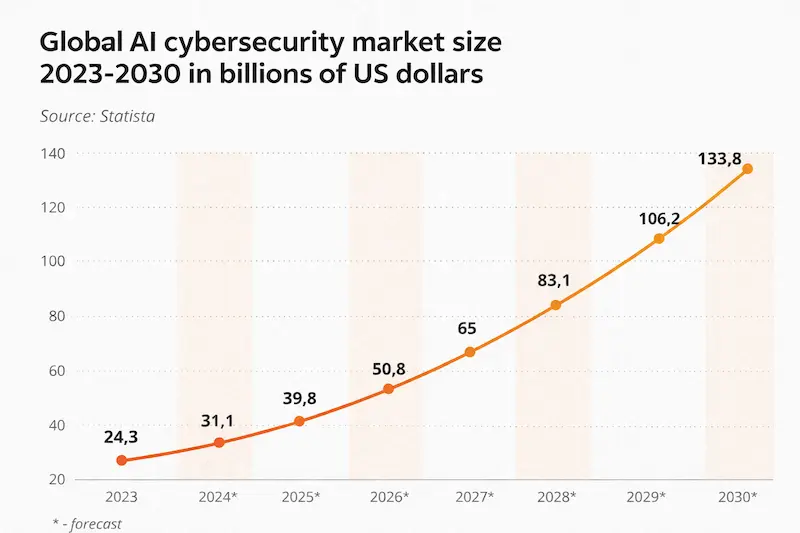
These days, artificial intelligence is used extensively in many domains, including cybersecurity. According to projections, the size of the global generative AI cybersecurity industry is expected to quadruple from $24.3 billion in 2023 to $50.8 billion in 2026 and $133.8 billion by 2030.
Accelerated automation, sophisticated threat detection, predictive analysis, cost savings, and other advantages are the reasons behind the increased interest in AI-powered security solutions. However, what are the precise applications of generative AI in cybersecurity?
How can artificial intelligence be applied without creating new weaknesses or compromising current defenses? We compiled the top ten cybersecurity applications of GenAI and offered helpful advice for effective implementation.
What is Generative AI in Cybersecurity?
In cybersecurity, generative AI creates synthetic data for security model training, automates incident response, and proactively detects threats using sophisticated algorithms. Anticipating vulnerabilities and generating real-time fixes before exploits can take place, it enables enterprises to protect against complex, AI-driven attacks.
It turns security from a reactive procedure into an intelligent, adaptive barrier that can spot minute patterns of malevolent activity by examining enormous datasets. Let’s take a look at the Top 10 uses of artificial intelligence in cybersecurity and see how those work!
Why do businesses implement generative AI in cybersecurity?
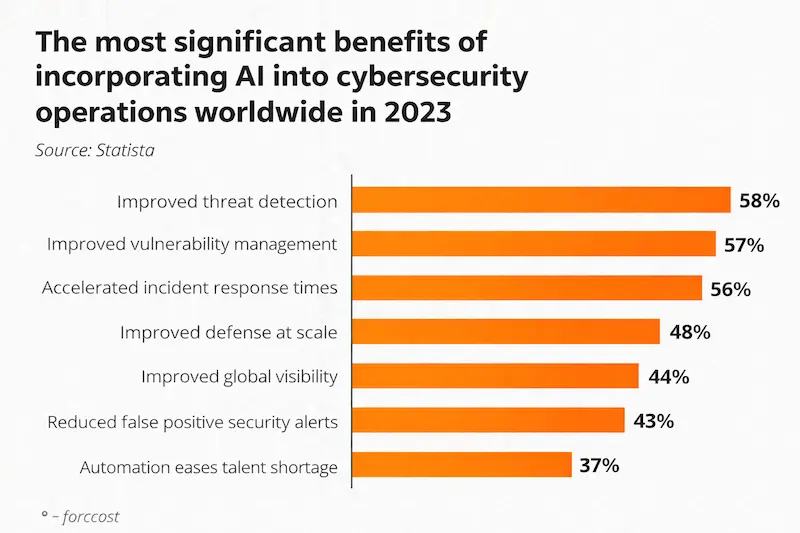
● Proactive threat identification: It anticipates such weaknesses before hackers can take advantage of them and models complex "zero-day" attack scenarios.
● Better risk management: It synthesizes complicated data from the full organizational infrastructure to produce extremely accurate risk assessments and compliance reports.
● Accelerated data analysis: Millions of security events are processed in a matter of seconds, allowing it to spot tiny patterns of malicious activity that human analysts might miss.
● Enhanced security automation: It automatically creates and implements intricate firewall rules and mitigation scripts to instantly eliminate active threats.
● Cost savings: By automating repetitive Tier-1 security operations, it decreases operational overhead and lessens the cost impact of breaches.
How can generative AI be used in cybersecurity?
In the following ways, generative AI is used in cybersecurity:
- Adaptive threat detection: By building complex models that change in tandem with new threats, generative AI enables systems to identify novel attack patterns as they emerge. In order to spot minor indications of criminal activity that conventional, rule-based systems frequently overlook, it continuously learns from new data.
- Predictive analysis: Artificial intelligence (AI) can predict where an organization is most likely to be targeted next by modeling millions of possible "zero-day" attack scenarios. Security teams can apply updates and protective countermeasures before a real breach happens because of this foresight.
- Anomaly detection: AI creates a "baseline" of typical network behavior and immediately detects even little anomalies, like odd data spikes or login times. In order to detect concealed threats in real time, these models, such as Variational Autoencoders (VAEs), detect large "reconstruction errors" in data packets.
- Data masking and privacy preservation: High-quality "synthetic data" that closely resembles real datasets but excludes sensitive personal information is produced by Generative Adversarial Networks (GANs). This guarantees that the original, confidential information is kept totally hidden while enabling businesses to share data for testing or study.
- Malware generation and analysis: Security teams may analyze sophisticated malware code more quickly by using AI to "auto-deconstruct" it into natural language. To test and strengthen antivirus software against "polymorphic" malware that alters its own code, it can, on the other hand, produce an infinite number of variations of known threats.
- Incident response: AI-driven "playbooks" automatically recommend the best containment measures, such as removing user access or isolating a compromised system. This shortens an attacker's "dwell time" and keeps a little infiltration from turning into a major disaster.
- Reporting: Thousands of technical logs are combined by generative AI to create concise, executive-level summaries that emphasize important risks and return on investment. This makes it possible for non-technical leaders to make quick, data-driven decisions about compliance and security initiatives.
- Development assistance and coding security: During the development stage, AI helpers check source code to identify common vulnerabilities such as SQL injection or hardcoded credentials. It ensures that apps are developed with security built into the foundation by offering real-time "secure-coding" recommendations.
- Automated security policy generation: AI can automatically create customized security rules by analyzing the unique architecture and legal needs of an organization. It ensures compliance with less manual labor by mapping system actions to intricate frameworks like GDPR or HIPAA.
- Employee training and education: The technology creates individualized, incredibly realistic phishing simulations that change in severity according to each employee's prior performance. Employees who receive this intensive training go from being a security risk to a "Human Firewall" that can recognize the newest social engineering techniques.
How can Craw Security help you adopt generative AI in cybersecurity?
Now that we have talked about the Top 10 uses of artificial intelligence in cybersecurity, you might want to learn how to use those professionally. For that, you can get in contact with Craw Security, offering the Six-Months Diploma in Artificial Intelligence (AI) and Machine Learning to IT Aspirants.
During the training sessions, the students will be able to test their knowledge on various tasks using generative AI under the supervision of AI experts. Moreover, online sessions will facilitate students to remote learning.
After the completion of the AI and ML Six-Months Diploma offered by Craw Security, students will receive a certificate validating their honed knowledge & skills during the sessions. What are you waiting for? Contact, Now!
- What is Artificial Intelligence? Definition, Uses, and Types - Craw Security
- Artificial Intelligence Course Syllabus: Complete Curriculum Explained
- Six Months Diploma in Artificial Intelligence (AI) and Machine Learning in India
- Best Artificial Intelligence Course After 12th in India (2026 Guide)
- Best Course to Learn Artificial Intelligence in Delhi
- AI Cyber Security Course in Delhi [2026]
- Advanced Artificial Intelligence Course in Delhi
- What Is Computer Vision in Artificial Intelligence (AI)?
Want to build a career in cyber security?
Talk to our counsellors about courses, batches and fees. Free demo class available.


