

Let’s talk about Social Engineering and Phishing in detail and find out what benefits or outcomes they keep with themselves for the users/ victims! These skills are two of the several ones that can be used by both ethical hackers and criminal online.
Thus, organizations are finding professionals to secure their data against such techniques. We will introduce you to a reputable service provider offering dedicated services to protect your confidential data. What are we waiting for? Let’s get started!
What is Social Engineering?
Social engineering is a tactic used to deceive people into disclosing private information or taking actions that jeopardize security by taking advantage of human psychology and trust. This type of "human hacking" gets over technical safeguards by motivating victims through deceit, such as posing as an authority figure or instilling a sense of urgency.
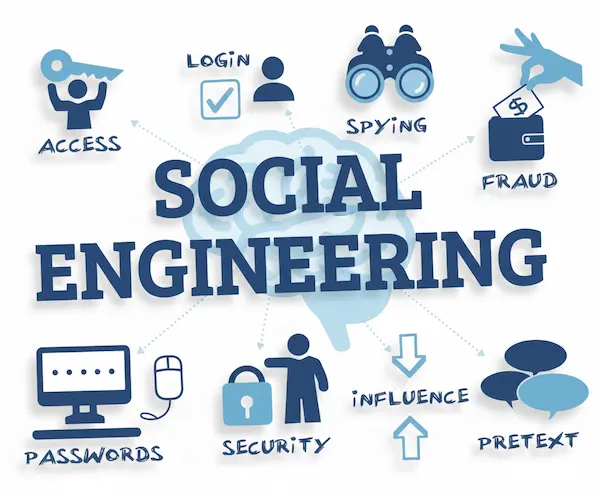
Phishing emails and pretexting, in which an attacker creates a scenario to acquire trust, are common instances. Let’s take a look at what Social Engineering and Phishing are and their outcomes!
What is Phishing?
Phishing is a kind of social engineering assault in which a malevolent actor poses as a reliable organization, such as a bank or a well-known business, and sends fraudulent messages, usually via email or SMS (smishing).
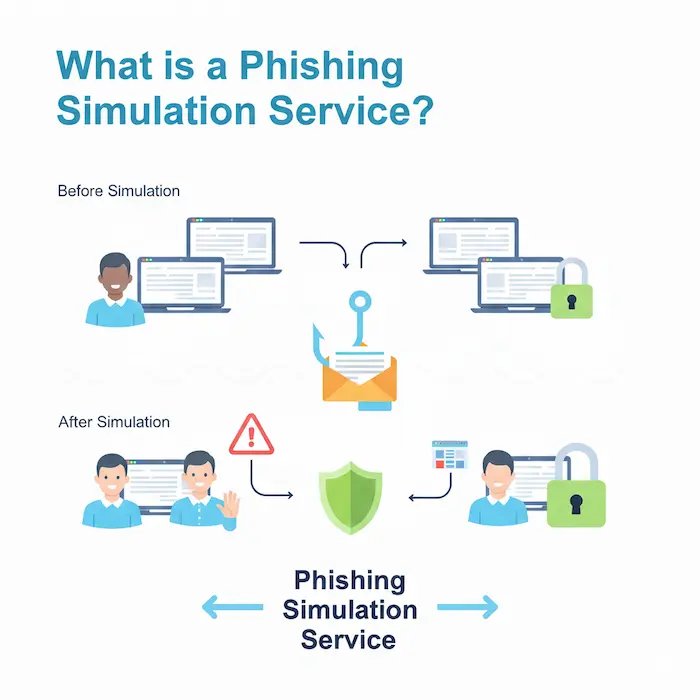
The intention is to trick the victim into opening an infected attachment, visiting a malicious link, or disclosing private information like credit card numbers or passwords. In order to obtain information for identity theft and financial crime, this attack depends on deceit and a sense of urgency.
What Makes a Great Social Engineering Tool?
|
S.No. |
Factors |
What? |
|
1. |
Urgency/ Fear |
Creates a threat or urgent crisis (such as "Your account is suspended!") that compels the victim to act without hesitation. |
|
2. |
Curiosity/ Greed |
Entices the victim with an alluring prize, offer, or confidential information (like as a USB stick infected with malware and marked "Confidential Salaries"). |
|
3. |
Trust/ Authority |
To avoid suspicion, pose as a reliable source, such as IT support, a senior executive, or a government representative. |
|
4. |
Plausible Pretext |
It depends on a plausible, thoroughly investigated scenario or backdrop (pretexting) to make the request appear reasonable and valid. |
|
5. |
Personalization |
To improve authenticity and rapport, the attack is customized utilizing Open-Source Intelligence (OSINT) on the target (names, job titles, current occurrences). |
|
6. |
Perfect Impersonation |
It flawlessly replicates official branding, domains, and communication styles for digital tools (such as phishing emails) so they look just like the authentic source. |
|
7. |
Simple Call-to-Action |
The request is straightforward, simple to complete (e.g., "click here," "reply with your password"), and doesn't need the victim to act differently than usual. |
|
8. |
Emotional Overload |
Strong emotional triggers are used to make sure the victim is experiencing intense emotion, which overrides their critical, logical defenses. |
Why Phishing Simulations are Crucial for Cybersecurity Awareness?
Phishing simulations are crucial for cybersecurity awareness for the following reasons:
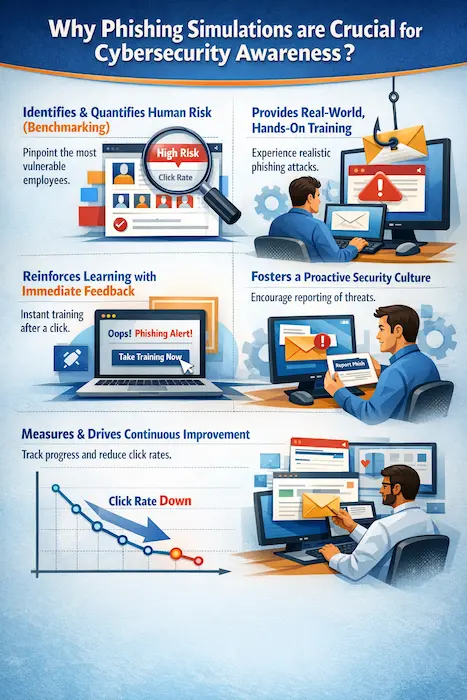
- Identifies and Quantifies Human Risk (Benchmarking): To identify the most vulnerable employees and departments for specialized training, they set up a quantifiable baseline of employee susceptibility (such as click rate).
- Provides Real-World, Hands-On Training: Employees are exposed to realistic, dynamic phishing techniques in a secure setting through simulations, which provide hands-on experience that traditional lectures cannot match.
- Reinforces Learning with Immediate Feedback: When an employee clicks on a link, they are immediately taken to a landing page containing remedial training, making for an effective, in-the-moment learning experience.
- Fosters a Proactive Security Culture: Through the simulations, employees become active danger reporters by normalizing the practice of reporting suspicious emails without fear of punishment.
- Measures and Drives Continuous Improvement: To demonstrate the efficacy of training and support continued security investment, organizations can monitor performance over time (e.g., lower click rates in subsequent tests).
How to Choose the Best Tool for Your Phishing Simulation Needs?
|
S.No. |
Factors |
How? |
|
1. |
Realism and Variety of Attack Scenarios (Threat-Led Content) |
A constantly updated collection of templates that imitate complex, current, and industry-specific assaults (such as MFA fatigue or QR code phishing) must be provided by the tool. |
|
2. |
Automated, Adaptive Training and Reinforcement |
When an employee fails a test, the platform should automatically enroll them in appropriate, tailored micro-training courses to encourage proper behavior right away. |
|
3. |
Comprehensive and Actionable Reporting |
It must include comprehensive statistics that are simple to convert into understandable risk assessments and executive summaries, such as click rates, reporting rates, and time-to-report. |
|
4. |
Ease of Use and Scalability (Minimal Admin Overhead) |
To reduce the amount of time and technical know-how needed from the security team, the software should include an easy-to-use interface and automated campaign scheduling. |
|
5. |
Seamless Integration with Existing Infrastructure |
For user administration, the solution must be easy to link with important systems like Google Workspace, Microsoft 365, and Active Directory.
It must also offer straightforward allow-listing for dependable email delivery. |
Enhancing Phishing Awareness with Tools
The ultimate objective of employing phishing simulation tools is to create a "Human Firewall" in which staff members automatically identify, reject, and report sophisticated threats, going beyond simple compliance.
This is accomplished by employing actionable metrics to assess behavioral change and promote a widespread culture of security alertness, continuously modifying training to meet the most recent real-world threats, and offering immediate, remedial education.

The best programs provide a strong, multi-layered protection by combining the empowered human element with technology controls like email filtering and MFA.
Frequently Asked Questions
About Social Engineering and Phishing
- What is social engineering, and how does it relate to phishing?
Phishing is a particular, popular digital delivery technique of social engineering, which is the more general activity of tricking people into divulging private information or granting access.
- Why are phishing simulations important for cybersecurity training?
For the following reasons, phishing simulations are important for cybersecurity training:
a) Identifies & Quantifies Human Risk,
b) Provides Realistic, Hands-On Practice,
c) Reinforces Learning with Immediate Feedback,
d) Drives Continuous Improvement & Resilience, and
e) Fosters a Proactive Security Culture.
- What are the best tools for phishing simulations?
The following are the best tools for phishing simulations:
a) Realism & Current Threat Templates,
b) Integrated, Adaptive Training,
c) Comprehensive, Actionable Reporting,
d) Ease of Management & Scalability, and
e) End-User Reporting Mechanism.
- How do phishing tools help in testing employee awareness?
In the following ways, phishing tools help in testing employee awareness:
a) Benchmark Current Vulnerability,
b) Provide Realistic Exposure to Evolving Threats,
c) Measure Behavioral Change Over Time,
d) Identify High-Risk Individuals & Departments, and
e) Test Incident Response Procedures.
- Can social engineering tools simulate spear phishing attacks?
Yes, the greatest commercial phishing simulation systems and social engineering tools are made expressly to mimic spear phishing by enabling the development of highly customized and focused email campaigns.
- What features should I look for in a phishing simulation tool?
You should look for the following features in a phishing simulation tool:
a) Realism & Current Threat Library,
b) Automated, Adaptive Training & Reinforcement,
c) Comprehensive & Actionable Reporting,
d) Integrated Phish Reporting Button, and
e) Ease of Use, Automation, & Scalability.
- How does the Social Engineering Toolkit (SET) help in phishing simulations?
In the following ways, the social engineering toolkit helps in phishing simulations:
a) Enables Credential Harvesting Simulation,
b) Facilitates Targeted Spear-Phishing,
c) Offers Diverse Attack Vectors,
d) Provides Realistic Payload Delivery Practice, and
e) Acts as an Open-Source, Customizable Alternative.
- Are there any free social engineering tools for phishing simulations?
Yes, there are great free alternatives. Gophish is a potent, open-source phishing platform that allows security teams to run and monitor realistic simulations.
- How do phishing tools improve security awareness in organizations?
In the following ways, phishing tools improve security awareness in organizations:
a) Quantify Human Risk,
b) Provide Realistic, Hands-On Practice,
c) Reinforce Learning with Immediate Feedback,
d) Promote a Proactive Reporting Culture, and
e) Drive Continuous, Measurable Improvement.
- How often should phishing simulations be conducted for effective awareness training?
To properly maintain awareness and track ongoing improvement, phishing simulations should be carried out at least once a month, or quarterly at the very least, employing a variety of more complex templates.
Conclusion
Now that we have talked about Social Engineering and Phishing, you might want to get the best experience for phishing techniques and skills. For that, you can get in contact with Craw Security, one of the best VAPT service providers in the IT Industry.
Craw Security offers the Best Phishing Simulation Service in India to several organizations to protect their confidential data against online attempts that can harm their funds and data. What are you waiting for? Contact, Now!
Read more Blogs
Top 10 Malware Attacks in World History - Craw Security
Top 10 Cyber Lawyers in India [2026] | Craw Security
Top 10 Signs Your Computer Has Been Hacked [2026]
Top 10 Endpoint Security Tools: How to Secure Devices in 2026?
Top 10 Web Attacks That Defined Cybersecurity Battles [2026]
Want to build a career in cyber security?
Talk to our counsellors about courses, batches and fees. Free demo class available.


