

In this article
Do you want to know what the Python Programming Data Types are and see how you can get the best use of them with reasonable knowledge? If yes, then you are at the right place. Here, we will explore the types in detail.
Moreover, we will introduce you to a reputed training institute offering a dedicated training program related to Python programming skills. What are we waiting for? Let’s get started!
What Are Data Types in Python?
Python's data types are classifications that specify a value's nature, instructing the interpreter on how to keep it in memory and what operations are allowed. They serve as an object's blueprint, deciding whether a variable can store a string of characters, carry out mathematical operations, or contain a group of other objects.
Python guarantees code stability by classifying data into types such as integers, strings, or lists, which also facilitate effective data manipulation and memory management. Let’s take a look at the Python Programming Data Types and their uses!
Why Are Data Types in Python Important?
Data types in Python are important for the following reasons:
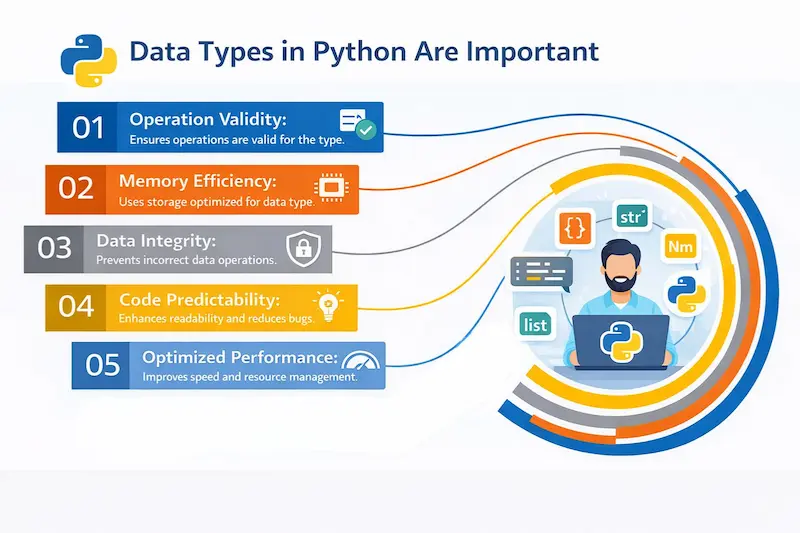
- Operation Validity: To avoid logical problems in your code, they specify what operations are permitted on a piece of data. For instance, you can divide an int but not a str.
- Memory Efficiency: Depending on the data type, Python allocates memory differently. A simple bool takes up significantly less space than a complex list, so your program won't waste system resources.
- Data Integrity: You can prevent important data from being inadvertently altered or corrupted while a program is running by utilizing particular types, such as tuples, which are immutable.
- Code Predictability: Understanding a variable's type helps you anticipate how it will behave, such as whether it will be unique (like a set) or ordered (like a list), which facilitates debugging your code.
- Optimized Performance: You can create more effective applications because some data types are made to be fast. For example, looking for an item in a dict is much quicker than looking through a list.
The Individual Building Blocks
Numeric Data Types in Python (int, float, complex)
● Integer (int): Represents whole numbers without digits, whether they are positive or negative (e.g., 10, -5, 0). Because of Python's arbitrary precision, numbers can be as big as the memory on your computer permits.
● Floating Point (float): Represents "real" numbers (such as 3.14 and -0.001) that have one or more decimals. Additionally, they can use "e" to denote the power of 10 in scientific notation (for example, 2e3 equals 2 x 103 = 2000.0).
● Complex (complex): These numbers, which are written with a j as the imaginary unit and have a real and an imaginary component, are used in mathematical engineering and physics (e.g., 3 + 5j).
String Data Type in Python: Text Handling Explained
● Definition & Syntax: For multi-line text, a string is a series of characters enclosed in single quotes ('...'), double quotes ("..."), or triple quotations ('''...''' or """..."").
● Immutability: Strings cannot have their individual characters changed after they are produced because they are immutable. A new string object is actually created by any operation that "modifies" a string.
● Indexing & Slicing: Strings are sequences; you can use their location (index) to access certain characters. For instance, index 0 is 'P' in "Python". You can extract a section of the text by slicing it; for example, text[0:2] extracts the first two characters.
● Concatenation & Repetition: You can use the * operator to repeat strings or the + operator to "glue" them together (for example, "Hi" * 3 yields "HiHiHi").
● Built-in Methods: Python has a wide range of text manipulation tools, including .upper() to, .split() sentences into lists of words, and .replace() individual characters.
Boolean Data Type in Python (True and False)
● Binary Logic: The truth value of an expression is represented by booleans. Since true and false (lowercase) are not accepted keywords in Python, they must always be capitalized.
● Comparison Outcomes: Usually, comparison operators produce booleans. The expressions 10 > 5 and 10 == 5 evaluate to True and False, respectively.
● Subtype of Integers: Booleans are handled by Python internally as a specific type of integer. In mathematics, True is equal to 1, whereas False is equal to 0.
● The bool() Evaluation: Any object's "truthiness" can be verified with the bool() function. The majority of objects in Python evaluate to False unless they are empty or represent "nothing" (such as 0, None, [], {}, or "").
● Control Flow: The "engine" of while loops and if statements, booleans decide whether a certain block of code should be skipped or executed.
Data Collections: Storing Multiple Items
Python Sequence Types: List, Tuple, and Range
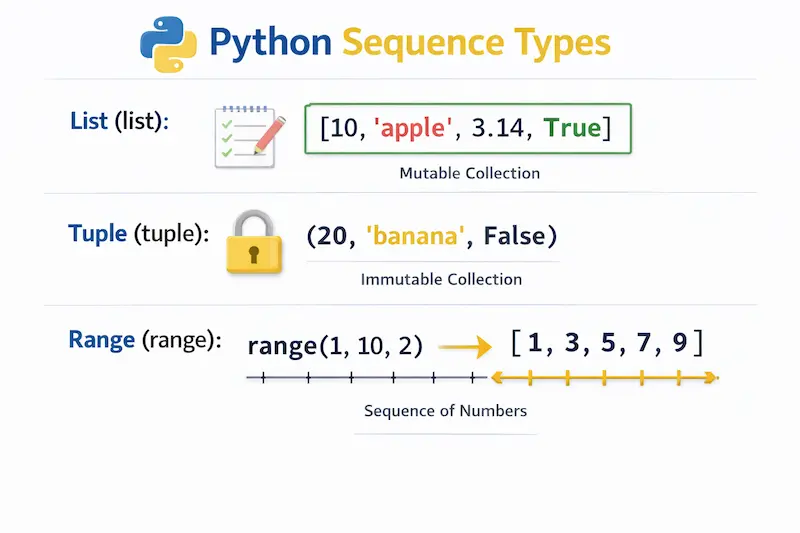
● List (list): A flexible "shopping list" of things that can be altered, added, or deleted after creation is stored in this mutable, ordered collection.
● Tuple (tuple): An ordered, immutable collection that serves as a "locked" record, preventing changes once defined and resulting in quicker speed and data security.
● Range (range): A specific, unchangeable set of numbers that is usually used to generate a sequence of integers that regulates the number of times a loop repeats.
Python Mapping Type: Understanding Dictionaries
● Key-Value Pair Structure: Dictionaries contain information in pairs, with a colon (e.g., {"name": "Alice"}) separating each pair of a unique Key (the identification) and a Value (the data).
● Unordered but Indexed by Key: With dictionaries, you may retrieve data instantaneously without knowing where it is in the collection, thanks to keys for retrieval, as opposed to lists, which employ number positions (0, 1, 2).
● Key Constraints: In order to guarantee that every "label" points to precisely one distinct piece of data, keys must be distinct and unchangeable (such as strings, integers, or tuples).
● Mutable Values: The values linked to keys are completely variable, but keys themselves are immutable; you can add, edit, or remove data points from a dictionary at any moment.
● Efficient Data Retrieval: Dictionaries are the best option for storing "database-like" entries, like contact lists, user profiles, and configuration settings, because of their excellent speed optimization.
Python Set Data Types: set and frozenset
● Unordered Collections: Neither set nor frozenset preserves a particular order; you cannot access items by position (such as my_set[0]) since they lack a fixed index.
● Automatic Uniqueness: Duplicate values are absolutely prohibited in both categories. Python is ideal for "deduplicating" lists since it rejects items that already exist if you try to add them.
● The Set (set): This is changeable. Once the set is formed, you can add or remove elements. However, a set cannot be used as a dictionary key because it is subject to change.
● The Frozenset (frozenset): This cannot be changed. It cannot be changed once it has been created. It can be used as a dictionary key or as an element in another set because it is "hashable" due to its unchangeability.
● Mathematical Operations: Union (combining sets), Intersection (finding common items), and Difference (finding things in one set but not the other) are examples of strong operations supported by both types.
Advanced Concepts: Behavior and Conversion
Type Conversion and Type Casting in Python
● Implicit Type Conversion (Coercion): This occurs on its own. To avoid data loss, Python transforms a "smaller" data type into a "larger" data type. For instance, Python will automatically promote an integer to a float (7.5) if you add an int (5) to a float (2.5).
● Explicit Type Conversion (Casting): The programmer uses built-in functions to do this manually. You can "force" a value into a certain type by using int() to convert the text "100" into an actual integer.
● The int() Function: Used to change compatible strings or floats to integers. Keep in mind that truncating a float, such as 3.9, to an integer will result in 3, not 4.
● The float() Function: Transforms numeric strings or integers into floating-point numbers (float(5) becomes 5.0, for example).
● The str() Function: Converts practically every data type into its string representation, including lists, booleans, and numbers. When concatenating text and numbers for print statements, this is commonly employed.
Mutable vs Immutable Data Types in Python:
|
S.No. |
Topics |
Factors |
What? |
|
1. |
Mutable Data Types |
In-Place Modification |
Using .append() on a list, for example, allows you to add, remove, or modify elements inside the object without generating a new one in memory. |
|
Shared References |
A change made to one variable will instantly update the other if both variables point to the same changeable object. |
||
|
Examples |
List, dict, and set are the most widely used mutable types. |
||
|
2. |
Immutable Data Types |
Object Stability |
The value is created and then "locked." Python really creates a new object at a different memory address if you attempt to change it (for example, by adding a letter to a string). |
|
Data Integrity |
Because their value is assured to stay consistent throughout the program, these types are safer to employ as dictionary keys or constants. |
||
|
Examples |
Float, str, tuple, bool, and int are examples of common immutable types. |
Frequently Asked Questions
About Python Programming Data Types
- What are data types in Python programming?
Classifications known as data types specify a value's characteristics, including how it is kept in memory and what operations (such as text manipulation or math) can be carried out on it.
- What are the 4 types of data in Python?
The following are the 4 types of data in Python:
a) Numeric Types,
b) Sequence Types,
c) Mapping Type, and
d) Boolean Type.
- What are the 4 types of data types?
The following are the 4 types of data:
a) Integer (int),
b) Floating-Point (float),
c) String (str), and
d) Boolean (bool).
- What is a list data type in Python?
A list is an ordered, changeable collection of things that can hold various kinds of data and can be altered after it has been created.
- What are the 4 types of data structures in Python?
The following are the 4 types of data structures in Python:
a) List (list),
b) Tuple (tuple),
c) Set (set), and
d) Dictionary (dict).
- Is there a data type in Python?
Yes, there are several built-in data types in Python, like int, str, and list, which specify the type of data and how the computer should handle it.
- Which datatype is date?
In Python, a date is an object provided by the built-in datetime module (more precisely, the datetime.date class), rather than a primitive built-in data type like an integer or text.
- Are data types in Python classes?
Yes, all variables in Python are instances (objects) of classes, and all data types are actually classes.
- Why are data types important in Python?
For the following reasons, data types are important in Python:
a) Defining Valid Operations,
b) Memory Efficiency,
c) Data Integrity and Security,
d) Search & Retrieval Speed, and
e) Code Readability & Logic.
Conclusion
Now that we have talked about Python Programming Data Types, you might want to learn about them in detail professionally. For that, you can get in contact with Craw Security, offering Python Training in Delhi to IT Aspirants.
During the training sessions, students will be able to test their knowledge on various tasks while using various data types under the supervision of experts. Moreover, online sessions will facilitate students in remote learning.
After the completion of the Python Programming Training in Delhi offered by Craw Security, students will receive a dedicated certificate validating their honed knowledge & skills during the sessions. What are you waiting for? Contact, Now!
Want to build a career in cyber security?
Talk to our counsellors about courses, batches and fees. Free demo class available.


