

In this article
You might want to enter the Ethical hacking job market in India if you have reached this article. However, before that, you need to know about the Ethical hacker demand in India. Here, we have explained why there is a huge demand for hackers in the IT Industry in India.
You can search for a Certified Ethical Hacker certification program that is a possible way for you to enter the market successfully. What are we waiting for? Let’s get started!
What is Certified Ethical Hacker (CEH)?
A globally recognized professional certificate, the Certified Ethical Hacker (CEH) certification attests to a person's capacity to detect and address security flaws by replicating actual cyberattacks using the same instruments and methods employed by malevolent hackers.
The program, created by the EC-Council, employs a "think like a hacker" approach to lawfully breach systems and networks to find vulnerabilities before they can be exploited. Artificial intelligence is incorporated into the current CEH v13 (AI-Powered) edition to improve efficiency throughout the five stages of ethical hacking and automate threat detection.
Let’s find out how beneficial a Certified Ethical Hacker can be for an IT practitioner working in the IT Industry!
The Skills and Knowledge Gained with a CEH Certification
|
S.No. |
Skills |
What? |
|
1. |
AI-Augmented Hacking |
Learn how to automate reconnaissance, create attack scripts, and identify possible breach points with 40% more efficiency by using AI tools like ShellGPT and PentestGPT. |
|
2. |
Adversarial AI Defense |
To ensure that AI systems are safe from malevolent manipulation, learn how to defend machine learning models against threats, including Prompt Injection, Model Poisoning, and Data Evasion. |
|
3. |
Advanced Vulnerability Analysis |
Learn the "Vulnerability Management Life Cycle" by using AI-powered and automated scanning to identify security flaws throughout the communication infrastructure of a company. |
|
4. |
Modern Network Reconnaissance |
Gain a thorough understanding of footprinting and scanning methods to map open ports, live hosts, and system architectures with sophisticated tools like Nmap and Recon-ng. |
|
5. |
System Hacking Mastery |
Proficiency with the five stages of hacking, including stenography, privilege escalation, and the crucial ability to conceal digital evidence after an exploit. |
|
6. |
Cloud & Hybrid Defense |
Specialized instruction on hacking cloud-native architectures (AWS, Azure, GCP), covering vulnerabilities in serverless computing, container security (Docker/Kubernetes), and S3 bucket enumeration. |
|
7. |
Web Application & API Security |
Thorough knowledge of SQL Injection techniques, the OWASP Top 10, and how to audit web servers for configuration errors that could result in data theft. |
|
8. |
IoT and OT Exploitation |
Discover how to secure the "physical internet" by hardening and hacking Internet of Things (IoT) devices and Operational Technology (OT) utilized in vital industrial control systems. |
|
9. |
Malware Analysis & Forensics |
Gaining knowledge about how viruses, worms, and fileless malware behave, as well as the capacity to reverse-engineer threats to create efficient anti-malware defenses. |
|
10. |
Modern Cryptography |
Recognizing public key infrastructure (PKI), symmetric versus asymmetric encryption methods, and the new threats that quantum computing poses to conventional encryption. |
Why Ethical Hacking is Crucial in Today's Cybersecurity Landscape?
For the following reasons, ethical hacking is crucial in today’s cybersecurity landscape:
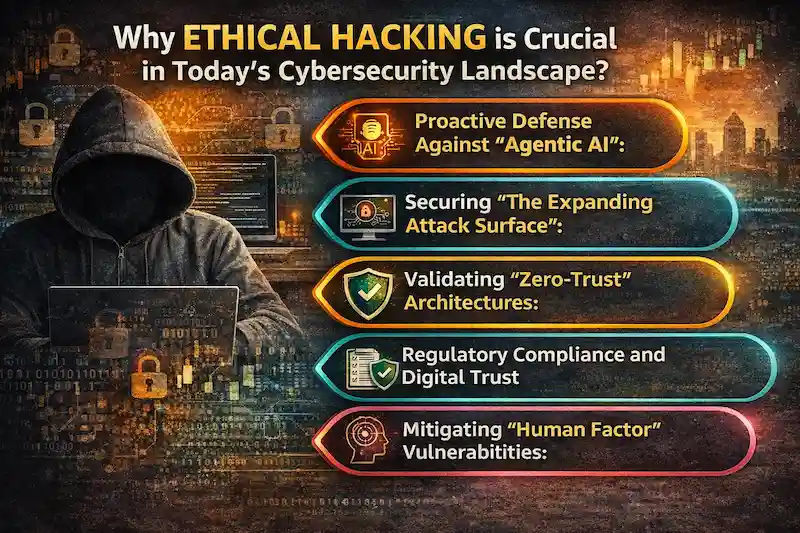
- Proactive Defense Against "Agentic AI": Before these "digital employees" may be duped into disclosing information through quick injection or logic manipulation, ethical hackers identify and fix flaws in autonomous AI agents.
- Securing "The Expanding Attack Surface": White-hat hackers map and harden each new endpoint to keep them from becoming "side-door" access points for attackers as 5G, IoT, and multi-cloud settings blur conventional boundaries.
- Validating "Zero-Trust" Architectures: To make sure that identity-based micro-segmentation truly prevents lateral movement during a true breach, they conduct ongoing stress tests on "Never Trust, Always Verify" systems.
- Regulatory Compliance and Digital Trust: Regular penetration testing demonstrates to authorities and clients that a business values "Security by Design" over reactive patching in an era of stringent data sovereignty regulations.
- Mitigating "Human Factor" Vulnerabilities: Ethical hackers find "behavioral gaps" in the workforce that technology cannot address on its own by using hyper-realistic deepfake and social engineering simulations.
CEH Certification Benefits
|
S.No. |
Factors |
How? |
|
1. |
Global Industry Recognition |
The CEH is a widely accepted benchmark that gives you immediate credibility in more than 160 countries and is mandated by government bodies and prestigious firms like Deloitte, IBM, and EY. |
|
2. |
AI-Enhanced Efficiency |
You can use automated threat identification and intelligent reconnaissance technologies to boost your auditing speed and accuracy by up to 40% by becoming proficient with the new AI-driven modules. |
|
3. |
Hands-On Mastery via iLabs |
Through the CEH Global Cyber Range, you can practice over 550 attack strategies in a secure, virtual environment that replicates genuine corporate networks, giving you hands-on, real-world experience. |
|
4. |
Significant Salary Premium |
With typical earnings in India ranging from ₹12 LPA to ₹25 LPA in 2026, qualified professionals have a significant salary advantage over their non-certified counterparts. |
|
5. |
Future-Proofing Your Career |
By covering cutting-edge topics like cloud security, IoT/OT hacking, and quantum-resistant cryptography, the certification puts you ahead of the curve and guarantees that your abilities stay applicable as technology advances. |
Top CEH Training Institutes in India
The following are the top CEH training institutes in India:
● Craw Security (Delhi-NCR): With a solid track record of placements in the Delhi IT corridor, they are well-known as a top EC-Council partner and provide the most recent CEH v13 AI training with a strong emphasis on AI-integrated hacking tools.
● Infosec Train (Bangalore/Online): Known for its "intensive bootcamp" approach, this global leader offers working professionals in Bangalore's IT hub over 40 hours of live instruction and 90 days of access to recorded sessions.
● ISOEH (Indian School of Ethical Hacking - Kolkata): It is the best option for students in Eastern India seeking a solid technical foundation because it provides a very reasonably priced, research-focused curriculum that combines CEH with academic diplomas.
● Simplilearn (Online/Global): The greatest "Flexi-Pass" option for self-paced learners, offering qualified applicants a "Job Guarantee" program and six months of access to a cloud-based Cyber Range with over 4,000 tools.
CEH career path in 2026
|
S.No. |
Path |
What? |
|
1. |
Stage 1: The Entry Point (0–2 Years) |
As a SOC Analyst (L1) or Vulnerability Analyst, you begin by keeping an eye on network traffic and running simple AI-assisted scans to find common security vulnerabilities. |
|
2. |
Stage 2: The Core Specialist (3–5 Years) |
You move into a position as a Penetration Tester or Cloud Security Engineer, leading offensive operations, simulating intricate breaches, and protecting multi-cloud (AWS/Azure) settings. |
|
3. |
Stage 3: The Expert/ Leader (5–10 Years) |
You advance into high-level roles like Red Team Lead or Security Architect, creating comprehensive organizational security frameworks and managing extensive threat hunting campaigns. |
|
4. |
Stage 4: Executive Leadership (10+ Years) |
As a Chief Information Security Officer (CISO) or Head of Cyber Risk, you advance to the executive suite, overseeing multimillion-dollar budgets and coordinating global security strategy with corporate goals. |
CEH exam requirements
The following are the CEH exam requirements:
a) The Official Training Pathway (No Experience Required): By completing an official EC-Council training program at an Accredited Training Center (ATC), on the iClass platform, or through an approved academic institution that does not require prior job experience, you can become eligible right away.
b) The Experience-Based Pathway (Self-Study): In addition to a non-refundable $100 application fee for background checks, candidates choosing self-study must submit an eligibility application demonstrating at least two years of verified work experience in the field of information security.
Ethical Hacking Tools
|
S.No. |
Tools |
What? |
|
1. |
Nmap (Network Mapper) |
The industry standard for network discovery and security auditing, which uses the Nmap Scripting Engine (NSE) to detect vulnerabilities and find live hosts, open ports, and services. |
|
2. |
Metasploit Framework |
Using a large library of pre-built payloads, this robust, modular penetration testing software enables hackers to create, test, and run exploit code against distant targets. |
|
3. |
Burp Suite Professional |
The crucial "X-ray machine" for online application security, it acts as an intercepting proxy to audit web traffic either automatically or manually for vulnerabilities like XSS and invalid authentication. |
|
4. |
Wireshark |
A deep-packet analyzer that records and examines network traffic in real-time, enabling analysts to "see" what's happening on a wire in order to spot irregularities or sensitive material that hasn't been encrypted. |
|
5. |
John the Ripper |
A flexible and quick password-cracking tool that uses dictionary or brute-force assaults to find weak credentials inside a company and supports hundreds of hash types. |
|
6. |
Aircrack-ng |
WEP and WPA/WPA2-PSK Wi-Fi networks may be monitored, attacked, tested, and cracked with this full package of wireless security auditing tools. |
|
7. |
Maltego |
A sophisticated graphical link-analysis tool for mapping out intricate relationships between individuals, IP addresses, domains, and digital footprints for Open Source Intelligence (OSINT). |
|
8. |
Nessus |
An advanced commercial vulnerability scanner that finds malware, misconfigurations, and unpatched software in a variety of business settings. |
|
9. |
Hashcat |
It uses GPU acceleration to break complicated encryption hashes through huge parallel processing, making it the fastest password recovery tool in the world. |
|
10. |
SQLmap |
An automated penetration testing tool that specializes in finding and using SQL injection vulnerabilities to "dump" whole backend databases or obtain unauthorized access. |
CEH vs. other cybersecurity certifications in India
As the main HR filter for corporate security tasks, the Certified Ethical Hacker (CEH v13 AI) occupies a special "intermediate" sweet spot in the Indian job market by striking a balance between theoretical breadth and AI-automated technologies.
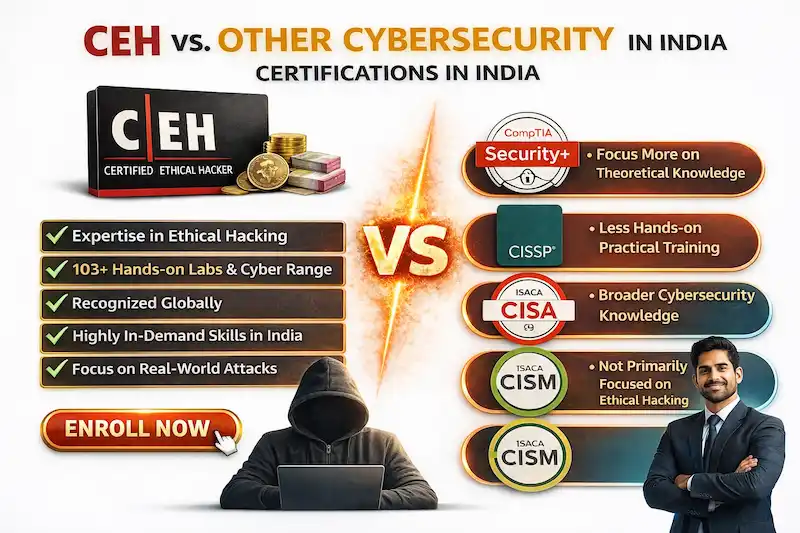
The CEH is still the most frequently accepted certificate for generalist "Ethical Hacker" and "Security Analyst" positions in India's enormous IT services industry, even though certifications like Security+ are preferable for complete beginners, and OSCP is favored for intensive penetration testing.
Challenges Faced by CEHs in the Indian Job Market
|
S.No. |
Challenges |
What? |
|
1. |
The "Experience Paradox" for Freshers |
Even though there is a huge talent deficit, 90% of hiring managers in India still require prior IT expertise, which makes it challenging for new CEHs to get their first "Junior Pentester" position without first working in networking or general IT support. |
|
2. |
AI-Driven "Upskilling" Pressure |
It will no longer be sufficient to have a basic CEH. Candidates who can handle AI-automated pentesting agents are now given preference by recruiters; those who haven't mastered "AI-Augmented Hacking" (from the new CEH v13) are frequently passed over. |
|
3. |
Long Recruitment Cycles |
In India, hiring for security positions is infamously delayed. Due to stringent background checks and multi-stage technical "live-fire" laboratories, it typically takes three to six months to fill a single cybersecurity position. |
|
4. |
Salary Stagnation in Mid-Sized Firms |
While multinational corporations (MNCs) pay expensive premiums, many Indian startups and mid-sized businesses struggle with tight security budgets and frequently give salaries that don't match the demanding and round-the-clock nature of the work. |
|
5. |
The "Tool-Knowledge" Gap |
A large number of CEH candidates from India are "tool-literate" but "concept-poor." Employers claim that although applicants are capable of running a scan (such as Nmap), they find it difficult to decipher the raw packets or communicate the business risk to stakeholders who are not technical. |
|
6. |
High Burnout and Workplace Stress |
Due to the complicated threat landscape and underfunded teams (40% of Indian security teams are now understaffed), nearly 60% of Indian cyber professionals report increasing stress levels in 2026. |
|
7. |
Regulatory Complexity (DPDP Act) |
With the full implementation of India's Digital Personal Data Protection (DPDP) Act, CEHs are now required to possess legal and compliance expertise, making their employment more about "paperwork and policy" than "breaking systems." |
|
8. |
"Signal Loss" in AI Resumes |
Human recruiters in India are increasingly rejecting certifications alone and requiring a demonstrated portfolio (such as Bug Bounty rankings or GitHub projects) because 79% of job hopefuls now use AI to enhance their CVs. |
|
9. |
Regional Concentration |
The majority of well-paying CEH positions are restricted to Tier-1 hubs (Bangalore, Delhi-NCR, Hyderabad). Since the "fully remote" trend has somewhat reversed in 2026, professionals in other cities will either have to migrate or receive much lower pay. |
|
10. |
Rapid Skill Obsolescence |
In 2026, technological skills will have a shelf life of less than 18 months. CEHs that don't participate in ongoing "micro-learning" find that their understanding of cloud-native and IoT risks quickly becomes obsolete. |
Salary Expectations for CEHs in India: What You Can Earn?
In India, the pay for a Certified Ethical Hacker is very competitive; entry-level new hires usually make between ₹4.5 and ₹8 LPA, while mid-to-senior professionals can fetch between ₹15 and over ₹40 LPA.
The candidate's location and level of expertise with AI-driven hacking tools have a significant impact on this pay range; tech hotspots like Bangalore and Hyderabad give a 20–30% premium above the national average.
Job Opportunities for Certified Ethical Hackers in India
|
S.No. |
Job Profiles |
What? |
|
1. |
AI Security Specialist |
CEHs are used by Indian businesses to perform "adversarial testing" on autonomous AI agents to make sure they can't be controlled via quick injection or data poisoning. |
|
2. |
Cloud Security Engineer (AWS/ Azure/ GCP) |
CEHs concentrate on identifying misconfigurations and safeguarding serverless architectures for software behemoths like TCS, Infosys, and Wipro, since 60% of Indian workloads are currently on the cloud. |
|
3. |
BFSI Vulnerability Analyst |
CEHs are employed by banks (SBI, HDFC, ICICI) and fintech companies (Paytm, PhonePe) to safeguard digital payment gateways and shield private client information from frequent fraud attempts. |
|
4. |
Red Team Operator |
CEHs undertake full-scope simulated attacks on an organization's personnel, hardware, and software in advanced roles at boutique security businesses like Qualysec or Varutra. |
|
5. |
Government & Defense Researcher |
High-stakes positions in organizations like the CBI, DRDO, or CERT-In, where CEHs carry out digital forensic investigations and assist in safeguarding vital national infrastructure. |
|
6. |
Application Security (AppSec) Engineer |
CEHs are employed by DevSecOps teams to do both automated and manual code evaluations, guaranteeing the security of mobile and web applications before their launch. |
|
7. |
Industrial SOC Analyst (OT/ IoT) |
CEHs are required to monitor and protect Operational Technology (OT) and IoT sensors in manufacturing facilities and power grids due to the emergence of "Smart Cities" in India. |
|
8. |
Data Privacy & Compliance Auditor |
CEHs assist businesses in ensuring that their technological security measures comply with the legal standards for personal data protection, which are motivated by the implementation of India's DPDP Act (2023/2025). |
|
9. |
Incident Responder |
CEHs work in fast-paced positions as "digital firefighters," spearheading forensic analysis and technical recovery following a ransomware attack or security breach. |
|
10. |
Cybersecurity Trainer & Mentor |
Experienced CEHs are in great demand at organizations like Craw Security or ISOEH to train the future generation of hackers, as the talent gap in India surpasses one million unfilled positions. |
Conclusion: Is CEH Certification Worth it in India?
Now that we have talked about the Certified Ethical Hacker, you might want to pursue a Cybersecurity career in India under the guidance of experts. For that, you can get in contact with Craw Security, offering the CEH v13 AI Course in Delhi to IT Aspirants.
During the training, students will be able to meet Cybersecurity professionals in India working for years in the IT industry and will be supervising students. Moreover, online sessions will facilitate students in remote learning.
After the completion of the Training in CEH v13 AI Certification offered by Craw Security, students will receive a certificate validating their honed knowledge & skills during the sessions. What are you waiting for? Contact, Now!
Frequently Asked Questions
About Certified Ethical Hacker
- Is CEH worth it in India?
Yes, the CEH is very worthwhile in India for 2026 since it serves as a required HR filter for large IT companies like TCS and Infosys. In particular, the latest CEH v13 (AI-Powered) version offers a 20–30% salary premium in hubs like Bangalore and Hyderabad.
- What is the salary of a CEH in India?
In India, the typical wage for a Certified Ethical Hacker (CEH) is between ₹4.5 and ₹12 LPA for professionals in their early to mid-career, while senior specialists with specific AI-security expertise can fetch as much as ₹25 to ₹40 LPA.
- Is CEH easy to pass?
The CEH v13 AI is regarded as "moderately difficult" to pass; although it is much simpler than the 24-hour practical OSCP, it necessitates a thorough understanding of more than 20 domains and 500 tools, making it challenging for people without a basic understanding of networking or practical lab experience.
- What is the salary of an ethical hacker in TCS?
In India, entry-level positions (such as SOC or Vulnerability Analyst) at TCS typically pay between ₹4 LPA and ₹8 LPA for ethical hackers, while more seasoned workers with CEH or OSCP certificates may make between ₹10 LPA and ₹22 LPA, depending on their region and level of skill.
- Can I get a job after CEH?
Yes, obtaining your CEH is a necessity for entry-level and mid-level cybersecurity positions in major Indian IT companies like TCS, Wipro, and Infosys.
- Is Becoming a CEH in India a Good Career Move?
A 3.5 million employment deficit worldwide and India's new data protection legislation (DPDP Act) have made certified ethical hackers among the most sought-after and well-paid IT workers in the nation, making being a CEH in 2026 a remarkable career move.
- Will AI replace hackers?
No, AI won't take the position of hackers in 2026; rather, it will change the function from manual execution to high-level orchestration, where human creativity and moral judgment are needed to manage "Agentic AI," which can automate up to 30–40% of typical security operations.
- How many attempts for CEH?
Up to five attempts are permitted during a 12-month period; if you fail the first time, you can repeat it right away, but after the fifth failure, there is a 14-day "cooling period" before a 12-month delay.
- Is 25 too late for cybersecurity?
No, 25 is actually the best age to start. In 2026, many of the most successful "hybrid" professionals are career-switchers in their late 20s and 30s who mix new technical abilities with previous work experience to fill India's more than one million cybersecurity job openings.
- Does CEH require coding?
No, coding is not necessary to pass the CEH exam because its main focus is on using pre-built tools and comprehending security procedures. However, for real-world applications and automating activities in the most recent CEH v13 AI labs, a basic familiarity with Python, Bash, and SQL is strongly advised.
- Is an ethical hacker stressful?
Because of the constant nature of cyber threats, the unrelenting speed of AI-powered attacks, and the enormous responsibility of safeguarding an organization's vital data and reputation, ethical hacking is seen as a high-stress, high-stakes job.
- How Long Does it Take to Become a Certified Ethical Hacker in India?
A candidate with a rudimentary understanding of IT may usually pass the CEH v13 test in one to three months, while a total novice in India should budget six months to become proficient in networking, Linux, and AI-security.
Want to build a career in cyber security?
Talk to our counsellors about courses, batches and fees. Free demo class available.


