

Do you know how huge the demand for Cisco Certified Network Associate is in the IT Industry? If not, then you really need to know about it for future gains. Here, we will talk about the skills they have that organizations globally need the most.
Moreover, we will introduce you to a reputed training institute offering a dedicated training program related to CCNA skills. What are we waiting for? Let’s get started!
What is CCNA?
Cisco Certified Network Associate, or CCNA, is an internationally recognized associate-level certification that attests to a professional's fundamental understanding of networking principles. It covers a wide range of IT fundamentals, such as IP connection, security principles, and automation, with a particular emphasis on the installation, configuration, and troubleshooting of medium-sized routed and switched networks.
Obtaining this certification from Cisco Systems is frequently seen as an essential first step for individuals seeking employment as network engineers, administrators, or systems professionals because it is a benchmark in the industry. Let’s explore what a Cisco Certified Network Associate is and how you can become one!
Key Skills You Will Learn in CCNA
|
S.No. |
Skills |
What? |
|
1. |
Network Fundamentals |
Knowing the OSI and TCP/IP models, switches, and routers. |
|
2. |
IP Addressing & Subnetting |
Learning IPv4 and IPv6 addressing, including subnetting—the effective division of networks. |
|
3. |
Routing & Switching |
Managing data flow by setting up and confirming VLANs, trunks, and inter-VLAN routing. |
|
4. |
IP Connectivity |
Configuring and debugging static and dynamic routing protocols, such as OSPFv2. |
|
5. |
IP Services |
Setting up DNS, DHCP, NAT, and NTP, among other crucial network services. |
|
6. |
Security Fundamentals |
Putting security features like WPA3 wireless security, port security, and access control lists (ACLs) into practice. |
|
7. |
Automation & Programmability |
Learning how to automate processes in modern networks using controllers (like Cisco DNA Center), Python, and APIs. |
|
8. |
Wireless Networking |
Setting up wireless local area networks (WLANs) and controlling access points. |
|
9. |
Network Troubleshooting |
Utilizing Telnet/SSH, Traceroute, and Ping to identify and resolve connectivity problems. |
|
10. |
Virtualization |
Knowing the fundamentals of containers, virtual machines, and software-defined networking (SDN). |
Why You Should Consider CCNA Certification?
You should consider the CCNA certification for the following reasons:
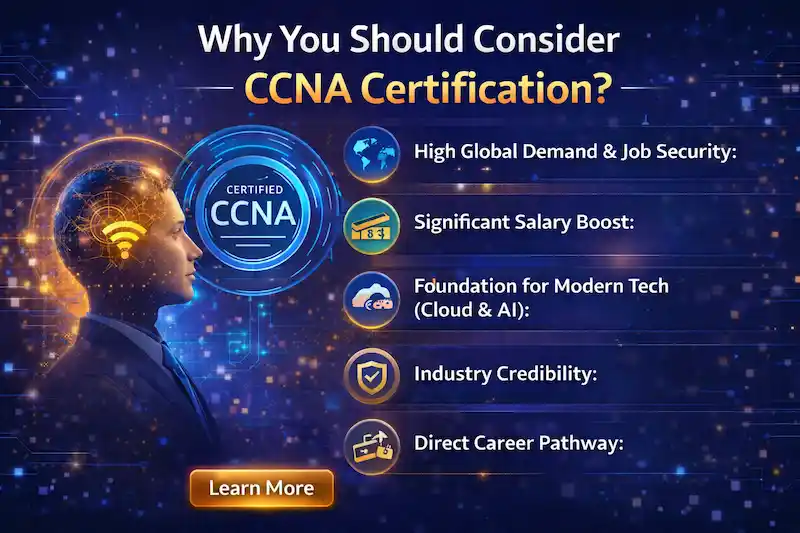
- High Global Demand & Job Security: To manage the networking infrastructure that fuels contemporary business, organizations around the world need qualified people.
- Significant Salary Boost: The typical salary in India is between ₹6 and ₹21 lakhs, depending on experience, and certified workers frequently make 20–30% more than their non-certified counterparts.
- Foundation for Modern Tech (Cloud & AI): The fundamental IP and routing skills needed to succeed in cutting-edge domains like AWS/Azure Cloud and AI-driven networking are provided by CCNA.
- Industry Credibility: As a Cisco-backed certificate, it acts as a "gold standard" that gives hiring employers rapid confirmation of your technical proficiency.
- Direct Career Pathway: High-level positions and advanced certifications like CCNP (Professional) and CCIE (Expert) require it.
CCNA troubleshooting skills
|
S.No. |
Skills |
What? |
|
1. |
Structured Methodologies |
Applying formal methods such as Divide and Conquer (beginning at the Network layer), Bottom-Up (examining physical cables first), or Top-Down (beginning at the Application layer). |
|
2. |
OSI Model Layer Isolation |
Determining the layer to which an issue belongs, such as realizing that an interface's "Protocol Down" state frequently denotes a Layer 2 (Data Link) mismatch. |
|
3. |
Connectivity Testing |
Learning the subtleties of Traceroute (path discovery) and Ping (ICMP reachability) to determine the precise location of a packet's drop. |
|
4. |
Interface Analysis |
Error counts, such as Runts, Giants, and CRC errors, which indicate defective cabling or duplex incompatibilities, can be interpreted using display interfaces. |
|
5. |
Routing Table Verification |
To find missing "Next Hop" entries or inaccurate Administrative Distance values that result in traffic taking less-than-ideal routes, use the show ip route command. |
|
6. |
VLAN & Trunking Diagnostics |
Checking the Native VLAN matches and permitted VLAN lists on trunk ports might help troubleshoot why devices in the same VLAN are unable to interact. |
|
7. |
OSPF Adjacency Troubleshooting |
Identifying the cause of routers' inability to establish neighbor associations by looking for mismatched Area IDs, MTU sizes, or Timers (Hello/Dead). |
|
8. |
IP Service Resolution |
Resolving DNS (resolution timeouts) and DHCP (exhausted pools or relay agent failures) problems that impede internet connectivity. |
|
9. |
ACL & Security Auditing |
Examining access control lists to make sure they aren't inadvertently obstructing authorized traffic (the "Implicit Deny" trap). |
|
10. |
LLDP/ CDP Discovery |
When physical access or documentation is lacking, you can map out a network using neighbor discovery methods to determine where a certain device is plugged in. |
The Path to CCNA: Steps to Follow
Following is the path to CCNA:
● Understand the Exam Blueprint: Examine the official Cisco 200-301 domains, paying particular attention to the most recent developments such as Automation, Cloud Management, and Generative AI.
● Choose Your Study Resources: Use a combination of the Cisco Learning Network, video courses (such as Jeremy's IT Lab), and Wendell Odom's Official Cert Guide (OCG).
● Set Up a Virtual Lab: To emulate real-world hardware, download Cisco Packet Tracer for simple labs or use GNS3/CML for more complex topologies.
● Master Subnetting: Exam speed is critical, so practice until you can mentally compute IPv4 and IPv6 addresses and masks.
● Consistent Hands-on Practice: To develop "muscle memory" for CLI commands, devote at least 30% of your time to setting switches and routers.
● Take Practice Exams: To find your weak points and prepare for the strain of a 120-minute exam, use top-notch simulators like Boson ExSim.
● Register via Pearson VUE: Make an appointment for your exam (which currently costs $300 USD) at a testing facility or through an online proctored session.
● Maintain Your Certification: Recertify every three years by obtaining thirty Continuing Education (CE) credits or passing a higher-level test (such as the CCNP).
Best Resources to Study for the CCNA Exam
|
S.No. |
Resources |
What? |
|
1. |
Official Cert Guide (OCG) Library |
Wendell Odom's "gold standard" was revised in late 2024 (2nd Edition) to incorporate new v1.1 subjects, including cloud management and generative artificial intelligence. |
|
2. |
Jeremy’s IT Lab (YouTube/ Udemy) |
Often regarded as the greatest free all-inclusive video course, it includes excellent lectures, daily flashcards, and lab files. |
|
3. |
Cisco Packet Tracer |
Free network simulation requires the most recent Version 9.0, which was published in late 2025 and now includes improved IoT and industrial security features. |
|
4. |
Boson ExSim-Max |
The most realistic practice test accessible, its questions are frequently more difficult than the real test, so you are well-prepared for the logic of the test. |
|
5. |
Cisco Learning Network (CLN) |
An official community center for webinars, study groups, and "Cisco U" services that provide the most recent learning routes and exam warnings. |
CCNA Exam Structure: What to Expect?
The 120-minute CCNA 200-301 (v1.1) exam consists of about 100–120 questions that examine a combination of practical technical skills and theoretical knowledge. You will be required to configure or troubleshoot live network devices in a simulated environment in a variety of question formats, such as multiple-choice, drag-and-drop, and performance-based labs.
Common Mistakes to Avoid While Preparing for CCNA
|
S.No. |
Mistakes |
What? |
|
1. |
Rote Memorization Over Understanding |
When Cisco poses scenario-based questions that require you to analyze network behavior, memorization of commands or responses is ineffective. |
|
2. |
Skipping the Exam Blueprint |
Many fail because they disregard the specified weights; it is disastrous to concentrate only on routing while ignoring the 20% on Network Access (VLANs/STP). |
|
3. |
Neglecting Hands-on Lab Practice |
In performance-based laboratories, which can make up as much as 20% of your final grade, theoretical knowledge won't help you. |
|
4. |
Relying on a Single Study Source |
Use a "primary" resource (like the OCG) and a "secondary" resource (like Jeremy's IT Lab) to fill in the gaps because no single book or movie can cover everything. |
|
5. |
Underestimating Subnetting Speed |
For complicated labs, you must "bank" time by solving subnetting problems in less than 45 seconds; you will run out of time if you have to create a chart for each question. |
|
6. |
Using Outdated Study Materials |
Make sure your materials address the v1.1 updates, particularly the new subjects like Terraform, Machine Learning, and Generative AI. |
|
7. |
Ignoring the "Boring" Topics |
Automation, SNMP, and Syslog are examples of "soft" topics that candidates frequently overlook; nonetheless, they are simple topics that can make the difference between passing and failing. |
|
8. |
Falling for "Exam Dumps" |
Because Cisco regularly rotates its bank, relying on leaked questions is dangerous, and being detected could result in a lifelong suspension from any Cisco certifications. |
|
9. |
Poor Time Management |
Candidates frequently speed through the final 20 questions, making basic errors, after devoting more than ten minutes to a single challenging topic. |
|
10. |
Not Reviewing Mistaken Answers |
It is insufficient to only take practice exams; you need to devote twice as much time to figuring out why you answered a question incorrectly in order to correct the underlying reasoning. |
How to Stay Motivated During Your CCNA Studies?
You can stay motivated during your CCNA studies in the following ways:
a) Book Your Exam Early: By setting a "hard deadline" three months ahead of time, you may prevent endless procrastination and create positive pressure.
b) Use the "One Chapter, One Lab" Rule: Applying theories in a lab right away can increase dopamine; completing a complete configuration gives you a sense of daily success.
c) Leverage Spaced Repetition (Anki): To avoid "information overload" and memory loss, learn dry facts in 15-minute daily bursts using prepackaged flashcards (such as Jeremy's IT Lab deck).
d) Join a Community (Reddit/ Discord): Participating in the Cisco Learning Network or the r/CCNA subreddit offers accountability and a secure space to ask questions when you're having trouble.
e) Focus on the "Why" (The Career Shift): Remember that CCNA is a "superpower" that opens doors to a 20–30% pay boost and forms the basis for networking positions in cloud and artificial intelligence.
Career Opportunities After CCNA Certification
|
S.No. |
Job Profiles |
What? |
|
1. |
Network Engineer |
Designing, implementing, and maintaining the physical and virtual gear that makes up an organization's network is the most direct route. |
|
2. |
Network Administrator |
Focuses on maintaining regular uptime, controlling user access, installing updates, and maintaining the "health" of the network on a daily basis. |
|
3. |
Network Support Engineer (L1/ L2) |
Frequently an entry-level position in which you serve as the initial responder for connectivity problems and technical failures. |
|
4. |
NOC Engineer (Network Operations Center) |
Large-scale infrastructure must be continuously monitored, alerts must be responded to, and field teams must be coordinated. |
|
5. |
Systems Administrator |
Although it goes beyond networking, this position necessitates CCNA expertise to oversee server and storage system communication via the corporate backbone. |
|
6. |
Network Security Specialist |
Implements firewalls, VPNs, and Access Control Lists (ACLs) using CCNA principles to safeguard data from online dangers. |
|
7. |
Wireless Network Engineer |
Focuses on creating and improving radio frequency (RF) and Wi-Fi networks, which are becoming more and more crucial for "smart office" settings. |
|
8. |
Technical Support Engineer |
Provides advanced troubleshooting and assistance for customers utilizing networking products on behalf of suppliers (such as Cisco, Dell, or HP). |
|
9. |
NetDevOps Engineer |
A contemporary hybrid position where you automate tedious network configuration and management activities using Python and APIs (acquired in CCNA). |
|
10. |
Cloud Support Engineer |
Manages "Virtual Private Clouds" and hybrid connections, bridging the gap between on-premise hardware and cloud providers like AWS or Azure. |
Frequently Asked Questions
About Cisco Certified Network Associate
- How do I get a Cisco Certified Network Associate CCNA?
For that, you can get in contact with Craw Security, offering the CCNA Training in Delhi 200-301 under the supervision of professionals.
- How can I study myself for the CCNA?
In the following ways, you can study for the CCNA:
a) Follow a Structured Video Course,
b) Use the "Golden Pair" of Resources,
c) Lab Every Single Day,
d) Master Spaced Repetition (Anki), and
e) Validate with Realistic Practice Exams.
- Can I complete CCNA in 3 months?
Yes, you may finish the CCNA in three months if you dedicate two to three hours a day during the week and four to five hours on the weekends, concentrating on a methodical combination of theory and practical lab work.
- Can I get CCNA for free?
Although free training is available, the official Cisco CCNA exam credential now costs about $300 USD (plus taxes) in India.
- Is CCNA very difficult?
Because it necessitates a transition from mere memorization to a thorough, practical understanding of how data travels over a network, the CCNA is regarded as moderately challenging.
- How many attempts to pass the CCNA?
Although there is no formal cap on the number of attempts, most successful candidates use realistic practice tests prior to their first official sitting and pass within one to two attempts.
- What is the salary after passing CCNA?
The average beginning wage for a CCNA-certified professional in India is between ₹3.5 lakhs and ₹6 lakhs annually, depending on the city and skill level.
- Who is eligible for CCNA?
Anyone interested in networking, from students to career changers, can take the CCNA exam because there are no official educational or professional requirements.
Conclusion
Now that we have talked about Cisco Certified Network Associate, you might want to get the Best CCNA resources to develop such skills professionally. For that, you can get in contact with Craw Security, offering the Best CISCO CCNA Course in Delhi to IT Aspirants.
During the training sessions, students will be able to get the facility of CCNA hands-on labs under the supervision of CCNA professionals. Moreover, online sessions will facilitate students' remote learning.
After the completion of the CCNA Training in Delhi 200-301 offered by Craw Security, students will receive a Cisco networking certification validating their honed knowledge & skills during the sessions. What are you waiting for? Contact, Now!
Want to build a career in cyber security?
Talk to our counsellors about courses, batches and fees. Free demo class available.


