

Introduction
The security of sensitive data and information is a major concern for both individuals and businesses in this technologically advanced era. Given the increasing frequency of cyber attacks and data breaches, robust security measures must be implemented to safeguard sensitive data. This blog post will provide you with helpful information and guidance on how to properly safeguard sensitive data and information. Whether you're a business attempting to protect your clients' information or an individual concerned about your own data, these strategies will help you stay one step ahead of any security threats.
Your Future Starts Here – Reserve Your FREE Demo Class Now!
Understanding the Importance of Data Security
Prior to investigating the many ways to safeguard sensitive data and information, it is essential to comprehend the significance of data security. Serious consequences, such as monetary losses and damage to one's reputation, can result from security breaches.

Because hackers are always developing new methods to obtain sensitive information without consent, it is imperative that both individuals and organizations take precautionary measures to protect their personal data.
Common Security Risks
Protecting sensitive data and information requires an understanding of the common security threats. By identifying these risks, it is possible to successfully implement the required safeguards to reduce potential dangers. The following are some significant security risks:
|
Phishing Attacks |
Phishing attacks involve posing as reputable organizations in order to trick victims into disclosing private information. |
|
Malware |
Malicious software, including viruses, worms, and ransomware, can enter systems and compromise data security. |
|
Weak Passwords |
Passwords that are easy to figure out or weak provide an easy point of access for hackers. |
|
Unsecured Wi-Fi Networks |
Confidential information is at risk of being intercepted and eavesdropped on when using unencrypted Wi-Fi networks. |
|
Social Engineering |
Social engineering techniques deceive people into divulging personal information by using psychological ploys. |
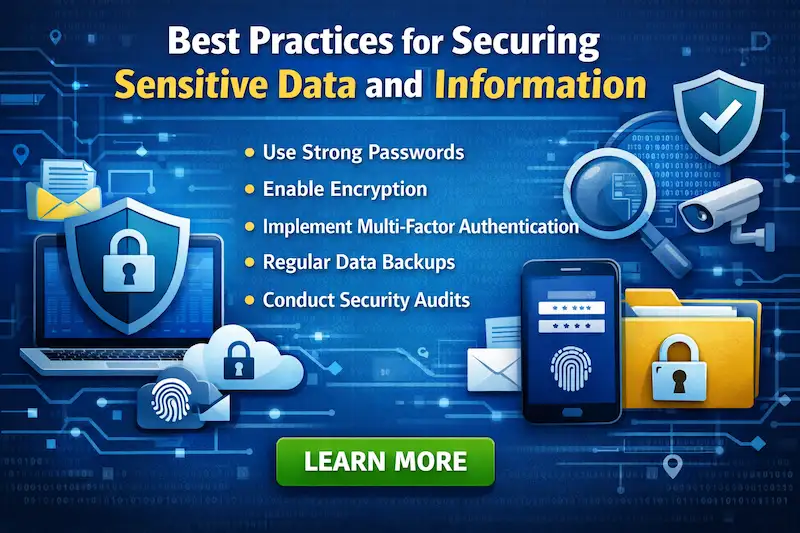
Best Practices for Securing Sensitive Data and Information
Now that we understand the importance of data security and the common hazards involved, let's look at some best practices for safeguarding sensitive data and information:
 ed access to your info, they won't be able to comprehend it.
2. Implement Strong Authentication Measures
Strict authentication processes are used to further secure the data you submit. Consider implementing multi-factor authentication (MFA) whenever you can. When utilizing MFA, users are required to provide two or more kinds of authentication, such as a password and a one-time code texted to their mobile devices. This significantly reduces the likelihood of illegal entry.
3. Regularly Update Software and Systems
Maintaining up-to-date software and systems is crucial for data security. Software updates often include patches and fixes, making it harder for hackers to exploit security weaknesses that have been found. To ensure that you don't overlook any important security updates, set up automated updates whenever possible.
4. Train Employees on Security Awareness
Because they are crucial to maintaining data security, employees should receive sufficient training on security awareness. Teach your staff the importance of creating strong passwords, how to recognize phishing scams, and how to browse securely. Organize regular training sessions to keep them up to date on the most recent security protocols.
5. Backup Your Data Regularly
You must regularly back up your data to ensure that you can recover it in the case of a security incident or data loss. Choose a reliable backup solution and set up automated backups to reduce the risk of data loss.
6. Restrict Access to Sensitive Data
Not every employee in a corporation requires access to private data. Implement role-based access control to ensure that only authorized individuals may work on certain files and documents, preventing anyone from doing anything on their own initiative that can have unintended consequences down the road.
7. Secure Your Network
Protecting sensitive data requires maintaining the security of your computer network. Use firewalls, intrusion detection systems (IDS), and intrusion prevention systems (IPS) to monitor and manage incoming and outgoing network traffic. Use secure Wi-Fi protocols, such as WPA2, and often update router firmware to prevent unauthorized access.
8. Regularly Monitor and Audit Systems
If security issues are to be promptly detected and resolved, system auditing and monitoring must be continuous. To monitor system events, network traffic, and user activity, make use of recording and tracking tools. Regularly review and scrutinize these logs to search for any illegal or dubious activities.
9. Use Secure Communication Channels
When communicating sensitive information, always use secure methods. Use the Transport Layer Security (TLS) or Secure Sockets Layer (SSL) protocols to encrypt data while it is being sent. It is best to avoid sending private information via email or other unsafe channels.
10. Secure Physical Access
Physical security is equally important for protecting sensitive data, even if it is occasionally ignored. Control direct communication with servers, data centers, and other places where sensitive information is kept. Install safety measures, such as biometric verification, access cards, and surveillance systems, to stop unauthorized entry.
11. Employ Data Loss Prevention (DLP) Solutions
Resolutions for Data Loss Prevention (DLP) may help stop the loss or illegal disclosure of private information. These tools monitor and control the use, storage, and transmission of data. They can detect and prevent data breaches by adhering to security protocols and encrypting vital information.
12. Regularly Assess and Update Security Measures
It is crucial to regularly review and update your security procedures because protecting information is a continuous process. Conduct routine security audits to identify vulnerabilities and promptly address them. Keep up with the latest security trends, technologies, and best practices under the close supervision of excellent penetration testers to ensure that your safety measures remain effective.
13. Implement an Incident Response Plan
Even with your best efforts, security problems could still arise. An incident response strategy must be in place in order to mitigate the impact of such occurrences. The strategy should specify what should be done in the event of a security or data breach, including recovery procedures, containment methods, and notification routes.
14. Conduct Regular Security Awareness Training
Security awareness training is crucial for keeping employees informed about evolving security threats. Organize regular training sessions to encourage good safety practices, such as identifying phishing emails, selecting strong passwords, and reporting suspicious activities. Encourage a security-conscious culture inside the organization and raise staff awareness.
15. Secure Third-Party Vendors and Partners
If you work with third-party vendors or collaborators that have access to sensitive and confidential information, be sure they adhere to stringent security protocols. Before engaging with vendors, perform your research by reviewing their background, credentials, and security policies. Clearly state contractual requirements for data security and make sure they are being fulfilled on a regular basis.
FAQs
About How Can I Secure Sensitive Data and Information?
Q. 1: How can I secure sensitive data on my mobile device?
Securing private data on your mobile device is crucial to protecting your privacy and preventing illegal access. By taking three vital actions, you may strengthen the security of important data on your mobile device:
● Use a Strong Device Lock,
● Enable Full Device Encryption,
● Keep Your Operating System and Apps Updated,
● Use Trusted Apps,
● Utilize App Permissions,
● Secure Wireless Connections,
● Enable Remote Tracking and Wiping,
● Be Cautious with Personal Information,
● Use Secure Messaging and Communication Apps,
● Regularly Back Up Your Data,
● Install and Update Security Software, and many more.
Q. 2: What should I do if I suspect a data breach has occurred?
If you suspect or discover that your data has been compromised, you must take immediate action to stop more damage and protect your personal information. In that scenario, you can take quick action and adhere to the best practices listed below to prevent the greatest amount of harm:
● Confirm the Breach,
● Secure Your Systems,
● Assess the Scope and Impact,
● Notify Relevant Parties,
● Change Passwords and Credentials,
● Monitor Accounts and Statements,
● Inform Credit Reporting Agencies,
● Seek Professional Assistance, like Craw Security,
● Learn from the Incident,
● Stay Informed, etc.
Q. 3: Are cloud-based storage solutions secure for storing sensitive data?
Cloud-based storage solutions can be safe for storing sensitive data if the right security measures are implemented. However, when evaluating the security of cloud-based storage, the following factors should be considered:
● Data Encryption,
● Access Controls,
● Physical Security,
● Data Redundancy and Backup,
● Compliance and Certifications,
● Data Privacy,
● Security Audits and Vulnerability Management,
● Service Level Agreements (SLAs),
● User Education and Awareness, etc.
Q. 4: How often should I update my security measures?
The threat landscape's continuous evolution, the sensitive nature of your systems and data, and security experts' guidelines will all affect how frequently you should update your security measures.
While there isn't a method that works for everyone, you can take your own time period that you arrange for a continual assessment of your security posture within an IT environment.
Q. 5: How can I protect sensitive data when sharing it with others?
Adopting security measures is essential to protecting data confidentiality, privacy, and integrity while sharing sensitive information with third parties. The following are some strategies to consider:
● Encrypt the Data,
● Secure File Transfer,
● Implement Access Controls,
● Use Time-Limited Access,
● Educate Recipients,
● Password Protection and Encryption for Documents,
● Verify Recipient Identities,
● Use Secure Collaboration Tools,
● Maintain Data Minimization,
● Secure Communication Channels,
● Regularly Review and Remove Access, etc.
Q. 6: What is the role of employee training in data security?
Data security requires employee education. This encourages the growth of a workforce that cares about security, understands the importance of protecting sensitive data, and possesses the knowledge and abilities necessary to improve the company's overall safety record.
Conclusion
To wrap up, we would like to state that protecting sensitive data and information from the prying eyes of hostile intruders is vital. Additionally, it is the duty of every person or organization to protect their extremely sensitive data from unwanted access. If so, you can contact Craw Security, the best VAPT services provider in India, which offers top-notch VAPT solutions under the direct supervision of highly qualified penetration testers with over 12 years of quality experience.
penetration testers with more than 12 years of quality expertise.
Your Future Starts Here – Reserve Your FREE Demo Class Now!


