

In this article
- What is Ethical Hacking?
- Importance of Ethical Hacking
- Legal Frameworks for Ethical Hackers
- Key Legal Boundaries for Ethical Hackers
- Global Ethical Hacking Laws
- Consequences of Illegal Hacking Practices
- How to Stay Within Legal Boundaries as an Ethical Hacker?
- Frequently Asked Questions
- Conclusion: Navigating the Legal Terrain of Ethical Hacking
Let’s find out what Ethical Hacking is and see how it can be beneficial for organizations to get aware of laws and legal boundaries! Organizations working in the IT Industry are bound by laws to work smoothly & freely professionally.
In the end, we will introduce you to a reputed training institute offering a dedicated training program related to ethical hacking skills. What are we waiting for? Let’s get straight to the topic!
What is Ethical Hacking?
In an authorized, proactive security assessment known as "ethical hacking," experts (white-hat hackers) employ the same instruments and methods as malevolent attackers to identify and take advantage of weaknesses in systems, networks, or applications.
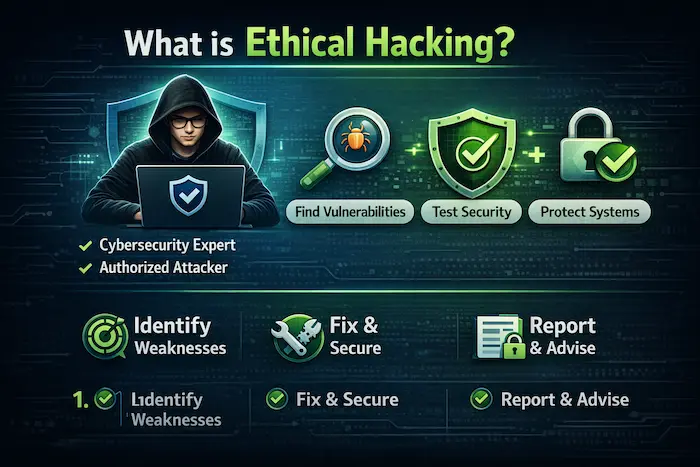
Finding security flaws and possible attack routes before cybercriminals can take advantage of them is the main objective. At the end of the process, the organization receives prioritized recommendations and actionable reports to improve its overall defensive posture.
Let’s take a look at what Ethical Hacking is and its capabilities in the IT Industry for the security of privacy!
Importance of Ethical Hacking
|
S.No. |
Factors |
Why? |
|
1. |
Proactive Vulnerability Identification |
Before malevolent attackers can identify and take advantage of them, it finds and demonstrates exploitable security holes in networks, systems, and applications. |
|
2. |
Cost-Effective Risk Mitigation |
Ethical hacking is a cost-effective strategy that, over time, saves substantial financial and legal penalties by preventing data breaches, which are exceedingly expensive in terms of fines and recovery. |
|
3. |
Strengthens Security Posture |
In order to create a more robust and resilient security architecture, it offers clear, prioritized recommendations and exposes chained attack vectors that go over layered protections. |
|
4. |
Ensures Regulatory Compliance |
It assists companies in complying with strict industry and governmental laws (such as PCI DSS, GDPR, and HIPAA) that require frequent penetration tests and security assessments. |
|
5. |
Raises Security Awareness |
Phishing simulations and other social engineering exercises highlight the human element, necessitating improved employee training and strengthening the security-conscious culture. |
|
6. |
Validates Incident Response |
The internal security team's capacity to identify, stop, and react to a sophisticated attack in a real-time, controlled setting is tested through red teaming exercises. |
|
7. |
Builds Stakeholder Trust |
Investing in ethical hacking shows a strong dedication to data security, boosting stakeholders' and partners' trust in the organization's security. |
Legal Frameworks for Ethical Hackers
The following are some legal frameworks for ethical hackers:

- Explicit Authorization (The Cornerstone): The organization's top authority must sign a legally binding Rules of Engagement agreement before any action is conducted.
- Computer Misuse Laws (e.g., US CFAA): To avoid being prosecuted for unauthorized access or damage under national computer crime laws, ethical hackers must make sure their simulated operations do not go beyond the parameters of authority.
- Data Protection and Privacy Laws (GDPR, HIPAA): Sensitive data and Personally Identifiable Information (PII) must be handled with the highest security, according to privacy laws for confidentiality and retention.
- Third-Party Consent: Explicit written consent from third parties (such as cloud providers or vendors) is also required if the testing involves or affects their services.
- Responsible Disclosure Policies: Hackers must adhere to the principle of not disclosing zero-day vulnerabilities or defects in commercial software before the vendor has had time to create and deploy a patch.
- Contractual Non-Disclosure Agreements (NDAs): Signed NDAs legally prohibit ethical hackers and companies from disclosing any customer data, research, or techniques to unapproved outside parties.
- No Harm Principle: The testing must be done with the goal of preventing any major operational disruption, data loss, or physical harm to the client's production systems.
Key Legal Boundaries for Ethical Hackers
|
S.No. |
Factors |
What? |
|
1. |
Written Authorization (Rules of Engagement) |
Legally, conducting simulated attacks requires a signed Rules of Engagement contract. |
|
2. |
Adherence to Defined Scope |
To avoid breaking the law, the hacker must tightly restrict all activity to the particular systems, IP ranges, and techniques specified in the contract. |
|
3. |
Computer Misuse and Fraud Laws (e.g., CFAA) |
To avoid breaking national laws against unauthorized computer access, ethical hackers must make sure their access stays within the parameters of the signed authorization. |
|
4. |
Data Protection and Privacy Laws (e.g., GDPR, HIPAA) |
In order to fully comply with applicable data privacy rules, any sensitive data (PII, PHI) that is found must be handled and reported with the utmost care. |
|
5. |
Third-Party Consent |
If the scope includes systems or services hosted or maintained by other vendors or service providers, permission must be obtained from them (e.g., public cloud infrastructure). |
|
6. |
Non-Harm Principle |
Unless specifically permitted during low-risk times, all testing must be done with the intention of preventing any physical harm, data corruption, or denial of service. |
|
7. |
Confidentiality and NDAs |
Non-Disclosure Agreements (NDAs) mandate that ethical hackers never divulge customer information, security discoveries, or sensitive material to unapproved third parties. |
Global Ethical Hacking Laws
The following are the global ethical hacking laws:
● Cybercrime Statutes (e.g., US CFAA, UK CMA): In order to avoid being prosecuted for computer misuse, ethical hackers must always operate with express, written agreement because these national laws make unauthorized access illegal.
● Data Protection Laws (e.g., EU GDPR, US HIPAA): In order to ensure confidentiality and minimal harm to private information, these regulations prescribe stringent criteria for the treatment, protection, and reporting of uncovered personal data (PII/PHI).
● Vulnerability Disclosure Legislation (Evolving): "Safe Harbor" clauses, which safeguard good-faith security researchers who adhere to established guidelines for reporting vulnerabilities, are now found in many jurisdictions and business policies.
● Sector-Specific Compliance (e.g., PCI DSS): Organizations in regulated industries, like as the credit card business, must use ethical hacking to demonstrate the efficacy of ongoing security measures.
● National IT and Security Acts (e.g., India's IT Act): All cyber activity and electronic trade are governed by these nation-specific laws, which mandate that ethical hackers understand and abide by local legal definitions of cybercrime.

Consequences of Illegal Hacking Practices
|
S.No. |
Factors |
Why? |
|
1. |
Criminal Prosecution and Imprisonment |
Charges under cybercrime legislation (such as the CFAA) may result in long-term detention in a state or federal jail. |
|
2. |
Hefty Fines and Restitution |
Hackers are frequently required to reimburse victims for all damages and cleanup expenses, and courts have the authority to impose heavy financial fines. |
|
3. |
Civil Lawsuits and Damages |
Civil actions are often filed by victims (individuals or corporations) to recover costs associated with breach notifications, financial losses, and intellectual property damage. |
|
4. |
Permanent Criminal Record |
Future work prospects, housing eligibility, and civic rights are all permanently hampered by a felony conviction for unauthorized hacking. |
|
5. |
Loss of Professional Certifications and Career Ruin |
The person is permanently forbidden from gainful employment in cybersecurity or IT, and certifications such as OSCP or CISSP are withdrawn. |
|
6. |
Confiscation of Assets |
Governments have the authority to confiscate goods, such as computers and cars, that were bought with money gained unlawfully or utilized in cybercrimes. |
How to Stay Within Legal Boundaries as an Ethical Hacker?
You can stay within legal boundaries as an ethical hacker:
a) Obtain Explicit Written Authorization: Before beginning any tests to demonstrate legal consent, obtain a signed "Rules of Engagement" contract from an authorized executive.
b) Adhere Strictly to the Defined Scope: Any system, IP address, or application that isn't specifically mentioned in the allowed contract scope should never be scanned, probed, or attacked.
c) Follow the Principle of Minimal Harm: Prioritize system availability and integrity by conducting all tests using techniques that are least likely to result in disruption, crashes, or data loss.
d) Maintain Absolute Confidentiality (NDAs): Never reveal or utilize any uncovered sensitive information (credentials, PII, internal documents) outside of the parameters of the signed Non-Disclosure Agreement (NDA). Instead, treat it as classified.
e) Comply with Data Privacy Laws: Make sure that all actions concerning the identification and management of protected personal data comply with applicable privacy regulations (such as GDPR and HIPAA).
f) Secure Third-Party Consent: If testing involves third-party apps, managed services, or external cloud environments, get written consent from suppliers or service providers.
g) Document All Actions Forensically: To provide an auditable legal trail proving conformity to the scope, meticulously record each command executed, time stamp, and tool output.
h) Report Vulnerabilities Responsibly: Adhere to a clear disclosure policy; only authorized client staff should be informed of any discoveries; vulnerabilities should never be made public without consent.
Frequently Asked Questions
About Ethical Hacking
- What are the basic legal boundaries of ethical hacking?
The following are the basic legal boundaries of ethical hacking:
a) Explicit Written Authorization (Consent),
b) Adherence to Defined Scope,
c) Compliance with Computer Misuse Laws,
d) Data Protection & Privacy Compliance, and
e) Non-Harm Principle (Avoiding Damage).
- Is ethical hacking legal in all countries?
The legality of ethical hacking is dependent on national cybercrime legislation (such as the US CFAA), which frequently punishes any illegal access, even though it is widely accepted with explicit consent.
- What is the Computer Fraud and Abuse Act (CFAA), and how does it relate to ethical hacking?
The main legal boundary that ethical hackers must adhere to by obtaining clear, written Rules of Engagement prior to any testing is the Computer Fraud and Abuse Act (CFAA), a US federal law that makes it illegal to access a computer without authority or to exceed allowed access.
- Can ethical hackers perform penetration testing without permission?
No, in order to avoid criminal unauthorized access under laws such as the CFAA, ethical hackers must never do penetration testing without express, written permission (a signed Rules of Engagement).
- What are the penalties for violating ethical hacking laws?
The following are the penalties for violating ethical hacking laws:
a) Criminal Prosecution & Imprisonment,
b) Hefty Fines & Restitution,
c) Civil Lawsuits & Damages,
d) Permanent Criminal Record & Loss of Professional Status, and
e) Confiscation of Assets.
- How can ethical hackers ensure they stay within legal limits?
In the following ways, ethical hackers ensure they stay within legal limits:
a) Obtain Explicit Written Authorization,
b) Adhere Strictly to the Defined Scope,
c) Comply with Computer Misuse Laws,
d) Prioritize the Non-Harm Principle, and
e) Maintain Strict Confidentiality.
- Are there any certifications that help ethical hackers understand legal boundaries?
The following certifications help ethical hackers understand legal boundaries:
a) Certified Ethical Hacker (CEH) by EC-Council,
b) Certified Information Systems Security Professional (CISSP) by (ISC)²,
c) CompTIA PenTest+,
d) Certified Penetration Testing Professional (CPENT) by EC-Council, and
e) Computer Hacking Forensic Investigator (CHFI) by EC-Council.
- What are the consequences of illegal hacking activities for cybersecurity professionals?
The following are the consequences of illegal hacking activities for cybersecurity professionals:
a) Criminal Prosecution & Imprisonment,
b) Loss of Professional Certifications & Career Ruin,
c) Hefty Financial Penalties & Restitution,
d) Civil Lawsuits & Damages, and
e) Professional Blacklisting & Loss of Trust.
- How do global laws differ when it comes to ethical hacking practices?
The main distinction between international laws is how clearly they define and offer legal protection for authorized ethical hacking activities. While some jurisdictions (like the US) rely on interpretations of broad cybercrime statutes (like the CFAA), others (like the EU) integrate authorization requirements with comprehensive data privacy regulations (like GDPR).
- What should ethical hackers do if they are unsure about the legality of a test?
If an ethical hacker is uncertain about the legality of a test, they should immediately stop all activities and ask the authorized executive or the client's legal counsel for clarification and specific written authorization.
Conclusion: Navigating the Legal Terrain of Ethical Hacking
Now that we have talked about “Ethical Hacking,” you might want to learn ethical hacking techniques and skills professionally. For that, you can get in contact with Craw Security, offering the Ethical Hacking Course with AI in Delhi to IT Aspirants.
During the training sessions, students will be able to try their skills on various tasks using ethical hacking skills, while being bound by the laws. Moreover, online sessions will facilitate students in remote learning.
After the completion of the Ethical Hacking Course with AI in Delhi offered by Craw Security, students will receive a certificate validating their honed knowledge & skills during the sessions. What are you waiting for? Contact, Now!
Want to build a career in cyber security?
Talk to our counsellors about courses, batches and fees. Free demo class available.


