

In this article
Let’s explore “Cybersecurity in Financial Services” and find the best service provider for your needs! Several financial firms are searching for a perfect solution for their confidential data against online threats.
Here, we will talk about how such threats can impact financial firms, and how you can get the best cybersecurity solutions for your business to fight against such threats. In the end, we will introduce you to a reputable VAPT service provider that will offer you a perfect solution for your needs!
What is Cybersecurity in Financial Services?
In the financial services industry, cybersecurity refers to the collective action taken to safeguard financial organizations and their clients against constantly changing online dangers. It includes procedures and tools to protect the availability, confidentiality, and integrity of sensitive financial data, including transactions and personal data.
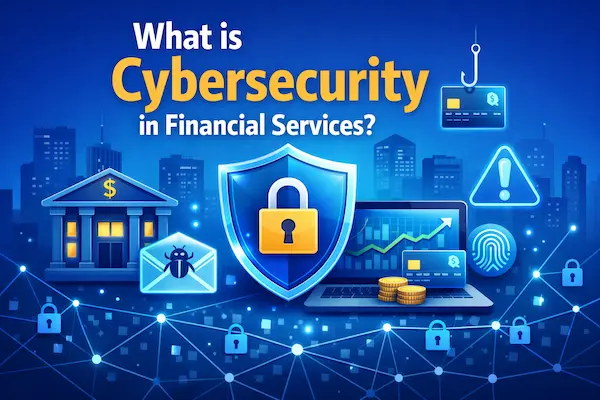
In order to preserve consumer confidence and guarantee regulatory compliance, the major objective is to stop financial fraud, cyberattacks, and data breaches. Let’s take a closer look at Cybersecurity in Financial Services!
Why Financial Institutions are Prime Targets for Cyberattacks?
|
S.No. |
Factors |
Why? |
|
1. |
High Financial Reward |
Attackers can directly and significantly profit from the vast amounts of liquid assets and transaction data held by financial institutions. |
|
2. |
Wealth of Sensitive Data |
They have a "digital goldmine" of financial credentials and personally identifiable information (PII) that is extremely useful for identity theft and dark web resale. |
|
3. |
Systemic and Critical Infrastructure Impact |
They are a strategic target for nation-state actors and organized crime because a successful strike has the potential to destabilize entire economies and vital national infrastructure. |
|
4. |
Digital Transformation and Attack Surface |
The quick uptake of mobile apps, third-party APIs, and online banking continuously increases the number of vulnerabilities and entry points that hackers can take advantage of. |
|
5. |
Regulatory Pressure |
Financial institutions are susceptible to extortion attempts because of the stringent regulatory framework (such as GDPR and PCI DSS), which results in severe fines and legal consequences for violations. |
|
6. |
Dependence on Legacy Systems |
Many fundamental banking functions continue to rely on antiquated, monolithic technology that is challenging to patch and protect against contemporary, sophisticated cyberthreats. |
|
7. |
Customer Trust and Reputation |
The industry's foundation is security, and a single breach can quickly and seriously undermine public confidence, resulting in lost business and reputational harm. |
Top Cybersecurity Threats in the Financial Sector
The following are the top cybersecurity threats in the financial sector:
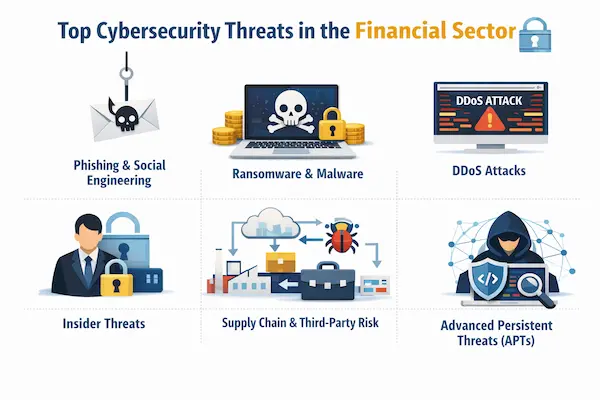
- Phishing and Social Engineering: By deceiving staff members or clients (often through email) into disclosing private information or downloading malware, these assaults take advantage of the human aspect.
- Ransomware and Malware: Attackers use malicious software to encrypt a company's vital information and systems. They then demand a ransom, which is frequently accompanied by threats to reveal the stolen information.
- Distributed Denial of Service (DDoS) Attacks: Online banking and other essential customer-facing services are shut down when a financial institution's servers are overloaded by coordinated waves of internet traffic.
- Insider Threats: Security threats come from within the company, whether they are caused by careless employees who unintentionally expose data or malevolent employees who abuse their access.
- Supply Chain and Third-Party Risk: Attackers can gain indirect access to the financial institution's network and data by compromising a trusted vendor, such as a software provider or IT managed service.
- Web Application and API Attacks: Vulnerabilities in online banking portals and the APIs that link various financial services are the focus of exploits like SQL injection and cross-site scripting.
- Advanced Persistent Threats (APTs): To systematically exfiltrate sensitive data or carry out espionage, highly trained, well-funded attackers, often state-sponsored, establish a covert, long-term presence in a network.
The Role of Compliance in Cybersecurity for Financial Institutions
|
S.No. |
Roles |
What? |
|
1. |
Mandates Minimum Security Standards |
For the purpose of safeguarding systems and data, compliance frameworks (such as FFIEC, NYDFS, and PCI DSS) set an unchangeable standard of administrative, technological, and physical protections. |
|
2. |
Drives Formal Risk Management |
Institutions are required by regulations to conduct frequent, organized cyber risk assessments in order to methodically discover, assess, and rank threats and vulnerabilities. |
|
3. |
Enforces Accountability and Governance |
Senior management and the Board are clearly given responsibility for cybersecurity under compliance, which calls for official monitoring and a written security program. |
|
4. |
Protects Consumer Data Privacy |
Strict restrictions on the collection, storage, and sharing of consumer PII are required by data protection legislation such as the GDPR and the GLBA Safeguards Rule, guaranteeing confidentiality. |
|
5. |
Requires Incident Reporting and Response |
Strict deadlines (such as 36 hours for US banks) are imposed by compliance regulations for notifying authorities of major cyber breaches and creating comprehensive response plans. |
|
6. |
Minimizes Financial Penalties |
The main defense against expensive fines, legal ramifications, and required corrective activities imposed by government agencies following a violation is compliance with regulatory requirements. |
|
7. |
Builds Trust and Competitive Advantage |
Customers, partners, and investors are reassured by a publicly visible, mature compliance posture, which preserves market confidence in a security-conscious sector. |
Best Practices for Protecting Financial Data
The following are the best practices for protecting financial data:
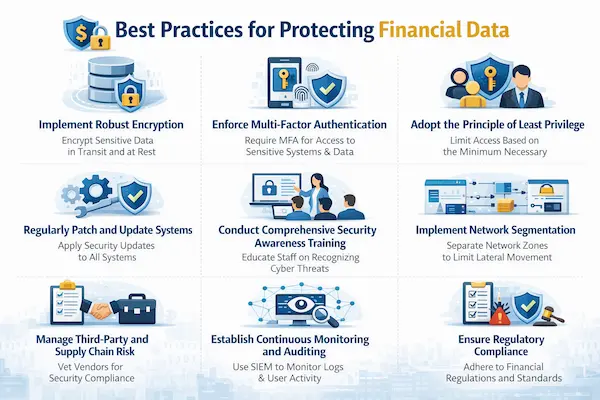
● Implement Robust Encryption: Use robust, contemporary cryptographic techniques to encrypt all sensitive data, both in transit (network traffic) and at rest (storage).
● Enforce Multi-Factor Authentication (MFA): To prevent unwanted access through compromised passwords, require several verification factors for any account that accesses sensitive data and systems.
● Adopt the Principle of Least Privilege (PoLP): Give workers and systems only the minimal amount of access that is necessary for them to carry out their core duties.
● Regularly Patch and Update Systems: To fix identified vulnerabilities, quickly apply security patches and upgrades to all firmware, software, and operating systems.
● Conduct Comprehensive Security Awareness Training: All employees receive ongoing training on how to spot and report instances of social engineering, phishing, and violations of internal security policies.
● Implement Network Segmentation: To limit the mobility of attackers during a breach, divide the network into separate zones (e.g., separating corporate IT from essential banking services).
● Manage Third-Party and Supply Chain Risk: Examine all suppliers and service providers carefully to make sure their security standards adhere to the institution's specifications and contractual commitments.
● Establish Continuous Monitoring and Auditing: To identify unusual activity and threats, employ Security Information and Event Management (SIEM) solutions to monitor system logs and user activity in real-time.
● Maintain and Test Incident Response & Recovery Plans: To reduce harm, guarantee business continuity, and swiftly recover from a cyberattack, create and simulate detailed plans on a regular basis.
● Ensure Regulatory Compliance: To preserve legal standing and a robust security posture, proactively abide by all pertinent industry and regulatory rules (such as FFIEC and PCI DSS).
Modern Cybersecurity Solutions for Financial Services
|
S.No. |
Solutions |
What? |
|
1. |
Zero Trust Architecture (ZTA) |
This security paradigm, which is founded on the idea of "never trust, always verify," mandates ongoing authorization and authentication for any user and device attempting to access resources, wherever they may be. |
|
2. |
AI-Powered Threat Detection and Response |
Employs artificial intelligence (AI) and machine learning (ML) to evaluate large data sets in real-time, identify small irregularities and undiscovered dangers, and automate security responses more quickly than human analysts. |
|
3. |
Behavioral Biometrics and Advanced Fraud Analytics |
In order to prevent fraud, it continuously analyzes distinct user behaviors (such as typing speed, mouse movement, and phone grip) to passively authenticate identity and promptly indicate activity that deviates from a customer's typical profile. |
|
4. |
Cloud Security Posture Management (CSPM) |
In order to avoid expensive misconfigurations and identity mistakes, automated technologies are used to continuously monitor and maintain the security configuration and compliance of cloud systems (AWS, Azure, Google Cloud). |
|
5. |
Extended Detection and Response (XDR) |
In order to provide comprehensive visibility and an automatic reaction to complex assaults, a unified security system gathers and correlates data from all security layers, endpoints, networks, email, and the cloud. |
|
6. |
Data Loss Prevention (DLP) and Data Classification |
Employs cognitive tools to automatically detect, classify, and keep an eye on sensitive data (such as personally identifiable information) and to enforce rules to stop it from being sent or moved outside of the secure network perimeter without authorization. |
|
7. |
Proactive Vulnerability Management and Penetration Testing |
Involves proactively identifying and fixing exploitable vulnerabilities before an actual attacker can exploit them through ongoing security vulnerability scanning and allowing simulated attacks (Pen Testing). |
|
8. |
Secure Access Service Edge (SASE) |
A cutting-edge strategy that combines cloud security services (such as Firewall as a Service and Zero Trust Network Access) with wide area networking (WAN) into a single, cloud-delivered platform for all users. |
How to Build a Robust Cybersecurity Strategy for Your Financial Firm?
You can build a robust cybersecurity strategy for your financial firm in the following ways:
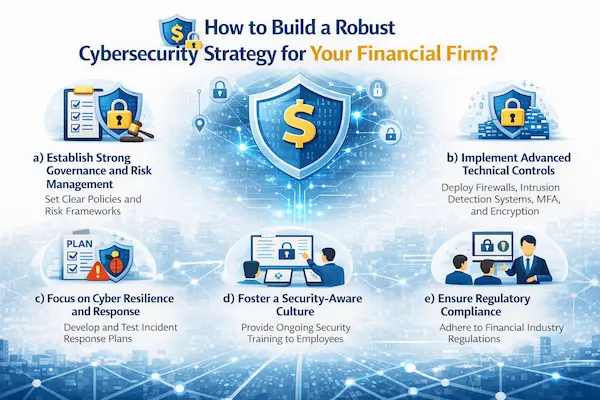
a) Establish Strong Governance and Risk Management: Obtain board-level support, establish distinct responsibilities, and include cyber risk management in the overarching business strategy and decision-making.
b) Implement Advanced Technical Controls: To safeguard important systems and data, implement cutting-edge security solutions like enhanced encryption, AI-driven threat detection, and Zero Trust.
c) Focus on Cyber Resilience and Response: To reduce downtime and guarantee quick recovery from attacks, create and regularly test thorough Incident Response (IR) and Business Continuity Plans (BCP).
d) Foster a Security-Aware Culture: To make the workforce the organization's best line of defense against social engineering, mandate regular, excellent security training for all staff members.
e) Ensure Regulatory Compliance: Maintain documentation to show compliance and prevent fines, and proactively map the security program to all pertinent national and international requirements (such as FFIEC and GDPR).
Emerging Trends in Cybersecurity for Financial Services
|
S.No. |
Trends |
What? |
|
1. |
Generative AI in Cyber Warfare |
GenAI is used by attackers to develop complex, customized social engineering and deepfake-powered phishing assaults on a large scale. |
|
2. |
The Quantum Computing Threat |
Post-Quantum Cryptography (PQC) standards must be adopted immediately due to the potential for quantum computers to crack existing encryption. |
|
3. |
Intensified Regulatory Cyber Resilience Focus |
Companies are increasingly required by regulations (such as DORA) to put service continuity and quick recovery ahead of only preventing breaches. |
|
4. |
Supply Chain and Third-Party Risk Deepening |
Growing interconnection necessitates thorough, ongoing security monitoring and screening of all third-party partners and providers. |
|
5. |
Hybrid Cloud Security Complexity |
Specialized Cloud Security Posture Management (CSPM) solutions are needed to manage security across intricate multi-cloud and on-premise settings. |
|
6. |
Behavioral Biometrics for Enhanced Fraud Prevention |
Static MFA is being replaced by ongoing analysis of distinct user actions (such as typing speed) to quickly thwart sophisticated account takeover fraud. |
|
7. |
Focus on 'No-Blame' Security Culture |
Institutions treat human error as a systemic problem that needs to be addressed and encourage staff to disclose security errors in a timely and honest manner. |
Frequently Asked Questions
About Cybersecurity in Financial Services
- What are the biggest cybersecurity threats facing financial services today?
The following are the biggest cybersecurity threats facing financial services today:
a) AI-Enhanced Phishing & Social Engineering,
b) Ransomware & Data Extortion,
c) Supply Chain & Third-Party Risk,
d) Advanced Persistent Threats (APTs), and
e) API & Web Application Exploits.
- How can financial institutions protect themselves from ransomware attacks?
In the following ways, financial institutions can protect themselves from ransomware attacks:
a) Implement Immutable, Air-Gapped Backups,
b) Enforce Multi-Factor Authentication (MFA) on All Access,
c) Deploy Network Segmentation & Least Privilege,
d) Strengthen Endpoint Detection & Response (EDR), and
e) Conduct Continuous Security Awareness & Incident Drills.
- Why are financial services a primary target for cybercriminals?
Financial services are a primary target for cybercriminals for the following reasons:
a) Direct & High Financial Reward,
b) Wealth of Highly Sensitive Data,
c) Systemic & Critical Infrastructure Impact,
d) Regulatory Pressure & High Penalty Risk, and
e) Expanding Digital Attack Surface.
- What is the role of multi-factor authentication in securing financial data?
The following is the role of multi-factor authentication in securing financial data:
a) Stops Stolen Credential Abuse,
b) Mitigates Phishing & Social Engineering,
c) Ensures Regulatory Compliance,
d) Secures High-Risk Transactions, and
e) Protects Remote & Privileged Access.
- How do data breaches affect financial services companies?
In the following ways, data breaches affect financial services companies:
a) Massive Financial Costs & Fraud Losses,
b) Severe Regulatory Penalties & Legal Action,
c) Erosion of Customer Trust & Reputation,
d) Operational Disruption & Prolonged Downtime, and
e) Heightened Scrutiny & Increased Future Costs.
- What modern solutions are most effective in preventing cyber threats in financial services?
The following modern solutions are the most effective in preventing cyber threats in financial services:
a) Zero Trust Architecture (ZTA),
b) AI/ ML-Powered Threat Detection & Response,
c) Extended Detection and Response (XDR),
d) Phishing-Resistant Multi-Factor Authentication (MFA), and
e) Cloud Security Posture Management (CSPM).
- What compliance regulations should financial institutions follow for cybersecurity?
The following are some compliance regulations that financial institutions should follow for cybersecurity:
a) Gramm-Leach-Bliley Act (GLBA) and the Safeguards Rule (US),
b) Payment Card Industry Data Security Standard (PCI DSS),
c) Digital Operational Resilience Act (DORA) (EU),
d) NYDFS 23 NYCRR Part 500 (New York), and
e) Federal Financial Institutions Examination Council (FFIEC) Guidance (US).
- How can artificial intelligence help detect cyber threats in financial institutions?
Artificial intelligence helps detect cyber threats in financial institutions in the following ways:
a) Real-Time Anomaly Detection in Transactions,
b) Predictive Threat Intelligence & Prioritization,
c) Advanced Phishing & Malicious Code Identification,
d) Behavioral Biometrics & Continuous Authentication, and
e) Automated Incident Response (SOAR).
- What best practices should financial services follow to protect customer data?
The following are the best practices financial services follow to protect customer data:
a) Strong Data Encryption (At Rest and In Transit),
b) Strict Access Control & Least Privilege,
c) Mandatory Multi-Factor Authentication (MFA),
d) Continuous Third-Party Risk Management, and
e) Regular Security Audits & Incident Response Testing.
- How can financial services prepare for emerging cybersecurity threats?
In the following ways, financial services can prepare for emerging cybersecurity threats:
a) Adopt a Zero Trust Architecture (ZTA),
b) Invest in AI-Driven Autonomous Defense,
c) Proactively Manage Digital Resilience & Supply Chain Risk,
d) Prepare for Post-Quantum Cryptography (PQC) Migration, and
e) Elevate Human & Identity Security.
Conclusion: Staying Ahead of Cyber Threats in Financial Services
Now that we have talked about “Cybersecurity in Financial Services,” you might want to get a reliable security provider in the IT Industry. For that, you can rely on Craw Security, which is one of the most reputed VAPT service providers offering the Craw Security ShieldXDR.
After the implementation of the Craw Security ShieldXDR, you will be able to detect complex threats faster and get rid of them in time to protect the confidential data against such threats. What are you waiting for? Contact, Now!
Want to build a career in cyber security?
Talk to our counsellors about courses, batches and fees. Free demo class available.


