

In this article
Do you want to learn about where you get the best learning experience for the CEH Certification? If yes, then you are at the right place. Here, not only explain how this certification is a better opportunity for hacking professionals, but also where you can get it.
Moreover, we will introduce you to a reputed training institute offering a dedicated training program related to CEH skills. What are we waiting for? Let’s get straight to the topic!
What is CEH Certification?
A top cybersecurity credential, the Certified Ethical Hacker (CEH) certification attests to a person's ability to recognize and take advantage of system vulnerabilities using the same instruments and methods as malevolent hackers.
The certification, which is granted by the EC-Council, guarantees that experts can lawfully evaluate security postures by adhering to a strict ethical framework. It is widely acknowledged as a global standard for offensive security that uses proactive defense to keep businesses ahead of cyber threats.
Let’s take a look at what CEH Certification is and how it can offer the best career opportunities to the IT Aspirants!
Benefits of Becoming a Certified Ethical Hacker
|
S.No. |
Benefits |
How? |
|
1. |
Global Industry Recognition |
CEH is an ANSI-accredited benchmark that is accepted as a standard for offensive security activities by prestigious corporations and governmental entities (such as the US Department of Defense). |
|
2. |
Mastery of the "Attacker Mindset" |
By teaching you to think like a bad actor, the curriculum empowers you to proactively detect and fix vulnerabilities before they are used against you. |
|
3. |
Significant Salary Premium |
In 2026, the average salary for mid-level CEH holders in the US was between $100,000 and $150,000, while in India it was between ₹12L and ₹25L. |
|
4. |
Hands-On Technical Proficiency |
By means of "iLabs," you can practice using more than 500 attack methods and 3,500 hacking tools in a secure, sandboxed setting. |
|
5. |
AI-Enhanced Security Skills |
You can employ AI tools for automated reconnaissance, vulnerability assessment, and protecting against AI-driven threats with the most recent CEH v13 (AI). |
Certified Ethical Hacker Prerequisites
Candidates must either complete an official EC-Council training program through an Accredited Training Center (ATC) or present documentation of two years of verified work experience in the information security field in order to receive a CEH certification in India.
Candidates must also be at least eighteen years old, while minors may apply if they have a letter of support from a nationally recognized educational institution and written parental approval.
Eligibility Criteria for the CEH Exam
The following is the eligibility criteria for the CEH Exam:
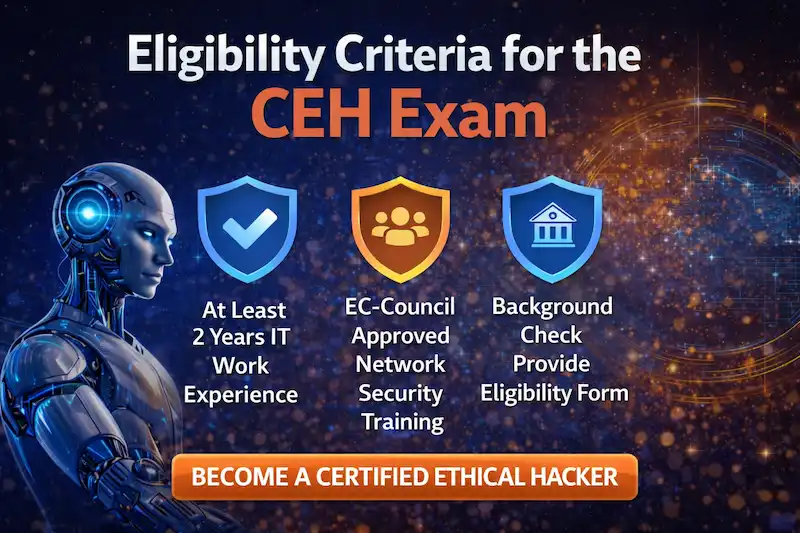
- The Official Training Path (Recommended for Beginners): Successfully finish an approved training course using the official iClass platform or at an EC-Council Accredited Training Center (ATC).
- The Work Experience Path (For Professionals): Provide documentation of at least two years of proven job experience in an information security field, together with your official application.
- General Requirements: If choosing the experience-based option, candidates must pay a non-refundable $100 application fee and be at least 18 years old (minors need parental agreement).
Key Skills Required for CEH
|
S.No. |
Skills |
What? |
|
1. |
Core Technical Skills |
Learn how to use Nmap for sophisticated network mapping, Wireshark for deep packet analysis, and the exploitation lifecycle in Linux-based platforms like Kali or Parrot OS. |
|
2. |
AI-Powered Hacking Skills (v13 Specific) |
Competence in automating reconnaissance, evading AI-based anomaly detectors, and fending off prompt-injection or model-poisoning assaults utilizing AI-driven tools (such as ShellGPT and DeepExploit). |
|
3. |
Specialized Domain Skills |
Practical expertise in IoT/OT firmware analysis, multi-cloud architecture security (AWS, Azure, GCP), and vulnerability detection in containerized workloads such as Kubernetes. |
|
4. |
Soft Skills & Ethics |
Clear technical reporting for stakeholders, strong analytical problem-solving skills to "think like a hacker," and rigorous adherence to international cyber laws and the EC-Council Code of Ethics. |
CEH Certification Pathway
Following is the CEH Certification Pathway:
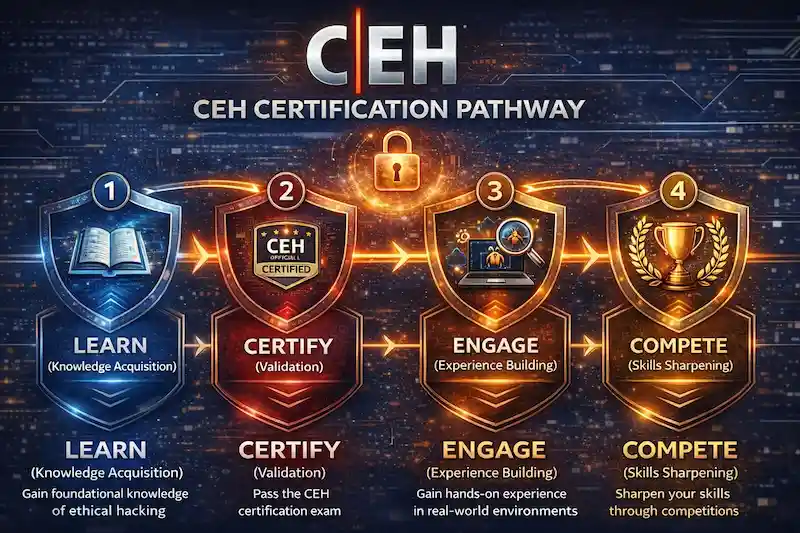
● Phase 1: Learn (Knowledge Acquisition): Through 220+ practical labs that incorporate AI-driven tools for more intelligent reconnaissance and exploitation, learn the 20 basic modules and 550+ attack strategies.
● Phase 2: Certify (Validation): To obtain the esteemed CEH Master title, demonstrate your proficiency by completing the 6-hour Practical Exam (20 real-world tasks) and the 4-hour Knowledge Exam (125 MCQs).
● Phase 3: Engage (Experience Building): Use your abilities in a four-part simulated ethical hacking exercise where you "hack" a fictitious company from beginning to end without facing any repercussions.
● Phase 4: Compete (Skills Sharpening): Participate in monthly international Capture-the-Flag (CTF) tournaments to keep your advantage and push your colleagues to solve fresh, cutting-edge vulnerability riddles.
Training Options for Aspiring Ethical Hackers
The following are some training options for aspiring ethical hackers:
a) Official EC-Council Training (CEH v13): A complete program that incorporates AI into all five stages of ethical hacking, including more than 221 labs and more than 25 hours of guided video learning.
b) Practical Cyber Ranges: CyberQ and EC-Council's iLabs are high-fidelity environments that offer six months of access to over 4,000 tools for testing exploits on real-time, virtualized targets.
c) Specialized Online Academies: Deep technical penetration testing and red-teaming are the main topics of rigorous, practical bootcamps offered by platforms like OffSec (OSCP), Pentester Academy, and Cybrary.
d) Community and Free Resources: CrackTheLab, and the EC-Council "Essentials" series offer free vulnerability sandboxes and core knowledge through high-quality learning.
e) Continuous Competition (The "Compete" Phase): Monthly Capture-the-Flag (CTF) challenges are available all year long, giving students the chance to compete against classmates from around the world and keep up with new threats for 2026.
How to Prepare for the CEH Exam Effectively?
|
S.No. |
Factors |
How? |
|
1. |
Master the Exam Blueprint (v5.0) |
Prioritize high-weight domains such as System Hacking (21%) and Reconnaissance (21%) by first going over the official EC-Council plan. |
|
2. |
Leverage AI Hacking Tools |
Since the v13 exam now assesses your proficiency with AI for automated vulnerability scanning and reconnaissance, familiarize yourself with AI-driven tools such as ShellGPT and DeepExploit. |
|
3. |
Hands-on Virtual Lab Practice |
Learn the terminal commands and tool flags for Nmap, Metasploit, and Wireshark by spending 60% of your time in laboratories (such as iLabs, TryHackMe, or Hack The Box). |
|
4. |
Use Active Recall with Practice Tests |
Use timed, extended practice tests (like Boson or SkillCertPro) to pinpoint your areas of weakness and develop the endurance required for the four-hour, 125-question session. |
|
5. |
Build a "Cheat Sheet" for Tools |
To improve long-term recall, make a personal quick-reference guide for popular port numbers, Nmap switches (such as -sV, -T4, -A), and SQL injection payloads. |
The CEH Exam Structure: What to Expect?
The CEH v13 (Knowledge) Exam is a proctored online test with 125 multiple-choice questions that must be answered in 4 hours. With a strong emphasis on scenario-based reasoning spanning fields including AI-powered hacking, cloud security, and IoT, it offers a variable passing score (usually between 60% and 85%) that varies according to the difficulty of the particular exam form you receive.
Common Mistakes to Avoid During the CEH Exam
The following are some common mistakes to avoid during the CEH Exam:
- Over-Focusing on Tool Syntax Instead of Concepts: Instead of only asking you to remember command-line flags, the exam frequently assesses your ability to analyze tool output (such as a particular Nmap scan result).
- Ignoring the Official Exam Blueprint: System Hacking and Reconnaissance alone account for roughly 42% of the total score; failing to match your study time with weighted domains might be disastrous.
- Underestimating Legal and Ethical Questions: By ignoring the "Ethics" domain, which covers important subjects like the Cyber Kill Chain, GDPR, and the EC-Council Code of Ethics, many candidates lose easy marks.
- Relying Solely on Outdated "Brain Dumps": The question bank has significantly switched toward AI-driven risks and cloud-native attacks with the v13 update, rendering previous study materials untrustworthy and possibly deceptive.
- Poor Time Management on Scenario Questions: You may feel hurried at the end if you spend more than two minutes on intricate, multi-paragraph scenarios; to maintain your pace, use the "Mark for Review" tool.
CEH Certification Renewal: What You Need to Know?
You must complete 120 EC-Council Continuing Education (ECE) credits every three years and pay an annual membership fee of $80 in order to keep your CEH v13 (AI-Powered) certification in 2026.
To keep your skills up to date against contemporary AI-driven threats, you can earn these points by participating in the infosec community, reading technical literature, and attending cybersecurity seminars.
Post-Certification Opportunities and Career Paths
|
S.No. |
Job Profiles |
What? |
|
1. |
Penetration Tester/ Red Team Specialist |
Perform allowed "ethical attacks" to identify system flaws; mid-level Indian earners make between ₹8L and ₹12L, whereas US earners make over $120,000. |
|
2. |
Vulnerability Assessment Analyst |
As a crucial entry-to-mid-level position for new hires starting at ₹4.5L–₹6L, use automated and AI-driven techniques to scan corporate assets for defects. |
|
3. |
Security Operations Center (SOC) Analyst |
A highly sought-after position in tech hotspots like Noida, Bengaluru, and San Francisco involves monitoring threats in real time and coordinating incident responses. |
|
4. |
AI/ ML Security Engineer |
A dedicated v13-specific route that focuses on safeguarding AI-integrated business processes and defending machine learning models from hostile attacks. |
|
5. |
Information Security Manager/ CISO |
Senior-level leadership positions that oversee an organization's whole security strategy can fetch top-tier salaries of more than $175,000 in the US or more than ₹35L in India. |
Frequently Asked Questions
About CEH Certification
- Who is eligible for CEH training?
Anyone interested in cybersecurity, including students, recent graduates, and IT professionals, is eligible for CEH training because certified training programs don't have rigorous prerequisites and are meant to build skills from the bottom up for the certification exam.
- How many attempts for CEH?
There is a mandated 14-day cooling-off period between any future tries and no waiting period for the initial retake, allowing you to take the CEH exam up to five times in a 12-month period.
- Is the CEH exam free?
The CEH exam is not free; a typical exam voucher costs $1,199 if taken through a Pearson VUE testing center or about $950 for remote proctoring through the EC-Council.
- Does CEH require coding?
You must be "code-literate" enough to read and comprehend simple scripts in languages like Python, Bash, and SQL in order to recognize vulnerabilities and decipher attack logic, even if the CEH exam itself does not require you to write code from scratch.
- How hard is IT to get CEH certification?
The CEH v13 (AI-Powered) exam is regarded as somewhat difficult; its extensive 20-module syllabus and variable passing score of up to 85% make it simpler than deep-technical practical exams like the OSCP.
- Is CEH an entry-level certification?
Although CEH is frequently referred to as an "entry-level" offensive security certification, it is actually a mid-level IT certification that presupposes you already have a solid understanding of operating systems, networking, and general security concepts.
- How many years is CEH valid?
After passing the test, the CEH v13 (AI-Powered) certification is good for three years.
Conclusion
Now that we have talked about CEH Certification, you might want to learn more about such skills professionally and where to get this certification. For that, you can get in contact with Craw Security, offering the CEH v13 AI Course in Delhi to IT Aspirants.
As you know, the CEH exam difficulty and you might want to get the best CEH certification preparation experience. For that, you can rely on Craw Security, which is a dedicated training platform for all practitioners globally.
After the completion of the CEH v13 AI Training in Delhi offered by Craw Security, students will receive a certificate validating their honed knowledge & skills during the sessions. What are you waiting for? Contact, Now!
Want to build a career in cyber security?
Talk to our counsellors about courses, batches and fees. Free demo class available.


