

In this article
Do you want to learn skills & techniques related to Artificial Intelligence (AI) and Machine Learning (ML)? If that’s what you’re looking for, you are at the right place. Here, we will talk about AI and ML in detail and the ways you can learn such skills faster.
Moreover, we will introduce you to a reputed training ground offering learning opportunities to students seeking guidance for AI and ML. What are we waiting for? Let’s get started!
What Are Artificial Intelligence (AI) and Machine Learning (ML)?
The broad idea of developing computer programs and robots that can replicate human cognitive abilities like reasoning, problem-solving, and decision-making to carry out challenging jobs is known as artificial intelligence (AI).
A subset of artificial intelligence called machine learning (ML) focuses on creating algorithms that let these systems automatically learn from data and get better without needing to be explicitly designed for every situation.
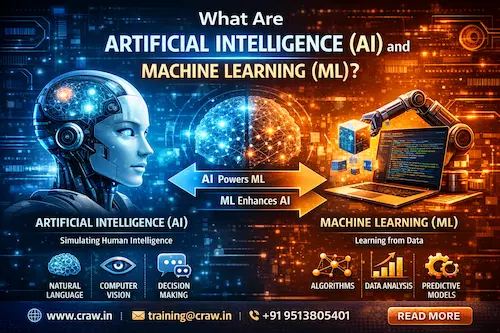
To put it succinctly, if AI is the main objective of creating "smart" machines, then machine learning is now the main technique utilized to teach those machines how to recognize patterns and make predictions. Let’s take a look at what Artificial Intelligence (AI) and Machine Learning (ML) are and their benefits!
AI & ML Skills That Make You Future-Ready
Following AI & ML skills can make you future-ready:
- Agentic AI & Workflow Orchestration: Developing and overseeing autonomous AI agents that can independently plan, use tools, and accomplish multi-step business objectives will go beyond simple suggestions.
- Applied Prompt Engineering: Learning sophisticated methods like "Chain-of-Thought" and "Reasoning" to direct LLMs through intricate reasoning as opposed to merely producing straightforward text or visuals.
- MLOps (Machine Learning Operations): Acquiring the engineering foundation required to implement, track, and expand AI models in actual production settings to avoid "model decay."
- Programming (Python-Plus): Though the emphasis has changed to leveraging AI to write code, debug scripts, and integrate web APIs, proficiency in Python is still the gold standard.
- Data Engineering & Wrangling: The capacity to organize, manage, and clean the enormous datasets that power AI systems, guaranteeing that the "fuel" for your models is impartial and of the highest caliber.
- AI Governance & Ethics: Recognizing the ethical norms and regulatory structures (such as the EU AI Act) necessary to guarantee that AI systems are just, open, and accountable.
- Cybersecurity for AI: Safeguarding data pipelines, controlling the dangers of "shadow AI" inside a company, and defending AI models from "prompt injection" attacks.
- Problem Framing: The high-level capacity to determine which business issues AI can truly resolve and precisely specify the "goal state" that a machine should perform.
- Adaptability & "Learn-it-all" Mindset: Continuously improving one's skills as AI tools change every few months, going from being all-knowing to being able to learn anything.
- Emotional Intelligence (EQ): Increasing the importance of empathy, negotiation, and relationship-building—qualities that are specific to humans and are becoming more valuable as basic cognitive tasks are mechanized.
How Learning AI & ML Improves Problem-Solving Skills?
|
S.No. |
Factors |
How? |
|
1. |
Logical and Structured Thinking |
Decomposition is the process of breaking down big, complicated problems into smaller, logical steps in order to build AI models. The Initial State, the Goal State, and the particular Actions required to close the gap are all defined. |
|
2. |
Data-Driven Decision Making |
Instead of depending on "gut feeling," machine learning trains you to search for proof in data. You gain the ability to recognize patterns, correlations, and anomalies, which enables you to make more impartial and precise decisions in real life. |
|
3. |
Iterative Mindset (Embracing Failure) |
Rarely do machine learning models perform flawlessly the first time; instead, they need ongoing adjustment and "training." This strengthens your resilience and teaches you that errors are opportunities for growth rather than definitive failures. |
|
4. |
Root Cause Analysis |
Fixing a "biased" or "underperforming" model requires delving deeply into the algorithm or the data. This cultivates a keen eye for identifying the root cause of an issue rather than merely addressing its symptoms. |
|
5. |
Scalability Thinking |
Millions of data points can be handled by AI. Gaining an understanding of this viewpoint enables you to approach challenges from a "big picture" perspective, creating solutions that can be expanded to serve thousands of people rather than just one. |
|
6. |
Reducing Bias and Subjectivity |
You become intensely aware of data and human biases when you study machine learning. You can approach issues more objectively and take into account other viewpoints that you might have otherwise disregarded, thanks to this insight. |
Why Learning AI & ML Is Important in 2026 and Beyond?
Learning AI & ML is important in 2026 and beyond for the following reasons:
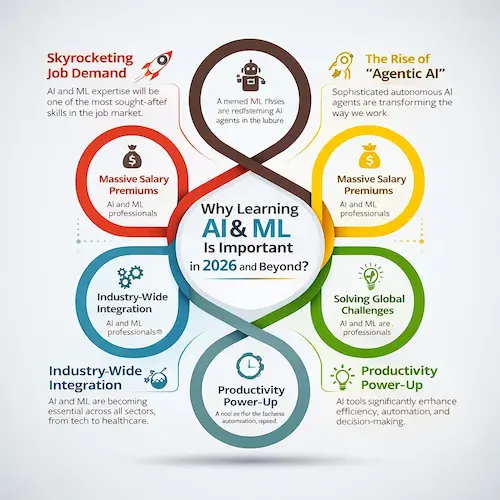
● Skyrocketing Job Demand: By 2026, there will likely be a need for more than a million AI specialists, with ten positions available for each skilled engineer in GenAI-related disciplines.
● The Rise of "Agentic AI": Chatbots are giving way to "Agents" that can autonomously plan, carry out multi-step activities, and oversee complete processes without human supervision.
● Massive Salary Premiums: In India, specialist positions can pay ₹45–60+ LPA, and professionals with AI experience currently make up to 56% more than their peers without AI expertise.
● Industry-Wide Integration: Beyond technology, AI is being used in manufacturing, healthcare, and finance, making it just as vital to corporate infrastructure as the internet or electricity.
● Productivity Power-Up: By automating basic data processing, scheduling, and reporting, AI "copilots" and agentic workflows can save workers 10–20 hours a week.
● Solving Global Challenges: These days, the main instruments for addressing the world's clean water crises, finding new life-saving medications, and forecasting climate calamities are AI and ML.
Benefits of AI & ML Across Industries
|
S.No. |
Benefits |
How? |
|
1. |
Healthcare |
Digital twins and wearable sensors powered by AI can now anticipate long-term problems like heart abnormalities weeks in advance, changing the focus of medical care from "fixing the sick" to "maintaining the healthy." |
|
2. |
Finance |
Financial agents employ non-traditional data to deliver fast credit and loans to millions of previously unbanked people while using "behavioral biometrics" (such as typing rhythm) to prevent fraud in real-time. |
|
3. |
Manufacturing |
AI agents that manage supply chains and employ predictive maintenance to cut machine downtime by up to 30% have transformed factories into "factory-sized robots." |
|
4. |
Retail & E-commerce |
Retailers provide "dynamic pricing" and individualized shopping experiences that resemble having a personal concierge by using real-time contextual data to go beyond simple recommendations. |
AI & ML as a Foundation for Advanced Technologies
Next-generation technologies like Quantum Computing, Autonomous Robotics, and the Spatial Web (AR/VR) rely on AI and machine learning as their fundamental "operating system" to provide the processing capacity and logic needed to manage their enormous data needs.
AI serves as the link between raw hardware and intelligent, self-evolving ecosystems that can solve issues that were previously unsolvable by humans or traditional computing by enabling systems to learn and adapt in real-time.
Benefits of Learning AI & ML for Students and Freshers
|
S.No. |
Benefits |
How? |
|
1. |
Massive Competitive Edge |
Freshmen who "speak AI" stand out right away in automated recruitment filters that now give priority to digital preparedness above college rank, as over 70% of IT professions will require AI fluency by 2026. |
|
2. |
High-Entry Salary Packages |
In India, starting salaries for new hires with AI/ML experience range from ₹6L to ₹12L, which is almost twice as much as the average for typical software positions. |
|
3. |
Future-Proofing Against Automation |
People who are familiar with the underlying models are transferred into "Human-AI Collaboration" roles, which are far more difficult to replace, while AI automates mundane entry-level work (such as data entry or simple coding). |
|
4. |
Global Career Mobility |
Since AI is a universal language, employers in the US, Europe, and the UAE are aggressively seeking Indian professionals with AI skills for remote and on-site positions with expedited visa procedures in 2026. |
|
5. |
Rapid Upskilling with AI Tutors |
Before they even graduate, students can acquire "years" of domain expertise by using AI-powered, tailored learning paths to master difficult subjects in half the time. |
|
6. |
Entrepreneurial Readiness |
The cost of starting a business has decreased because of AI tools; one student may now utilize AI agents to handle marketing, coding, and legal research, transforming an idea into a Minimum Viable Product (MVP) in days as opposed to months. |
Salary and Growth Potential in AI & ML Careers
With specialized positions in India, such as Generative AI Engineers and MLOps Architects, commanding starting salaries of ₹8 – 14 LPA and senior professionals topping ₹60 LPA, AI and ML jobs provide some of the largest financial incentives in the global tech market in 2026.
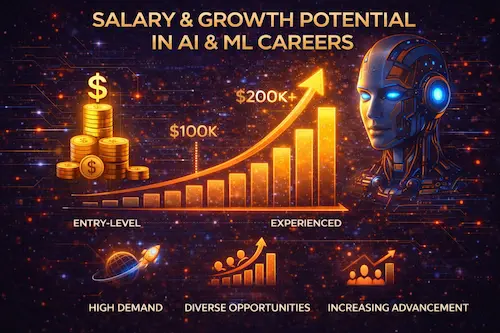
As businesses transition from experimental to "Agentic AI" workflows, this industry has exponential development potential, creating a huge demand for experts who can coordinate autonomous systems across manufacturing, healthcare, and finance.
Is Learning AI & ML Worth It? Final Thoughts
In 2026, mastering AI and ML will be well worth it since, like reading or basic computers, these technologies have become the essential "utility" of the modern worker. Beyond the high pay and job security, developing these abilities gives you a future-proof problem-solving toolset that enables you to lead and innovate in a time when intelligent systems and autonomous agents power every significant global enterprise.
Conclusion
Now that we have talked about Artificial Intelligence (AI) and Machine Learning (ML), you might want to learn more about AI and ML in detail. For that, you can get in contact with Craw Security, offering the Six-Months Diploma in Artificial Intelligence (AI) and Machine Learning to AI students.
During the training sessions, students will be able to try their skills on various projects using different AI and ML skills under the supervision of AI professionals. Moreover, online sessions will facilitate your remote learning.
After the completion of the Six-Months Diploma in Artificial Intelligence (AI) and Machine Learning offered by Craw Security, students will receive a certificate validating their honed knowledge & skills during the sessions. What are you waiting for? Contact, Now!
Frequently Asked Questions
About Artificial Intelligence (AI) and Machine Learning (ML)
- What are the main benefits of learning AI and Machine Learning?
The following are some of the main benefits of learning AI and ML:
a) Exceptional Career Resilience,
b) Massive Financial Upside,
c) Enhanced Analytical Thinking,
d) Efficiency & Productivity Multiplier, and
e) Contribution to Global Innovation.
- Why is learning AI & ML important for future careers?
Learning AI & ML is important for future careers for the following reasons:
a) Immunity to Automation (Job Resilience),
b) The "Hybrid Skill" Salary Premium,
c) Expansion of Human Productivity,
d) Creation of Entirely New Career Paths, and
e) Data-Driven Decision Mastery.
- How does learning AI & ML help in career growth?
By converting you from a manual executor to a high-value orchestrator of autonomous systems, learning AI and ML accelerates career progress and increases salary premiums and protection against job displacement.
- What job opportunities are available after learning AI and ML?
The following job opportunities are available after learning AI and ML:
a) Machine Learning (ML) Engineer,
b) AI Agent Architect & Orchestrator,
c) MLOps Engineer,
d) AI Product Manager, and
e) AI Ethics & Governance Specialist.
- Is AI and Machine Learning a good career choice in 2026 and beyond?
Because AI and machine learning have evolved from "experimental" skills to the core operating system of the global economy, they continue to be an exceptional career choice in 2026.
They offer enormous salary premiums, high job security through "Agentic AI" orchestration, and a projected $1 million+ in job openings in India alone.
- What skills do you gain by learning AI and Machine Learning?
You will gain the following skills by learning AI and ML:
a) Computational & Structured Thinking,
b) Data Literacy & Statistical Reasoning,
c) Proficiency in "Agentic" Orchestration,
d) Iterative Problem Solving (Resilience), and
e) Ethics & Bias Awareness.
- How does AI & ML improve problem-solving and analytical skills?
By training you to break down difficult problems into logical, data-driven steps and use pattern recognition to make unbiased, evidence-based conclusions, learning AI and ML enhances your analytical and problem-solving abilities.
- What industries benefit the most from AI and Machine Learning skills?
The following industries benefit the most from AI and ML skills:
a) Healthcare,
b) Finance,
c) Manufacturing, and
d) Retail & E-commerce.
- Can students and beginners learn AI and Machine Learning easily?
By leveraging AI-powered coding assistants to handle syntax and concentrating on intuitive, "no-code" platforms or visual learning aids to acquire the fundamental logic, students and beginners in 2026 can learn AI and ML more easily than ever before, even though the underlying arithmetic can be challenging.
- Is learning AI & ML worth the time and effort?
Learning AI and ML in 2026 is well worth the effort because it offers the largest return on investment through enormous wage premiums, shields your profession from automation, and gives you the "superpower" to coordinate autonomous systems that solve challenging, valuable problems.
Want to build a career in cyber security?
Talk to our counsellors about courses, batches and fees. Free demo class available.


